Looking for a Baby Bib Manufacturer? Here’s What Your Brand Should Know
Adding bibs to a baby collection may sound simple, but things can get confusing when you start talking to manufacturers. One supplier may ask for a large MOQ for every design. Another may have only a few fabric options. Someone else may offer custom prints but may not be interested if your order is small.
Then there are the different prices and quotes. At first, the cheapest option may look like the best choice, but it is not always the easiest one to work with.
The right baby bib manufacturer should fit your brand’s needs today and also be able to support you as your business grows. A small test order today could become a much bigger repeat order later.
This guide explains what to look for in a baby bib manufacturer, which things are important when comparing suppliers, and what questions you should ask before sending your first enquiry.
What should I look for in a baby bib manufacturer? Look for a baby bib manufacturer with a realistic MOQ for each style, a clear fabric range, custom print and embroidery options, a proper sampling process, consistent quality control and a record of repeat production. The best choice supports your brand from first sample to reorder, not just the first quote.
What Should You Look for in a Baby Bib Manufacturer?
Think about the whole journey: idea, sample, first order, market testing, reorder, larger production. A supplier who is strong at only one step will cause problems at another. Use these points as a first filter.
- Product quality. Ask for physical samples, not just photos. Check the stitching, how the edges sit after a wash, how the neckline closes, and whether the fabric matches what was described. A good manufacturer expects this and will not rush you.
- Fabric options and absorbency. A bib is a working product, so absorbency matters as much as the print. Ask which fabrics the factory can source, how the layers are built, and how the bib holds up after repeated washing.
- Customisation. Find out which parts are done in-house and which are outsourced, such as printing, embroidery and labels. This affects both quality and lead time.
- MOQ. Ask how it is set (per style, per colour or per print) before you compare prices. Two quotes with the same unit price can mean very different commitments.
- Communication. Notice how quickly they reply, whether they raise problems early, and whether they keep clear records of approvals. In practice, this often tells you more about how production will go than any brochure.
- Reorder capability. Ask directly whether they can repeat your first order closely. More on this below.
Is a Low MOQ Important When You Are Starting a Baby Bib Collection?
For most growing brands, yes. When you add bibs to an existing range, you rarely know which prints, shapes or colours your customers will choose. Committing to thousands of pieces per design before you have any sales data is a big bet.
A smaller first order lets you test designs, prints, colours, shapes and sizes, and see how customers respond. For example, a brand could launch four prints in small quantities, see which two sell through first, and put the reorder budget behind those.
But low MOQ is not automatically better. The more useful question is: what is the lowest commercially sensible MOQ for this product? Several things pull against each other here.
- Unit cost. Smaller runs usually cost more per piece. That is fine if the extra cost is smaller than the loss from unsold stock.
- Fabric minimums. The mill may set a minimum per colour or print. Ask who carries that minimum and whether it can be shared across designs.
- Customisation. Print set-up, embroidery digitising and new patterns are fixed costs. Spread over 200 pieces they hurt far more than over 2,000.
- Production efficiency. Very small runs can be awkward for a production line, which may affect price or priority.
- Inventory risk and reorders. A higher first-order price can be worth paying if reorders are planned and priced properly.
So do not chase the lowest number on a quotation. A very low MOQ from a factory that cannot rebuy your fabric is less useful than a slightly higher MOQ with a clear route to repeat orders.
How Can Brands Make Baby Bibs Feel Different From Competitors?
Many bibs on the market look alike: the same shape, a stock print, no link to the rest of the range. That leaves room for brands that treat the bib as part of the collection rather than an accessory added at the end.
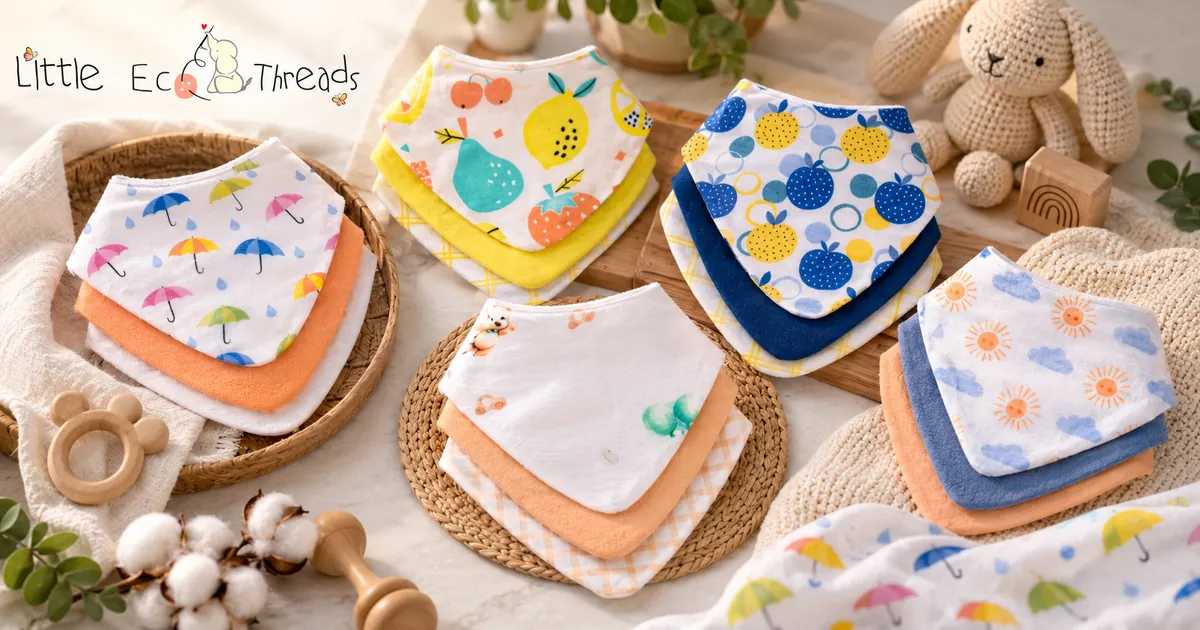
A good starting point is a signature print. If a print already works on your muslins, swaddles or rompers, putting it on bibs and other accessories makes the range look planned and gives customers a reason to buy more than one item.
Other ways to stand apart include:
- Shape. A different outline or neckline changes how the product looks on a shelf or in a photo.
- Trims. Contrast binding or piping in colours from your palette.
- Embroidery. A small brand mark or motif.
- Personalised details. Names or initials, though these usually add cost and lead time per piece.
- Fabric combinations. For example, a muslin front with a terry back.
- Packaging. Gift-ready sets or multipacks that suit your sales channel.
- Seasonal collections. Limited prints that give returning customers something new.
Bibs also tend to sit at a lower price point than clothing, which makes them a good entry product. A bib in your signature print can introduce someone to the brand before they buy a full outfit.
What Fabrics Should Brands Consider for Baby Bibs?
Rather than asking which fabric is best, ask what the manufacturer can tell you about how each one performs. These are the points worth raising:
- Absorbency: how many layers, and what fabric weight?
- Softness: how does it feel after several washes, not just when new?
- Durability and wash performance: shrinkage, colour fading, and whether prints and embroidery hold up.
- Drying time: thicker fabrics hold moisture longer, which matters for daily use.
- Comfort: especially around the neck.
- Sustainability and certification: what exactly is certified, and can they show the documents?
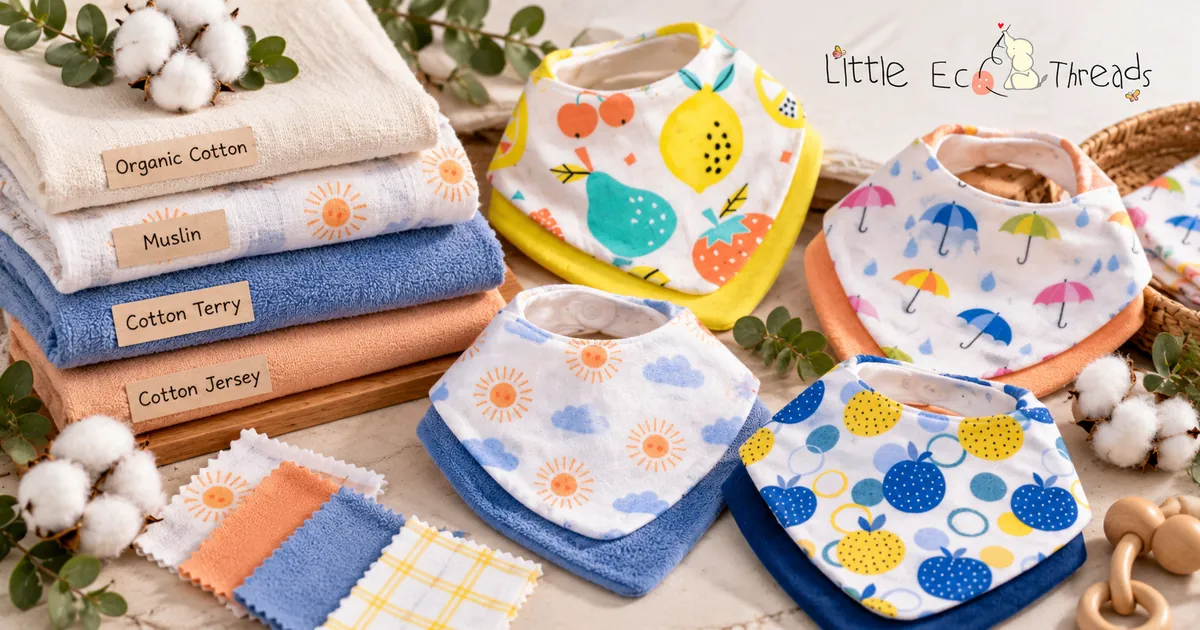
Organic cotton, muslin, cotton terry and cotton jersey all behave differently. Muslin is light and dries quickly. Terry absorbs more but dries slower. Jersey is soft and stretchy but usually needs extra layers to absorb well. Recycled materials may suit some components or trims, depending on the product.
The right choice depends on the product and its positioning. A premium newborn bib, a feeding bib and a fashion-led accessory do not need the same fabric. Decide the use first, then ask the manufacturer to recommend options and send a sample of each.
On sustainability, be specific. If you plan to market organic cotton baby bibs, make sure the documentation covers the fabric you are actually buying. A certification may apply to a material, a facility or a finished product, and it does not automatically cover everything a supplier makes.
Custom Prints, Embroidery and Private Label: What Can a Manufacturer Actually Offer?
There is a real difference between a factory that produces your finished design and one that helps you develop it. The first needs a complete tech pack. The second can advise on fabric, construction, print placement and trims, which helps if your team is new to bibs. Ask early which one you are dealing with. Then check each area:
- Custom prints: Which print methods are available, can they match your brand colours, and will they send a print sample before bulk?
- Embroidery: Is it done in-house, what are the size and placement limits, and is there a set-up charge?
- Labels and hangtags: Woven or printed labels, care labels, and who supplies them. Labels can have their own lead time.
- Packaging: Polybags, cards, boxes and barcodes, and whether private-label packaging is possible in small quantities.
- Custom shapes: Whether pattern making is included or charged separately.
- Sampling and approvals: How many sample rounds are included, how long each takes, and who pays.
Every one of these can change MOQ, unit cost and lead time. A custom shape with embroidery and branded packaging is a very different order from a standard bib in a stock print. Ask for the cost and timing effect of each choice before you commit, so the final quote holds no surprises.
Little Eco Threads is one example of a manufacturer that works this way. It makes baby and kidswear, including bibs, and offers custom prints, embroidery, sampling and private-label packaging, with export experience and the ability to work with small first orders. It also works with sustainable materials and holds certifications including GOTS, GRS and Sedex. As with any supplier, ask which certification applies to which materials, products or sites, and ask to see the documents.
What About Quality Control and Baby Product Safety?
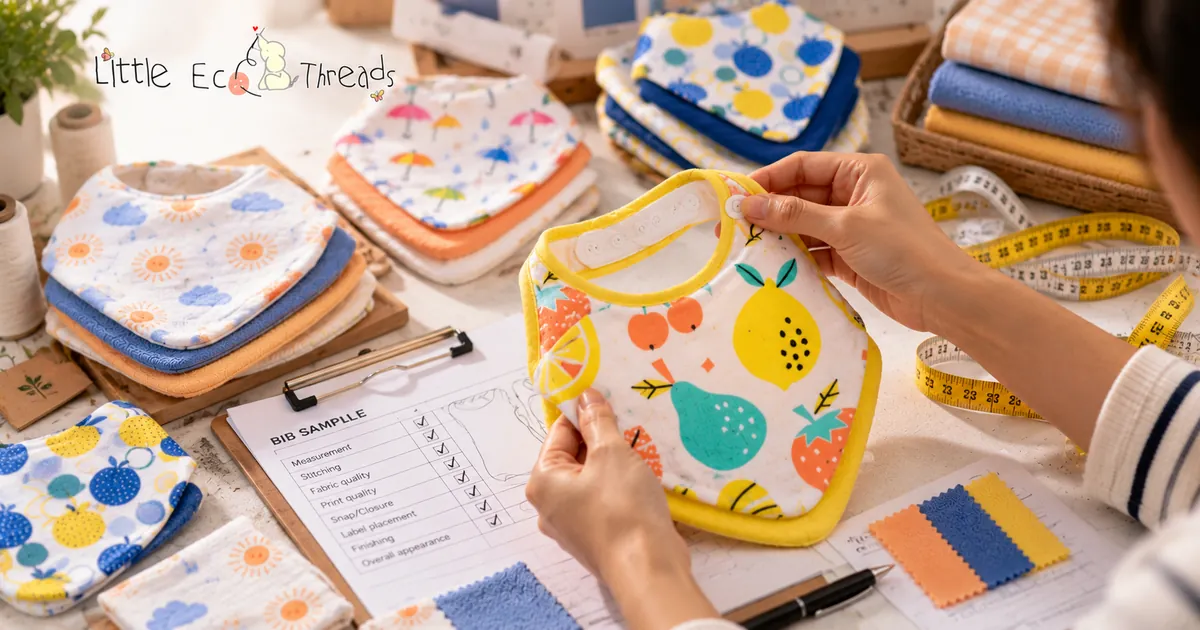
Bibs are used by infants and young children, and they are washed often, so consistency matters. A small flaw on one piece can become returns or complaints across a batch. Typical checks cover stitching and seams, fabric quality, print quality, embroidery finish, fasteners where used, labels, dimensions and washing performance. Ask the manufacturer what they check, and when.
Ask whether inspections happen during production as well as at the end, and whether you can see an inspection report. A manufacturer that keeps records is easier to work with when something goes wrong.
On safety and compliance, requirements vary by destination market and product type. Do not assume that a supplier’s standard testing covers your market. Confirm the rules that apply where you plan to sell, and ask the manufacturer what testing documentation they can provide and what they can arrange.
Can a Manufacturer Handle Both Small Orders and Bulk Production?
This is where many brands get caught. A factory may happily take a small test order and then struggle, or lose interest, when you want to scale. The usual path is sampling, a small first order, market testing, a reorder and then bulk production. Ideally one manufacturer supports all of it. Check these points:
- Repeat production: Do they keep patterns, specs and approved samples on file?
- Fabric availability: Can they buy the same fabric again, or was it a one-off?
- Batch consistency: Will shade, size and feel match the first order? Keep an approved sample as your reference.
- Capacity and planning: What happens if a reorder jumps from a few hundred pieces to several thousand?
- Lead times: Are repeat orders quicker, and how far ahead do they need booking?
- Documentation: Tech packs, approval records and test reports kept in one place.
Changing manufacturers after a good first collection creates avoidable problems. You may need new samples, and the fabric, shape or print colour may come out slightly different. Customers notice when a favourite product changes. It is far easier to start with a partner that can grow with you.
Questions to Ask Before Choosing a Baby Bib Manufacturer
Copy these into your supplier comparison sheet and ask every manufacturer the same questions.
MOQ and fabric
- What is your MOQ per style?
- Is the MOQ calculated per colour or per total order?
- Can multiple designs share the same fabric minimum?
- What fabrics are available?
Development and sampling
- Can you develop custom prints?
- Do you offer embroidery?
- Can you provide samples before bulk production?
- What is the sample lead time?
- What is the bulk production lead time?
Quality and compliance
- What quality checks are performed?
- Can you provide relevant certification or testing documentation?
Branding and packaging
- Do you offer private labelling?
- Can you provide custom packaging?
Scaling and export
- Can you support small brands as well as larger orders?
- Can successful products be reordered consistently?
- Which international markets do you currently manufacture for?
Choosing the Right Baby Bib Manufacturer for Your Brand
The right baby bib manufacturer is not always the one offering the lowest price or the smallest MOQ. A good manufacturer should give you a good balance of quality, flexibility, customisation, communication and the ability to handle bigger orders when your product starts selling well.
Before contacting manufacturers, first decide what you want to test, how much customisation you need and what you want your first order to achieve. Then ask the same questions to different suppliers and compare their answers.
If a manufacturer gives clear answers, understands your needs and is easy to communicate with, that is usually a good sign. It can also make things much easier when your brand starts growing.