Baby Gift Set Manufacturer: MOQ, Customisation, Fabrics and More for Growing Brands
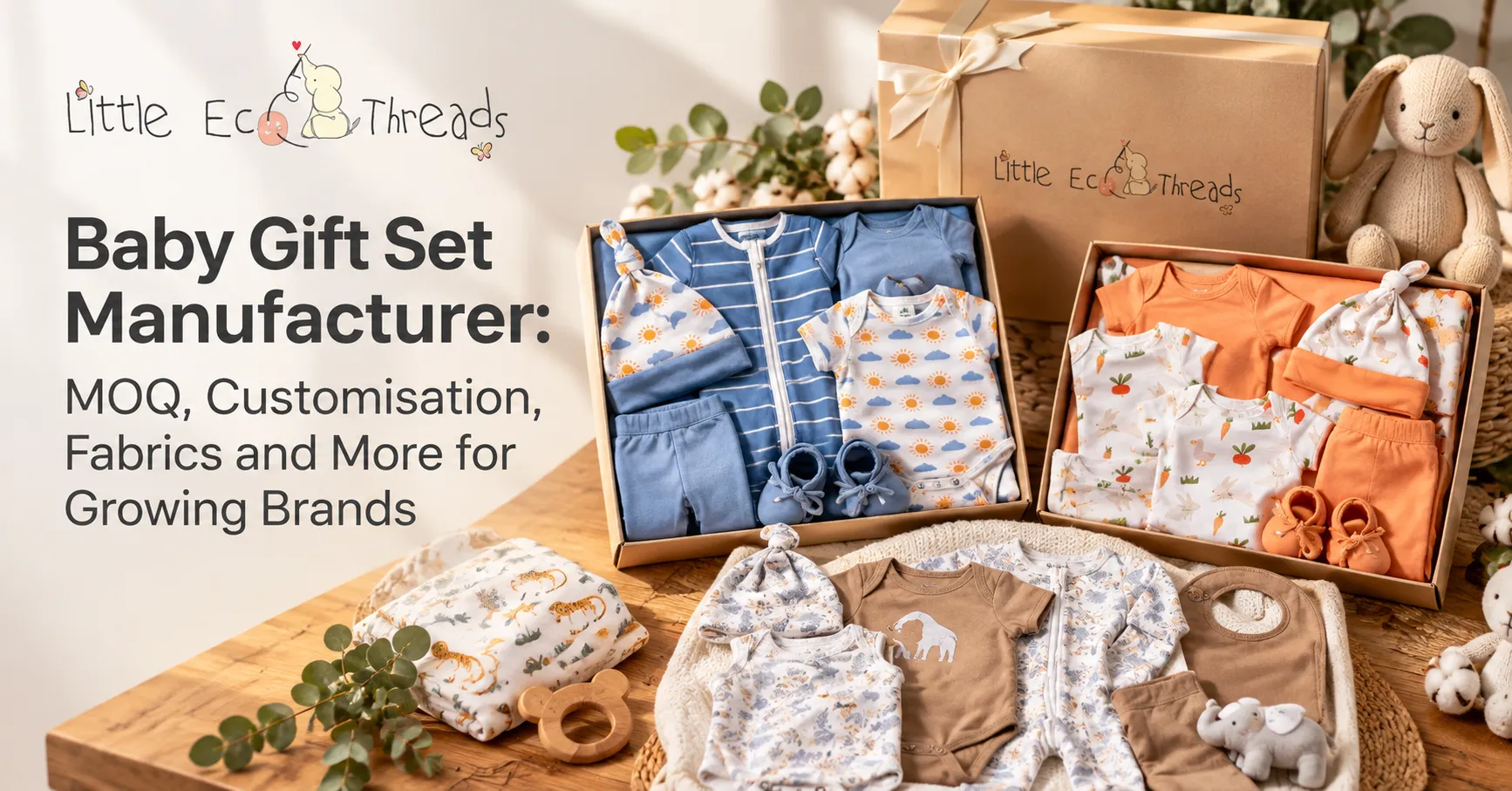
A brand that already sells baby bodysuits and blankets decides to add gift sets. The idea seems simple: put a bodysuit, hat, mittens and muslin cloth together in one box, with three colour options.
But then the brand starts contacting manufacturers, and things become more complicated. One supplier asks for 1,000 sets for each colour. Another offers a smaller MOQ, but only if the brand uses the fabrics they already have. A third supplier can match the prints but cannot give a clear date for when the packaging will be ready.
This is where baby gift set manufacturing can become difficult. Putting different products into one box is easy. The real challenge is finding a manufacturer who can manage the fabrics, colours, prints, quantities, packaging and delivery dates together. At the same time, the manufacturer should not force a new brand to place a very large first order when the collection is still being tested.
That is why it is better to look at a baby gift set manufacturer as a production partner, not just a supplier with a product catalogue.
This guide explains what questions to ask, what kind of MOQ you can expect, and how to find out early whether a manufacturer can support your brand as it grows.
Why Baby Gift Set Manufacturing Is Different From Ordering Single Products
A single bodysuit order means one fabric, one cutting plan and one delivery date. A set multiplies each of those, and the products depend on each other. If one component is late, the whole set cannot ship.
The dependencies usually appear in six places:
- Fabrics. A set may combine jersey, rib, muslin and fleece. These often come from different mills with different lead times and minimums.
- Colour matching. Dye behaves differently across fabric types. A jersey bodysuit and a muslin swaddle specified in the same shade can still look different side by side.
- Prints. Print scale that works on a blanket may look wrong on a hat. Prints, embroidery and labels all need to read as one design.
- Production units. Knitted accessories, cut and sew garments and woven items are often made in different workshops, sometimes in different factories.
- Size and mix. Offering newborn and 0 to 3 months multiplies the stock you carry for every product in the set.
- Packaging. The box or bag must fit the final combination and arrive before the last product is packed.
A factory that makes good babywear is not automatically the right choice for making gift sets. Some manufacturers focus on only one type of product and get the other items made by different suppliers. There is nothing wrong with this, but you should know how the process is managed.
Ask who is responsible for the other suppliers, who checks that the colours match across all the products, and who will handle the problem if one part of the gift set fails quality checks.
The best option is usually a baby and kidswear manufacturer that can make different products in house. Another good option is a manufacturer with a dedicated merchandiser who looks after the complete gift set, from choosing and booking the fabric to packing the final box.
This makes it easier to keep the whole set consistent and reduces the chances of problems between different suppliers.
How to Think About MOQ for Baby Gift Sets
Asking for "the MOQ" rarely helps, because a gift set carries several minimums at once. When a quote arrives, find out which of these it refers to:
- Per finished set. The number of complete sets. This is the figure most brands focus on, and often the least fixed.
- Per product. Each item has its own minimum, set by cutting and sewing efficiency. Knitted hats and cut and sew bodysuits behave differently.
- Per colour. Three colourways at 300 each is a bigger commitment than 900 in one colour.
- Per print. Custom prints carry setup costs, and printed fabric may be sold in minimum metres.
- Per fabric. Custom dyed or custom woven fabric usually has a mill minimum. Stock fabric often removes it.
- Packaging. Printed boxes frequently have their own minimums, sometimes higher than the garments.
Here is how this plays out. A brand wants a four piece newborn set in two colourways and is quoted 300 per product per colour. That sounds like 600 sets. But the muslin is a custom print with a 1,000 metre fabric minimum, and the printed box has a minimum of 1,000 units. The real first commitment is far larger than the headline number. These figures are illustrative, but the pattern is very common.
Ask also whether components can be ordered at different quantities. Some factories will let you order extra bodysuits to sell on their own alongside the sets. That helps you reach a product minimum without producing more sets than you can sell.
Several approaches can bring the first order down without weakening the product:
- Use stock fabrics and put your branding into embroidery, woven labels and packaging.
- Limit custom prints to one hero item and keep the other pieces plain or in shared colours.
- Share fabrics across products. One jersey for the bodysuit and the hat means one fabric minimum, not two.
- Launch with fewer colourways and add more after the first sell through.
- Use stock packaging with a printed sleeve or card instead of a fully custom box.
Ask whether low MOQ baby gift sets are available on a core range, with higher minimums only for fully developed products. Many manufacturers work this way. Also ask how the unit price changes at the next quantity tier. A slightly higher first order with a much better price can be the smarter choice if you are confident in the design.
Customisation: Where to Spend and Where to Save
Custom baby gift sets can mean anything from a new label to fully developed products, fabrics and packaging. The level matters more than the word. In practice there are three:
- Light. Private label baby gift sets built on the manufacturer's existing designs, with your labels, hangtags and packaging. Fastest to launch, lowest MOQ.
- Medium. Your colours, trims, embroidery or prints applied to existing patterns and fabrics. A good balance for growing brands.
- Full. Your own patterns, fabrics, specifications and packaging. Most control, highest minimums and the longest development time.
Most growing brands do best at the medium level. Spend where the buyer notices: the print, the colour palette and the packaging. Custom pattern making is rarely worth the cost at early volumes.
One caution. Every custom element adds a sample round. Decide early what is fixed, or development will stretch well beyond the plan.
Fabrics and Product Combinations That Work Together
The best sets are built around a shared fabric logic, not the longest product list. Each fabric brings a trade off:
- Cotton jersey. Soft and stretchy. Suits bodysuits, hats and bibs.
- Rib. Holds shape well. A natural choice for mittens, booties and hat trims.
- Interlock. Heavier and more stable. Better for sleepsuits, with a higher cost.
- Muslin or cotton gauze. Light and popular for swaddles and bibs. Shrinkage is a risk, so wash test before bulk.
- Knit or fleece blankets. Strong gift appeal, but bulky. Freight volume rises quickly.
- Terry. Used for hooded towels and washcloths in bath sets.
Combinations that tend to work commercially include newborn essentials (bodysuit, hat, mittens and swaddle), sleep sets (sleepsuit, hat and blanket) and bath sets (hooded towel, washcloth and bib). Each one shares a use moment, which makes the set feel designed rather than assembled.
Two checks are worth making. First, do all products share care instructions? A cotton bodysuit packed with a knit that needs delicate washing creates complaints. Second, if you make claims such as OEKO-TEX or GOTS, confirm the certification covers every component and that the factory can supply the documents. Safety rules also differ by market, covering drawcords, small parts and nightwear flammability. Confirm which apply to you before trims are chosen.
Packaging Is a Production Component
Packaging should be specified once product dimensions are known and approved before bulk begins. Check how the folded products sit in the box, whether the pack survives carton shipping, and where barcodes and inserts go.
Ask who assembles the sets. Assembly at the factory reduces your handling and gives consistent presentation. Assembly in your own warehouse costs labour, but lets you mix sizes and colours later and respond to demand.
Sampling, Lead Times and Quality Control
Sampling a set takes longer than sampling one item, because approvals run in parallel and the slowest one sets the pace. Ask for one combined timeline from first sample to shipment, not separate timelines per product.
Lead time is set by the slowest component. Custom printed fabric and printed packaging are often the longest items, so start them first. Work backwards from your selling date and leave room for a resample if colour fails.
A few habits protect you:
- Request a full set sample in the actual fabrics and colours, not one assembled from different existing samples.
- Check colour in daylight, with all products side by side.
- Run wash tests on every fabric before bulk is cut.
- Ask for set level inspection. A missing item or wrong size inside a set is a bigger problem than a minor garment defect. Inspection should check completeness and assembly, not only garment quality.
What Drives the Price of a Set
Set pricing is not the sum of individual product prices. Fabric minimums, the number of components, trims, packaging and assembly all shape the final cost.
A small accessory such as mittens may use little fabric, but it still adds a cutting, sewing, labelling and packing step. Before you add a fifth item, ask what it does to the unit price and the lead time.
Request a cost breakdown by component, including packaging and assembly. It shows where the money goes and where a change, such as a stock fabric or a simpler box, would save the most.
Questions to Ask a Baby Gift Set Manufacturer
Before committing, these questions separate coordinated manufacturers from catalogue suppliers:
- Who owns the whole set? Is there one person responsible across all products?
- Which products are made in house, and which are subcontracted?
- What are the minimums per set, product, colour, print, fabric and packaging?
- Which fabrics are available in stock and at what lead time?
- How is colour approved across different fabric types?
- What is the realistic timeline from approved sample to shipped cartons?
- What does a reorder look like in minimum quantity and lead time?
Can the Manufacturer Grow With Your Brand?
A low MOQ for the first order is helpful, but you should also think about what happens after that. Try to find a manufacturer who is interested in supporting your second and third orders too, not just getting your first order.
One good sign is when a manufacturer is willing to discuss a step by step plan. For example, you could start with a small order using their available fabrics. If the products sell well, you could then move to a bigger order with your own custom prints.
Another good sign is having a clear process for repeat orders. Ask if they can keep or reserve your fabric so that your next order can be made faster.
It is also useful if the manufacturer makes different baby and kidswear products. As your brand grows, you may want to add new products or seasonal collections without having to search for another supplier every time.
Be careful with manufacturers who agree to everything during the first conversation. A good manufacturer may sometimes tell you that a certain MOQ, design or delivery time is not realistic. Honest advice and reasonable pushback can actually be a good sign that they understand production well.
Choosing the Right Baby Gift Set Manufacturer
The right baby gift set manufacturer should be able to manage the whole set, clearly explain the MOQ for each part, and support your brand as your orders grow.
When comparing different manufacturers, do not only look at the main MOQ number. Check how that MOQ is calculated and whether it applies to each product, colour, fabric or the complete set.
Ask for one complete production timeline and a sample of the full gift set before placing a large order. It is better to start with a range that matches how much you expect to sell and then increase the order once you know what customers like.
A good manufacturer should be able to grow with you as your orders become bigger.