Baby Playmat Manufacturer for Private Label
If you are planning a baby playmat for your own brand, the sourcing question is not simply about finding someone who can make a padded mat. You need a manufacturer who can make your design, use the fabrics you choose, produce the quantity you need, and keep the quality consistent from the first piece to the 50th.
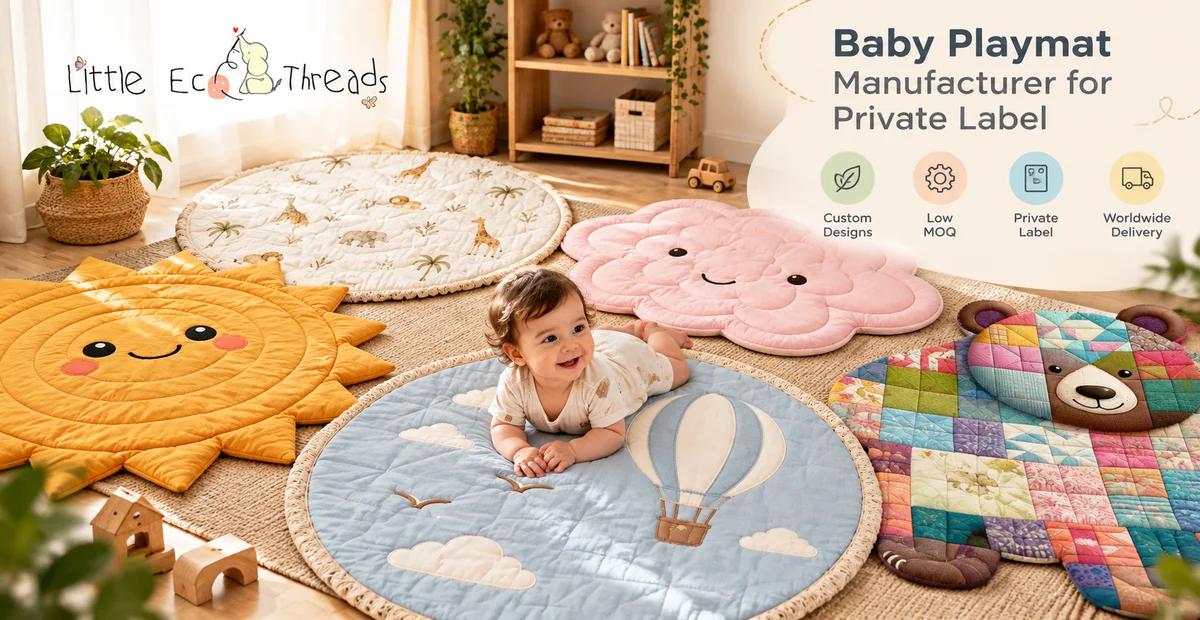
Little Eco Threads manufactures baby and children’s products for brands, with private label and custom manufacturing as an important part of its work. As a baby playmat manufacturer, it offers different styles that give brands a practical starting point, including animal shaped mats, patchwork designs, quilted and appliquéd round mats, and linen and velvet styles. These mats are made with a padded base for comfort and support.
This article explains what the manufacturing process looks like, including customisation, minimum order quantities, sampling, quality control, and compliance. It will help you understand what to look for when choosing a baby playmat manufacturer for your brand.
What Brands Need From a Baby Playmat Manufacturer
Baby playmats are soft products, and soft products depend on small decisions being made well. Whether you call the partner a baby playmat supplier or a playmat manufacturer, a few areas decide if the finished mat holds up.
Materials. The top fabric, the reverse and the filling all affect feel, washing behaviour and how the mat sits on the floor. A manufacturer should be able to source and develop fabrics, not only offer what is already on the shelf.
Padding and construction. Even filling matters more than thickness alone. Lumpy padding is one of the first things a buyer notices, along with stitching that puckers around curves. Shaped mats such as animals and flowers are harder to sew cleanly than a plain square, so ask how the factory handles curves and corners.
Print, colour and finishing. Colour needs to match across the full production run, and prints need to sit where the designer placed them. Edges, bindings and trims are where a mat looks either finished or rushed.
Durability. Secure stitching and colourfast fabrics matter for a product that gets washed, dragged around and chewed.
Commercial fit. Finally, there is the practical side: sampling, MOQ, packaging, private labelling and delivery. A great sample only helps if the same team can produce, pack and ship it in volume.
Baby Playmat Styles at Little Eco Threads
The current catalogue lists 31 playmat designs, and they fall into a few clear groups.
Shaped animal playmats are the most distinctive. The range includes a standing bear, a seated teddy, a tree frog and a capybara, in patchwork or densely quilted fabrics. Novelty shapes such as a daisy, a sun and a cloud add embroidered faces, quilted rings and petals.
Round quilted playmats come in two styles. Some carry appliquéd scenes, such as a bunny among embroidered daisies, a duck pond or a little steam train, with a printed reverse and a bobble trim. Others use printed cotton with watercolour designs of dinosaurs, safari animals, sea life or fruit, quilted in wave channels and finished with a bound edge. Most reverse to a coordinating gingham, stripe or print, so the buyer gets two looks in one mat.
Linen and velvet playmats cover the quieter end of the market. A blush linen round with a gathered ruffle suits minimalist nurseries, while a terracotta velvet flower mat with quilted petals works as nursery décor. There is also a large round mat with a colour block wave design.
All of these are padded baby play mats with soft inners and cotton backing, each a play mat for babies that works for tummy time and as a room accessory. Sizes range from compact to large, which can suit infant play mats as well as larger kids play mats.
It helps to read the catalogue correctly. The designs are illustrative and made to order, not kept in stock. The website invites brands to modify designs, materials and styles, and what is possible on a specific mat depends on its construction. For many brands the catalogue is a starting point. For others it is simply a reference for the level of finish to expect. You can browse the full play mats catalogue to see each design.
Custom Playmat Manufacturing for Private Labels
A playmat looks simple as a finished product. It is a flat, soft shape on a floor. But once a brand starts developing one, the questions arrive quickly.
How thick should the padding be so it feels supportive without being stiff? Does the print run across a seam or stop before it? Where does the appliqué sit once the quilting lines pull the fabric in? Will the edge trim keep its shape after washing? And how does a mat that size fold into a box that looks good when a retailer opens it? None of this shows up on a mood board, and all of it shows up in the first sample.
This is where a manufacturer that works from a brief, rather than from a fixed catalogue, earns its place. Little Eco Threads develops products from a brand's requirements, and the first sample is best treated as part of the design process. Depending on the design and construction, custom development can include:
- Custom pattern making for new shapes and sizes
- Fabric sourcing and development, including custom colours
- Printing your own artwork
- Embroidery where suitable, plus appliqué and patchwork
- Custom trims
- Private labels and hang tags
- Custom packaging
- Fabric testing and certification support
Not every option suits every mat. A dense patchwork bear, a printed round mat and a velvet flower each have different construction limits, and an early conversation will show what is realistic and what needs a different approach.
The point is that a brand does not have to choose a fixed design and accept it as is. Custom baby play mats can start from your shape, your artwork or your palette, with the pattern, samples and production built around that. For private label baby playmats, it also means your name goes on the label, the tag and the box. The custom manufacturing page explains how this works across product categories.
Low MOQ for Growing Brands
Minimum order quantity is often the deciding factor for startups and boutique labels. Each playmat design currently listed in the Little Eco Threads catalogue shows an MOQ of 100 pieces, and the website describes its playmat minimums as suitable for boutique brands. That makes it possible to launch a small range across several designs instead of committing heavily to one. It also helps retailers and brands who want wholesale baby play mats without carrying large stock.
That 100 piece figure applies to the listed designs. It should not be read as a fixed MOQ for every custom project. The final number depends on the design, the materials, the size, the level of customisation and the production requirements. A new shape that needs a fresh pattern, a custom printed fabric or a special trim can change the minimum, and so can a very large size or complex patchwork.
The practical approach is to share your concept, target quantity and budget early. From there, the team can tell you whether your plan fits the listed MOQ or needs adjusting, and may be able to suggest ways to bring the quantity down, such as building on an existing fabric or pattern. For a brand testing its first playmat collection, that conversation is more useful than a headline number.
From Sample to Production
The route from idea to delivered stock is simple when each stage has a clear purpose.
- Brief. You share artwork, references, size, shape and target market, or you pick a catalogue design as a base.
- Development. Patterns are made and fabrics and prints are selected. You can also order fabric swatches to check colour and hand feel.
- Sampling. A sample is made so you can review shape, padding, stitching, print placement and finish. Little Eco Threads lists sampling with quick turnaround as part of its playmat service. Changes are made and approved before bulk begins.
- Bulk manufacturing. Production follows the approved sample, with quality control across the run.
- Packing and delivery. Labels, hang tags and packaging are applied, and orders ship worldwide by sea or air freight.
The website gives a general production lead time of 45 to 90 days. For a specific playmat, timing depends on the design, materials and quantity, so confirm dates when you receive a quote and leave room for sample revisions before planning a launch.
Quality, Certifications and Compliance
Little Eco Threads describes its playmat production as including secure stitching, soft and even filling, colourfast fabrics and quality checks on bulk orders. For buyers, this means paying attention to the areas that matter most, such as strong construction, consistent padding, colour, finishing and packing.
The company is GOTS approved, GRS approved and Sedex approved. For a B2B buyer, these credentials provide information about the company’s approach to sourcing and production.
GOTS covers organic textile standards and responsible processing. GRS focuses on recycled materials and their traceability. Sedex is a platform that helps businesses share information about ethical and responsible sourcing. Together, these credentials can support sustainability requirements, supply chain transparency and questions from your own retail customers.
However, these credentials do not mean that every playmat is automatically certified. Certification for a specific product depends on the materials used and the supporting documentation.
Compliance for baby and children's products also depends on the product, materials, destination market and regulations that apply there. A playmat sold in the UK, EU, US or Australia may have different requirements. It is therefore better to decide the target market and testing requirements at the beginning of product development. This allows fabric testing and certification requirements to be planned from the start instead of being added later.
Experience can also make the development process easier. Little Eco Threads has worked with more than 100 brands across Europe, North America and Australia and works across more than 20 product categories. The company has more than 25 years of experience and a team of more than 500 people in India. Its parent company, Home Fashions, has more than 30 years of manufacturing experience.
This experience is useful because different children's products often involve similar questions about materials, testing and documentation. Having experience with these requirements can help make the development process smoother and save time.
In July 2026, CWB Magazine, also known as Childrenswear Business, featured Little Eco Threads in an article titled “Introducing Little Eco Threads.” The article discussed the company’s approach to transparency, sustainability, compliance, product development and manufacturing for children's brands. It is a feature rather than an endorsement, but it can be a useful external reference for buyers researching the company.
More Than Playmats
A playmat rarely sells alone. Brands often build around it with a quilt, a nest, a soft toy or a gift set.
Little Eco Threads also manufactures baby and children's apparel, PJ sets, sleeping bags, swaddles, baby quilts, baby nests, soft toys, bibs, gift sets, bags, swimwear, knits and linen products.
For a brand, that opens the possibility of a coordinated collection, such as a matching playmat, quilt and soft toy in related fabrics, developed with one manufacturing partner. Whether that suits your range depends on the products and timing, but it is worth raising at the start.
A Manufacturing Partner for Your Brand
Most brands start a playmat project with an idea in mind, such as a fox shape, a rainbow design, or a soft linen round mat for a nursery. The challenge is turning that idea into a product that can be made in larger quantities while keeping the quality consistent and making sure parents will enjoy using it for a long time.
This usually involves making one or two samples, adjusting the padding or print placement, and discussing what can and cannot be done with the design. Little Eco Threads supports this process, from custom shapes and prints to sampling, quality checks and delivery.
If you are planning a new range or improving an existing one, you can share your artwork, preferred size, target market and expected quantity through the contact page. A clear brief makes it easier to understand what is possible and how the product can be developed.