Children's Apparel Compliance for USA Imports
Children's apparel compliance starts long before a shipment reaches a U.S. port. A T-shirt, romper, hoodie, sleepwear style, or dress may begin with a fabric swatch in India, but by the time it reaches the U.S. market it may need testing records, a Children's Product Certificate, tracking labels, customs data, and CPSC eFiling information that all match the product being imported.
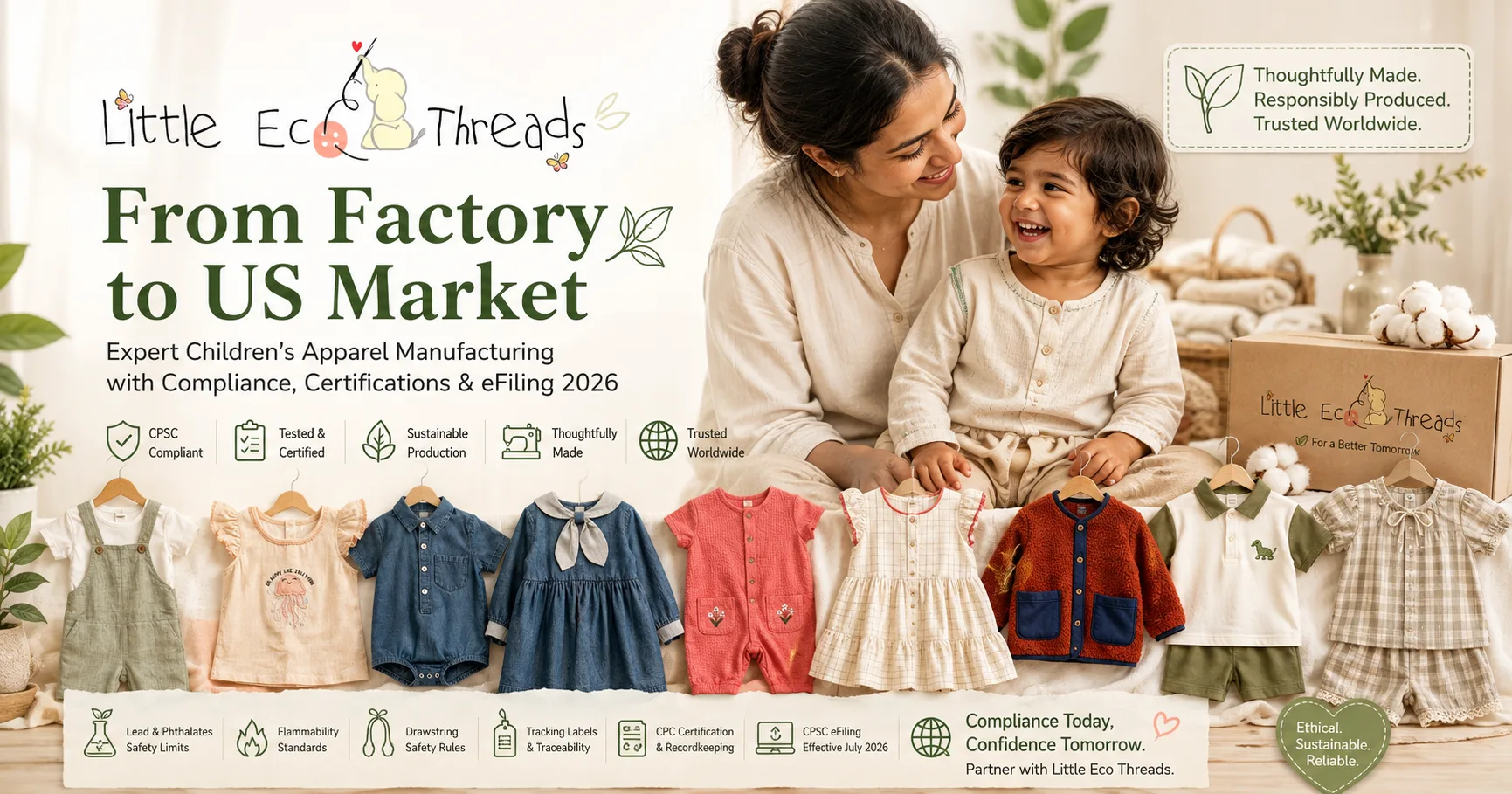
For brands working with a children's apparel manufacturer India partner, the practical goal is to build compliance into product development instead of chasing documents after production. Fabric, dyes, trims, prints, drawstrings, labels, and packaging can all affect what needs to be tested or documented.
This guide explains US children's apparel compliance, including CPSIA, CPSC children's apparel compliance, children's apparel import requirements, children's apparel testing requirements, CPSC third-party testing, CPSC eFiling, and the role of a manufacturing partner. It also outlines where voluntary certifications and EU, UK, and Australian rules fit into the wider compliance picture.
This article provides general information only and is not legal advice. Product-safety, chemical, testing, labeling, customs, and certification requirements vary by product, construction, age range, intended use, and destination market. Brands and importers should confirm requirements with qualified laboratories, customs brokers, compliance advisors, or official authorities before placing products on the market.
Why Children's Apparel Compliance Begins At The Factory
Compliance risk is often created early. A fabric choice can affect flammability. A print can affect chemical testing. A snap, zipper pull, button, applique, or cord can be treated as an accessible component. A hoodie drawstring can create a design problem that no lab report can fix later.
That is why the strongest compliance workflow usually looks like this:
- Review the target market before sampling.
- Check trims, prints, and construction before cutting.
- Confirm whether the style is daywear, sleepwear, outerwear, or a child-care article.
- Match testing to the finished product and relevant components.
- Keep production records tied to fabric lots, trims, and style codes.
- Prepare certificate and import data before shipment.
Little Eco Threads supports brands by treating compliance as part of product development, not as a last-minute document request. That is especially important for brands importing kidswear from India to USA retailers, boutiques, and e-commerce markets.
The U.S. Children's Apparel Compliance Framework
The main U.S. regulator for children's apparel is the Consumer Product Safety Commission. The CPSIA expanded the framework for children's products, including lead limits, phthalates where applicable, third-party testing, certificates, and tracking labels.
CPSC generally treats a children's product as one designed or intended primarily for children 12 years of age or younger. For kidswear brands, the important point is that product design, size range, packaging, marketing, and consumer recognition can all matter.
Once a garment is in scope, requirements can come from several layers:
| Area | Why it matters for kidswear |
|---|---|
| Lead content | Accessible components may need review or testing. |
| Phthalates | Covered child-care articles and accessible plasticized components can trigger restrictions. |
| Flammability | General apparel and children's sleepwear follow different rules. |
| Drawstrings | Children's upper outerwear has specific design restrictions. |
| Tracking labels | Product and packaging need traceability information where practicable. |
| Certificates | Applicable children's products need a CPC. |
| Imports | Regulated imported products may require eFiled certificate data. |
This is why children's clothing compliance should be reviewed style by style.
Lead Content, Phthalates, And Component Risk
U.S. rules limit lead content in accessible parts of children's products. Paint and similar surface coatings have a separate lead limit. For children's apparel, ordinary dyed or undyed textiles may qualify for certain CPSC determinations, but trims, coatings, transfers, rhinestones, metal snaps, zippers, and decorative components can still need separate attention.
Phthalate rules are narrower than many brands assume. They do not automatically cover every children's garment. They principally apply to children's toys and child-care articles, and can become relevant when a product includes accessible plasticized components or is intended for sleeping, feeding, sucking, or teething use.
The useful manufacturing habit is to review the full bill of materials. A base fabric test does not automatically prove that every trim, print, coating, or plasticized component is acceptable.
Flammability, Children's Sleepwear, And Drawstrings
General wearing apparel is subject to federal flammability requirements where applicable. Children's sleepwear has separate rules, and misclassifying sleepwear as daywear can become expensive once labels, samples, and bulk production are already complete.
Children's sleepwear should be reviewed early by size range, intended use, fit, fabric, and labeling route. A pajama, robe, sleep sack, footed sleeper, lounge set, or nightgown may need a different compliance plan from an everyday T-shirt.
Brands also need to assess drawstrings in children's upper outerwear. Hood, neck, waist, and bottom drawstrings can create strangulation or entanglement risks depending on the garment and size range. This is a design-stage issue, not simply a testing-stage issue.
CPSC Third-Party Testing Requirements
CPSC guidance states that children's products subject to children's product safety rules generally require testing by a CPSC-accepted third-party laboratory for the applicable rule. CPSC notes that the specific testing depends on product class, intended age audience, use patterns, and material composition.
Not every lab is accepted for every rule. A lab may be qualified for one test and not another, so the certifier needs to confirm that the laboratory is accepted for the exact requirement being certified.
Testing should be tied to the production reality:
- Which style is being tested?
- Which fabric lot is involved?
- Which trim supplier was used?
- Was the print, coating, or embellishment included?
- Is this a continuing style or a new construction?
- Has any material change occurred?
For brands using India as a production base, a disciplined factory record system makes CPSC third-party testing easier to manage.
Children's Product Certificate And Importer Responsibility
The Children's Product Certificate, often called a CPC, is the written certification that an applicable children's product complies with the relevant children's product safety rules.
A CPC and a lab report are not the same document. The lab report records what was tested and the result. The CPC is the certification document issued by the responsible manufacturer or importer using the test results and product information.
CPSC guidance says a CPC generally includes:
- Product identification.
- Citation to each applicable safety rule.
- Certifier name and contact information.
- Contact information for the person maintaining records.
- Date and place of manufacture.
- Date and place of testing.
- Identification of the CPSC-accepted laboratory where applicable.
For imported children's apparel, the U.S. importer is generally responsible for certification and import compliance. An overseas factory can support the importer with accurate production, material, testing, and traceability information, but it does not automatically become the U.S. certifier.
Tracking Labels And Batch Records
CPSC guidance on tracking labels says children's products need permanent distinguishing marks on the product and packaging, to the extent practicable, with information that helps identify manufacturer or private labeler, production location, production date, batch or run details, and other source information.
For children's apparel, that means production records should connect the visible tracking information to actual factory records:
- Style code
- Production date
- Factory location
- Fabric lot
- Trim supplier
- Size run
- Batch or run number
- Testing records where relevant
Tracking labels are not just a label-design task. They depend on accurate factory-level recordkeeping.
CPSC eFiling And The CPSC Product Registry
CPSC eFiling became effective on July 8, 2026 for most imported consumer products subject to CPSC certification requirements. CPSC says the Foreign Trade Zone date is January 8, 2027. The agency also states that eFiling does not create new testing or certification obligations; it changes how already-required certificate data is transmitted.
For imported products, certificate data is filed through the U.S. Customs and Border Protection ACE system using a Partner Government Agency, or PGA Message Set. The CPSC Product Registry can store certificate data for use with Reference PGA Message Sets. CPSC notes that the Product Registry is a standalone repository and does not communicate with ACE automatically.
The two main filing approaches are:
| Filing route | Practical use |
|---|---|
| Full PGA Message Set | Certificate data is submitted with the entry. |
| Reference PGA Message Set | Certificate data is stored in the Product Registry and referenced during entry. |
For repeat import programs, the registry can reduce repetitive data entry. For small or varied orders, a Full PGA Message Set may be simpler. Either way, the importer and broker need accurate product identifiers, citation codes, manufacturing details, testing data, laboratory information, and records contacts before the shipment reaches the import stage.
The US Customs and Border Protection Automated Commercial Environment, or ACE, is the trade processing platform used for import and Partner Government Agency data.
Component-Part Testing And Composite Testing
Component-part testing can sometimes help reduce duplicate testing when the same qualifying component is used across multiple styles. CPSC guidance on component-part testing says firms may rely on qualifying component-part testing or certification only when the required conditions are met and due care is used.
Composite testing can also reduce cost in specific circumstances, but it is not a free shortcut. The certifier must confirm that the test method, sample grouping, component identity, documentation, and due-care requirements support the certificate being issued.
For apparel, this is where recordkeeping becomes operational. A button test is only useful if the brand can trace the tested button to the exact supplier, batch, and production run used in the finished garment.
Voluntary Certifications: Useful, But Not Substitutes
CPSC compliance is the legal floor for many U.S. children's apparel products, but brands often need voluntary certifications or buyer-required standards too.
OEKO-TEX STANDARD 100 is a textile harmful-substance certification. OEKO-TEX states that every thread, button, and accessory is tested against a list of harmful substances, with stricter requirements for products with more intensive skin contact and for babies.
The Global Organic Textile Standard supports organic textile claims across certified processing and supply-chain stages. Textile Exchange standards such as the Global Recycled Standard and Recycled Claim Standard support recycled-content claims and chain-of-custody verification.
Other programs may support sourcing, factory, or management-system expectations. The Better Cotton Initiative relates to cotton sourcing practices. WRAP and SA8000 are commonly discussed in relation to social compliance and factory practices. ISO 9001 relates to quality management systems, while ISO 14001 relates to environmental management systems.
These certifications can strengthen brand claims and buyer confidence, but they do not replace CPSIA, CPC, CPSC eFiling, or customs obligations where those apply.
International Requirements For EU, UK, And Australia
Many brands sell the same children's apparel collection across the United States, Europe, the United Kingdom, and Australia. That does not mean one compliance file automatically works everywhere.
In the European Union, the General Product Safety Regulation sets general product-safety expectations for consumer products. REACH addresses chemical substances and can affect textiles, trims, dyes, coatings, and accessories. EN 14682 is relevant to cords and drawstrings in children's clothing, though brands should verify the exact harmonized standard and market route that applies.
In the United Kingdom, UK REACH is separate from EU REACH. The Nightwear (Safety) Regulations can apply to relevant children's nightwear products.
In Australia, the Australian Competition and Consumer Commission is the competition and consumer product-safety regulator. Children's nightwear and limited daywear can be subject to mandatory requirements based on AS/NZS 1249:2014.
The pattern is consistent: the risks may sound similar, but the legal mechanisms, responsible parties, labels, tests, and documentation can differ by market.
What A Compliance-Ready Manufacturing Partner Looks Like
A good manufacturing partner does not replace the brand's or importer's legal responsibility. It makes that responsibility easier to manage by keeping production information accurate and accessible.
For children's apparel import requirements, look for a supplier that can support:
- Design-stage review of trims, drawstrings, prints, and closures.
- Sample coordination for third-party testing.
- Product specifications linked to each production run.
- Batch and component traceability.
- Quality checks tied to the approved sample.
- Documentation for CPC preparation.
- Information needed for CPSC eFiling.
- Clear communication about material or supplier changes.
- Realistic lead times and order quantities.
Through Custom Manufacturing, Little Eco Threads helps brands plan fabric, trims, sampling, labels, packaging, and production records before bulk production. The Design Catalog can also help brands define product categories early, while the organic and certified material options support stronger material claims when they are relevant to the order.
FAQ
What is children's apparel compliance?
Children's apparel compliance means identifying and meeting the product-safety, testing, certification, labeling, documentation, and import rules that apply to a specific children's garment. Requirements vary by product type, material, age range, intended use, and destination market.
What is CPSC eFiling?
CPSC eFiling is the electronic filing of certificate data for imported consumer products subject to CPSC certification requirements. It uses CBP's ACE system and a CPSC Partner Government Agency Message Set.
What is a Children's Product Certificate?
A Children's Product Certificate is the written certification that an applicable children's product complies with relevant children's product safety rules. For imported products, the U.S. importer is generally responsible for issuing it.
Does CPSC third-party testing apply to all children's apparel?
The exact testing depends on the product, materials, intended age audience, use pattern, and applicable rule. Children's products subject to CPSC children's product safety rules generally require testing by a CPSC-accepted third-party laboratory for those rules.
Do GOTS, GRS, or OEKO-TEX replace CPSIA?
No. GOTS, GRS, Recycled Claim Standard, and OEKO-TEX can support organic, recycled-content, or harmful-substance claims, but they do not replace CPSIA, CPC, eFiling, customs, or market-specific safety obligations.
Build Compliance Into Production Early
Children's apparel compliance is easiest to manage when it is built into product development. Fabric selection, trims, testing, tracking labels, certificates, import data, and market-specific requirements should be planned before shipment.
If you are developing children's apparel for U.S. or international markets and need a manufacturer that can support product development, clear records, certified material options, and practical compliance coordination, contact Little Eco Threads to discuss your collection.