What Should You Ask a Children's Clothing Manufacturer Before Placing an Order?
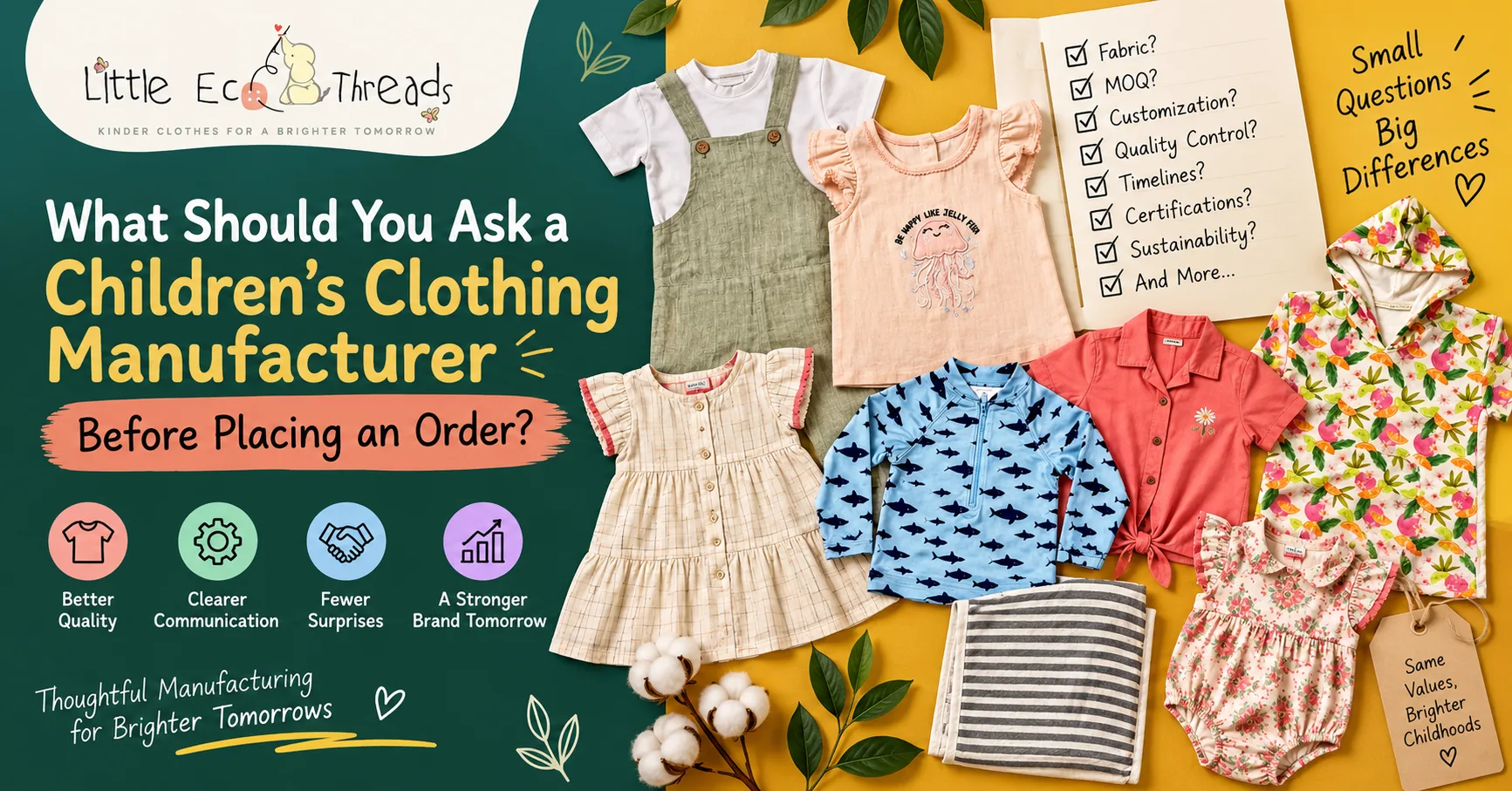
Choosing a children's clothing manufacturer is one of the most important decisions a baby or kidswear brand makes before placing an order. Good photos, attractive pricing, and a friendly first email are useful, but they do not tell you enough about fabrics, sampling, MOQ, quality control, certifications, timelines, or what happens if the bulk order does not match the approved sample.
Before you pay a deposit, ask direct questions. A serious manufacturing partner should be able to explain what it makes, how it develops samples, what documentation supports material claims, how quality is checked, and what information it needs from your brand.
This guide gives brand founders, retailers, and sourcing teams a practical checklist to use before choosing a manufacturer for children's clothing manufacturing.
Why the Right Questions Matter
A strong children’s clothing manufacturer relationship starts before production begins. The questions you ask upfront shape the sample, the quote, the timeline, and the final product.
If a brand assumes a factory can make organic cotton babywear, only to learn later that the quoted fabric is standard cotton, the launch loses time. If MOQ is unclear, a small brand may discover too late that the minimum applies per colour, not per total order. If packaging, labels, or trims are discussed after bulk production starts, the schedule can slip.
Clear questions protect both sides. The brand gets a more accurate quote, and the manufacturer gets the information it needs to produce the order correctly.
1. What Types of Children's Clothing Do You Manufacture?
Start by confirming category fit. A general apparel factory may not have the same experience as a specialist kidswear manufacturer, especially when the order includes newborn pieces, small sizes, soft seams, or garments worn close to sensitive skin.
Ask whether the supplier regularly produces baby clothing, children's apparel, newborn clothing, kids' tops and shirts, babywear, rompers, dresses, bottoms, swaddles, accessories, or sleepwear. A supplier with direct category experience is more likely to understand fit, fabric weight, closure placement, washing, and construction details for young children.
Little Eco Threads works across baby and children's clothing categories, so the first conversation usually starts with the product type: newborn essentials, rompers, dresses, knitwear, swaddles, sleepwear, summer clothing, or a broader private label range.
2. Can You Make Custom Children's Clothing?
Not every order uses a ready design. Some brands need small changes to an existing style. Others need Custom children's clothing developed from sketches, reference samples, CADs, measurements, or mood boards.
Ask what level of customization the manufacturer supports. Can it adjust fit, sleeves, trims, prints, embroidery, colourways, labels, fabric, and packaging? Can it develop patterns from a brief? Can it interpret technical details accurately?
For a brand planning custom manufacturing, this question matters as much as price. The more specific your product is, the more important the sampling and development process becomes.
3. Do You Support Private Label Children's Clothing?
If you are building a brand, ask whether the manufacturer supports private-label children's clothing, including neck labels, care labels, hangtags, barcode stickers, custom polybags, retail packaging, and carton markings.
private-label production is not just about sewing in a label. It affects purchasing, artwork, trims, packing, compliance information, and the final presentation a retailer or customer sees.
Brands planning Private-label kidswear should confirm these details before approving the quote:
- What label files are needed?
- Who sources care labels and brand labels?
- Can the manufacturer follow market-specific care wording?
- What packaging materials are available?
- Are hangtags, stickers, and barcodes handled in-house or by a third party?
- When must packaging artwork be approved?
4. What Do You Need From My Tech Pack?
A tech pack is the document that tells a manufacturer exactly how the garment should be made. It usually includes measurements, size grading, construction notes, fabric, trims, stitching, print or embroidery artwork, label placement, and packaging requirements.
Ask what the manufacturer expects before quoting and before sampling. If you do not have a complete tech pack, ask whether it can help turn your idea into a production-ready specification.
Incomplete specifications create avoidable confusion. A reference photo can show the look, but it does not define seam allowance, shrinkage tolerance, fit, fabric composition, artwork scale, or packing details.
5. How Does Sampling Work?
sampling is where problems should be found, not after hundreds of garments are produced. Ask what sample stages are available and what each one is meant to approve.
Useful sample stages can include:
- Fabric swatch review
- First development sample
- Fit sample
- Print or embroidery strike-off
- Size-set sample
- Pre-production sample
For children's clothing sampling, the goal is not only to approve the look. It is to test fit, comfort, construction, wash behaviour, trims, and whether the approved sample can be repeated in bulk.
6. What Fabrics and Materials Do You Work With?
Fabric choice affects price, hand feel, durability, shrinkage, and how parents judge the garment after washing. Ask whether the manufacturer works with cotton jersey, rib, interlock, muslin, woven cotton, linen, denim, swim fabrics, fleece, corduroy, recycled fibres, or organic cotton kidswear.
If the supplier describes itself as a sustainable kidswear manufacturer, ask what documentation supports that positioning. Organic, recycled, and certified claims should be specific, not vague.
For organic textile claims, GOTS (Global Organic Textile Standard) can verify organic textile processing when the certified scope and chain of custody are intact. For harmful-substance testing, OEKO-TEX STANDARD 100 is often relevant to textiles used close to the skin. For recycled materials, GRS is part of Textile Exchange's standards system. For ethical sourcing data and social audits, Sedex is a widely used responsible sourcing platform.
7. What Fabric Testing Do You Recommend?
fabric testing helps confirm whether the material behaves the way the product requires. For children's garments, ask about shrinkage, colourfastness, pilling, seam strength, print durability, and wash performance.
If the product is for babies or young children, ask whether the fabric, trims, and finishes are appropriate for the target market. Requirements vary by product and country, so brands should confirm specific compliance needs with qualified labs, importers, retailers, or advisors.
Testing does not remove all risk, but it gives the brand a better chance of catching problems before bulk production.
8. What Is the MOQ?
MOQ means minimum order quantity. It may apply per style, per colour, per size, per fabric, or per total order. Those distinctions matter.
Ask:
- Is the MOQ per style or total order?
- Does each colour have its own minimum?
- Does a custom print increase the minimum?
- Are fabric minimums different from garment minimums?
- Can a small test order be split across sizes?
- What happens when the brand scales into repeat orders?
For a startup, kidswear MOQ can decide whether a launch is realistic. A good manufacturer should explain what drives the minimum instead of giving a single number without context.
9. How Do You Handle Quality Control?
quality control should happen throughout production, not only at the packing table. Ask how the manufacturer checks fabric before cutting, measurements during construction, stitching, seams, trims, colour consistency, prints, embroidery, finishing, and final packing.
Children's clothing quality control is especially important because small problems can become customer complaints quickly. Weak seams, scratchy labels, loose trims, poor snap placement, inconsistent sizing, and shrinkage are more than minor details in baby and kidswear.
Ask how the bulk order is compared with the approved sample. That comparison is one of the simplest ways to understand whether the production process is controlled.
10. Can You Handle Custom Prints, Packaging, and Branding?
If your range includes custom designs, ask how artwork is prepared, scaled, sampled, and approved before production. Custom print children's clothing needs careful print placement, colour control, fabric compatibility, and wash testing.
For packaging, ask whether the manufacturer can support custom packaging solutions, branded tags, folded presentation, size stickers, barcode labels, and carton packing by style or size.
Packaging details should be confirmed early because they affect sourcing, timeline, cost, and how the order arrives at your warehouse or retail partner.
11. What Is the Production Timeline?
Ask the manufacturer to break the timeline into stages:
- Fabric sourcing
- Sampling
- Revisions
- Pre-production approval
- Cutting
- Stitching
- Finishing
- Quality checks
- Packing
- Dispatch
bulk production usually depends on fabric availability, approval speed, trims, printing, embroidery, packaging, and order size. A supplier that explains the timeline clearly is easier to plan with than one that gives only a vague dispatch date.
Also ask how delays are communicated. The answer tells you a lot about how the manufacturer manages production pressure.
12. What Happens If Something Is Wrong With the Order?
Even reliable manufacturers can run into issues. What matters is how problems are handled.
Ask what happens if:
- Measurements do not match the approved tolerance
- Fabric differs from the approved sample
- Colour varies between batches
- Trim placement is incorrect
- Packaging does not match the agreed specification
- Production is delayed
- Defects are found during final inspection
Clarify rework, replacement, credit, and communication before placing the order. It is easier to agree on process before there is a live problem.
Checklist Before You Place an Order
Use this checklist before choosing a children's clothing manufacturer:
- Do they regularly manufacture your product category?
- Can they make custom children's clothing or only catalogue styles?
- Do they support private-label production?
- What information do they need in the tech pack?
- What sample stages are available?
- What fabrics and certifications can they document?
- How is fabric testing handled?
- What is the MOQ by style, colour, fabric, and order?
- How does quality control work during production?
- Can they support custom packaging solutions?
- How long does sampling and bulk production take?
- How are delays or defects handled?
- Who is responsible for final approvals?
FAQ
What should I ask a children's clothing manufacturer first?
Start by asking what product categories they regularly make, what fabric options they support, what their MOQ is, and how their sampling process works. These answers show whether the supplier is a realistic fit before you discuss detailed pricing.
Is a kidswear manufacturer different from a general clothing factory?
Often, yes. A kidswear manufacturer should understand babywear fit, children's sizing, soft seams, safe trim placement, shrinkage, wash testing, and the quality expectations of parents and retailers.
Do I need a tech pack before contacting a manufacturer?
A tech pack is helpful, but some manufacturers can support early development if you have sketches, references, fabric direction, and size goals. A complete tech pack becomes more important before sampling and bulk production.
What certifications should I ask about for children's clothing?
Ask which certifications are relevant to your product and claim. GOTS, OEKO-TEX STANDARD 100, GRS, and Sedex can each relate to different parts of textile sourcing, testing, recycled materials, or responsible sourcing. They are not interchangeable.
How do I avoid mistakes before bulk production?
Approve fabric swatches, review samples carefully, confirm measurements, test wash performance, clarify packaging, document tolerances, and make sure the approved sample is used as the reference for bulk production.
Final Thoughts
Choosing a children's clothing manufacturer should not be based on price alone. The best partner for your brand is the one that can understand your product, explain the production process clearly, support the right materials, manage samples properly, and produce consistently.
Little Eco Threads works with brands across baby clothing, kidswear, custom product development, private-label children's clothing, organic cotton, sampling, and export-ready production. If you are planning a new collection, contact Little Eco Threads to discuss your product brief, fabric needs, MOQ, and next sampling step.