Custom Kids Winter Wear Manufacturer: From Design Development to Bulk Production
The Business Opportunity in Children's Winter Clothing
Winter is the season in which a children's brand can make its strongest statement, and its most expensive mistakes. Outerwear and heavier layering pieces carry higher unit values than summer basics, they use more fabric and take longer to construct, and they must reach retailers before the first cold weeks arrive. A missed delivery window cannot be fixed with a later discount. The season simply moves on.
For that reason, a winter range needs to be planned as a collection rather than a handful of jackets. Buyers expect depth: outerwear for the coldest days, knitwear and mid-layers beneath it, and softer separates that carry a range into early autumn and spring. Every decision, from sherpa or quilted fabric to the number of colourways, affects design consistency, production complexity and how the range will be merchandised.
This is where the manufacturing partner becomes part of the product strategy. A kids winter wear manufacturer that understands insulation, trims, pattern grading and seasonal deadlines can raise problems while a design is still a sketch, not after fabric has been cut. The sections below explain how custom kids winter clothing moves from design development through sampling and quality control to bulk production, and what brand owners and sourcing teams should expect at each stage.
What Goes Into a Well-Developed Kids' Winter Collection?
A commercially viable winter collection rarely depends on one garment type. The aim is a coordinated assortment in which each category has a defined job.
Outerwear: the anchor pieces
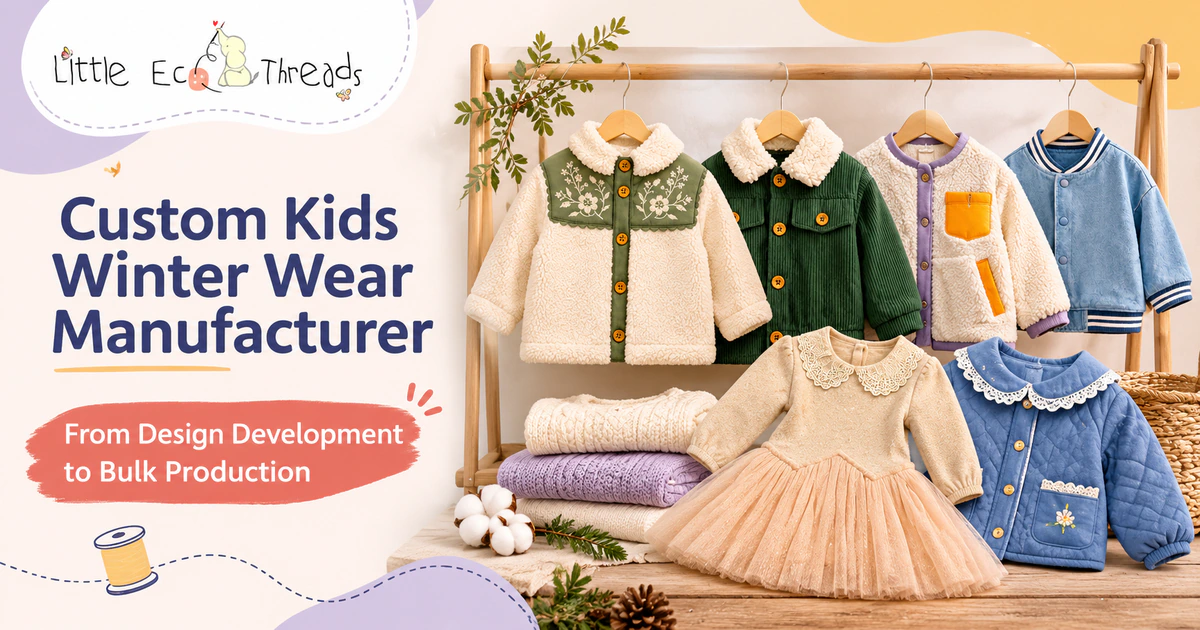
Sherpa jackets and sherpa vests give a brand a soft, textured look that layers easily. Quilted jackets and quilted vests offer a lighter, more structured silhouette suited to cool and transitional weather. Corduroy jackets and coats add a heritage, workwear-inspired character, and combining a corduroy body with a sherpa collar or lining creates a hybrid design that feels distinct from a standard fleece. For the colder end of a range, padded and puffer jackets and fleece-lined coats give buyers a clear warmth story.
Knitwear and layering: the volume builders
Cable-knit pinafore dresses, cable-knit joggers, quilted button cardigans, and waffle-knit sweatshirts and joggers generally sit at a lower price point than outerwear, which makes children's knitwear a practical way to widen a range. A cable-knit pinafore with matching cable-knit joggers, for example, lets one fabric decision generate several SKUs.
Muslin and quilted separates: the transitional layer
Muslin dresses and rompers, quilted baby joggers and thermal base layers do two things. They work beneath heavier outerwear in colder markets, and they extend a collection's selling window into milder weather.
Thinking in roles (hero outerwear, volume knitwear, transitional separates) helps a brand balance risk, price architecture and order quantities.
For buyers, this assortment should also be evaluated against the collection's intended price points and sales channels. A premium outerwear style may act as the visual lead, while coordinated separates create accessible entry points for retailers. Planning these roles early helps teams decide where custom details will add value and where a simpler construction will protect the target cost. It also makes forecasting more disciplined: brands can identify the styles that deserve deeper quantities and keep experimental designs at a more cautious level.
Design Development and Customisation: Turning Brand Ideas into Manufacturable Garments
Most winter ranges begin as a mood board, a set of sketches, a competitor garment or a tech pack of varying completeness. The first job of a manufacturer's development team is to translate that material into something that can be cut, sewn and repeated across thousands of units. Good custom manufacturing support works with whatever the brand brings, whether that is a finished tech pack or only a reference image.
Silhouette and construction
Silhouette decisions have practical consequences in winter garments. A boxy jacket with a hood needs different pattern allowances from a fitted quilted gilet, because bulk at the seams, collar and cuffs changes how the garment hangs and moves.
Colour, surface detail and trims
Colour palettes should be set for the whole collection, not garment by garment. The same shade can look different on corduroy, sherpa and knit, so Pantone referencing and fabric-specific colour approvals help keep a range visually coherent. Surface details such as prints, embroidery and appliqué give a brand recognisable identity. The winter catalogue shows examples of this approach, including an embroidered floral yoke on a sherpa jacket and a sherpa puppy appliqué on a denim jacket.
Trims deserve the same attention. Wooden buttons, snaps, zips and ribbed finishes affect cost, handling and perceived quality, and for children's garments they also affect safety.
Building coordinated ranges
Distinctive design does not require every garment to be unique. Shared colour stories, repeated trims and a common fabric across two or three styles (a cable-knit pinafore and matching joggers, for instance) give a collection visual consistency and keep development cost manageable.
Choosing the Right Fabrics for Winter Clothing
Fabric selection determines how a winter garment is constructed, how warm and heavy it feels, how it looks on the rail, how well it holds up to wear and washing, and what it costs.
| Fabric | Typical role in a winter range | Development considerations |
|---|---|---|
| Sherpa and fleece | Jackets, vests, collars, hood and body linings | Pile height affects bulk, cutting and sewing, and how the garment sits at seams |
| Quilted fabrics | Jackets, vests, cardigans, joggers | Outer fabric, filling and backing work as a system; stitch pattern influences loft and durability |
| Corduroy | Jackets and coats | Rib width changes appearance; usually paired with lining for warmth |
| Knit and cable-knit | Pinafores, joggers, cardigans | Textured knits use more material and affect weight and cost |
| Waffle-knit | Sweatshirts and joggers | Surface texture gives visual interest in a mid-layer |
| Merino blends | Knitwear and base layers | Chosen for softness and lightweight warmth; blend ratios are a brief-level decision |
The filling used in quilted and padded garments deserves particular scrutiny. It affects warmth, weight, how evenly the garment lies, and how it behaves after repeated washing. Brands should ask for the filling specification in writing and approve it at sample stage, instead of assuming a standard.
Linings and layering materials are easy to overlook, yet they influence comfort against the skin and how a garment slides over other layers.
Finally, request physical swatches before committing. A fabric's hand, drape and colour are hard to judge from a digital image, and approving them in hand reduces surprises later. Little Eco Threads offers free fabric swatches for this purpose.
The fabric brief should record composition, weight, finish, colour and care instructions. For brushed or pile fabrics, buyers should also review surface consistency and shedding. When several materials appear in one outfit, assess them together to ensure the pieces coordinate in colour, texture and overall feel.
From Design Concept to Sampling: Where Winter Collections Are Won or Lost
Sampling is the stage at which a design stops being an idea and becomes a garment that can be measured, worn and criticised. For winter clothing it matters more than for lightweight basics, because padding, lining, quilting and trims interact in ways a drawing cannot predict. Finding a problem on one sample costs a few days. Finding the same problem across a bulk order costs a season.
Technical specifications. The process starts with a tech pack or equivalent document: measurements by size, construction notes, stitch details, a bill of materials covering fabric, filling, lining and trims, plus label and packaging placement.
Pattern development and grading. Patterns are cut for the base size and then graded across the full range.
First sample and review. The first sample is checked against the specification for measurements, then assessed for fit, fabric handle, quilting appearance, zip and button function, colour and finishing.
Revisions and approval. Most winter styles need at least one correction round. Once the brand is satisfied, the signed-off sample becomes the reference standard for bulk production.
The custom manufacturing process at Little Eco Threads follows this sequence of design and development, sampling, production and delivery, with sample revisions included before bulk begins.
Planning Bulk Production for Winter Collections
Once samples are approved, the work shifts from development to repeatability. The objective of bulk production is to make every garment in the order match the approved sample, on schedule and within cost.
Materials and trims first. Fabric and trim availability should be confirmed before production is scheduled. Speciality items such as custom hardware, quilted fabrics and coloured corduroy can take longer to source or develop than standard materials, so they set the real start date.
Sizes and quantities. Size breakdowns should be agreed per style and colour. Minimum quantities are normally set per design, so brands launching a first winter range need to balance range breadth against depth.
Consistency and inspection. Consistency comes from clear standards (approved samples, measurement tolerances, colour references) and from inspection during production instead of only at the end. Inline checks catch stitching, fabric or construction drift while it can still be corrected. Finishing and packaging then complete the process: trimming, pressing, labelling, hang tags and carton packing to the brand's requirements.
A production plan should allow time for material approval, cutting, sewing, finishing, inspection and packing. Brands should also agree how changes will be managed after approval. Alterations to fabric, colour, measurements or trims can affect both cost and delivery, so they should be documented and approved before production proceeds.
Working backwards from the launch date. Seasonal production is a scheduling exercise. Little Eco Threads states on its website that production lead times run between 45 and 90 days and that finished orders ship worldwide by sea or air; the actual timeline for any winter style depends on fabric, quantity and complexity, and should be confirmed when the order is quoted.
Quality Control in Children's Winter Clothing
Quality control protects a brand's margins and reputation. A sound quality process defines what "acceptable" means before production starts and checks against that definition at several points.
The main areas to define and inspect include:
- Stitching and seams: consistent stitch density, secure seam allowances and reinforced stress points such as pocket corners, underarms and zip ends.
- Fabric and filling: even filling distribution in quilted and padded styles, no fabric flaws, and sherpa or fleece pile that is consistent across panels.
- Zips, buttons and snaps: firm attachment, smooth operation, and closures that suit the garment and the age group.
- Measurements: checks against the approved spec and agreed tolerances, by size.
- Colour: shade consistency within a garment and between production batches, compared against approved references.
- Finishing and appearance: clean thread ends, flat pressing, correct label placement and presentable packing.
- Durability: how the garment looks after handling and, where the brand specifies it, after washing.
For international orders, keep inspection records and test reports organised by style and shipment. This creates a clear record of the specification used and any corrective action taken. It is also useful when a winter design is reordered or adapted for another market.
Safety and compliance need separate attention. Requirements for children's apparel vary by destination market and product type. Rules covering drawstrings and cords, small parts, labelling and flammability do not apply identically in the USA, UK, Europe and Australia. The brand, as the party placing the product on the market, should define the applicable requirements in its specification and confirm testing with an accredited laboratory for each market. A manufacturer can support this by building in safer design choices, such as secure closures, covered zip pulls and appropriate lining options, which Little Eco Threads lists among the safety-focused details of its winter range.
Why Choose Little Eco Threads as Your Winter Clothing Manufacturing Partner?
Little Eco Threads is a baby and children's clothing manufacturer supplying brands in Europe, the US and Australia. Its website reports more than 25 years of experience and over 100 brands served, and lists GOTS, GRS and Sedex certification. As with any certification, brands should confirm its scope for the specific fabrics and styles in their own order, since it does not automatically apply to every garment.
A winter catalogue built around layering
The winter collection currently shows more than 30 designs. These include sherpa jackets and a colourblock sherpa vest, quilted jackets and vests, corduroy jackets and a hooded corduroy coat, and denim and chambray jackets. On the knitwear and layering side, it features a cable-knit pinafore dress with matching cable-knit joggers, waffle-knit sweatshirts and joggers, a quilted button cardigan and quilted baby joggers. The website describes these as illustrative products made to order, and states that any design, material or style can be modified. Catalogue listings show a minimum order of 100 pieces per design.
Beyond the catalogue, the winter page lists manufacturing services for padded and puffer jackets, fleece-lined coats and gilets, knitwear and merino styles, and base layers and thermals. These are capabilities Little Eco Threads offers on request rather than designs displayed in the catalogue, so brands interested in them should share a brief and reference garments. The company also offers a broader knitwear collection for year-round ranges.
Support from development to delivery
The custom manufacturing service covers pattern making and grading, fabric sourcing and development, printing, embroidery, appliqué, custom trims, buttons and zippers, Pantone colour matching, private labelling, hang tags and custom packaging. Sizes run from 0–3M to size 13. The process is built for both new brands launching a first range and established labels extending an existing line, with sampling, quality control during production, and worldwide freight by sea or air. For brands building a private label winter clothing range, this means one kids winter clothing manufacturer can handle children's winter wear manufacturing from the first pattern to the labelled carton.
Building a Winter Collection with the Right Manufacturing Partner
A successful winter range depends on decisions made long before bulk production starts: which categories carry the collection, which fabrics suit each garment, how designs are specified, and how samples are approved. A manufacturer that understands this whole process helps a brand turn design intent into a commercially viable collection, and reduces the risk of costly corrections once fabric is cut.
If you are planning an upcoming season, contact Little Eco Threads to discuss your winter collection, share a tech pack or reference garments, and talk through your manufacturing requirements.