From a Small Test Launch to a Growing Private Label Brand
Launching a private label baby or kidswear brand does not always need to begin with a large collection or heavy inventory commitment. For many retailers, the better route is to start with a focused test range, learn from the market, and scale the styles that prove demand.
This case study shows how Little Eco Threads helped an Australian retailer build its own baby essentials brand, starting with 5 muslin swaddle designs and approximately 100 pieces per style, then growing into a multi-category private label business with production volumes of 1,000 pieces per SKU.
The Challenge: Testing a New Category Without Overcommitting
The retailer wanted to enter the baby essentials category with its own private label brand. The challenge was not simply how quickly the business could scale. The real question was how to test the idea without committing to large production quantities at the beginning.
The retailer needed a launch plan that could:
- Test customer demand before increasing production volumes
- Start with a curated product range instead of a large portfolio
- Keep initial inventory risk manageable
- Work with a manufacturer capable of supporting larger production later
The objective was straightforward: start small, test the market, and scale as demand grows.
The Solution: A Focused Muslin Swaddle Launch
The retailer chose muslin swaddles as the starting point for its baby essentials collection. It was a practical first category because muslin swaddles have clear consumer appeal, strong gifting potential, and manageable production requirements for a test launch.
The first collection was deliberately controlled:
| Launch Element | Starting Point |
|---|---|
| Product category | Muslin swaddles |
| Initial range | 5 designs |
| Starting quantity | Approximately 100 pieces per style |
| Goal | Test customer response before scaling |
Little Eco Threads supported the retailer across the early production process, including product development, concept refinement, sampling, pre-production preparation, manufacturing, and quality control.
This gave the retailer a practical starting point without forcing the business into unnecessary inventory risk.
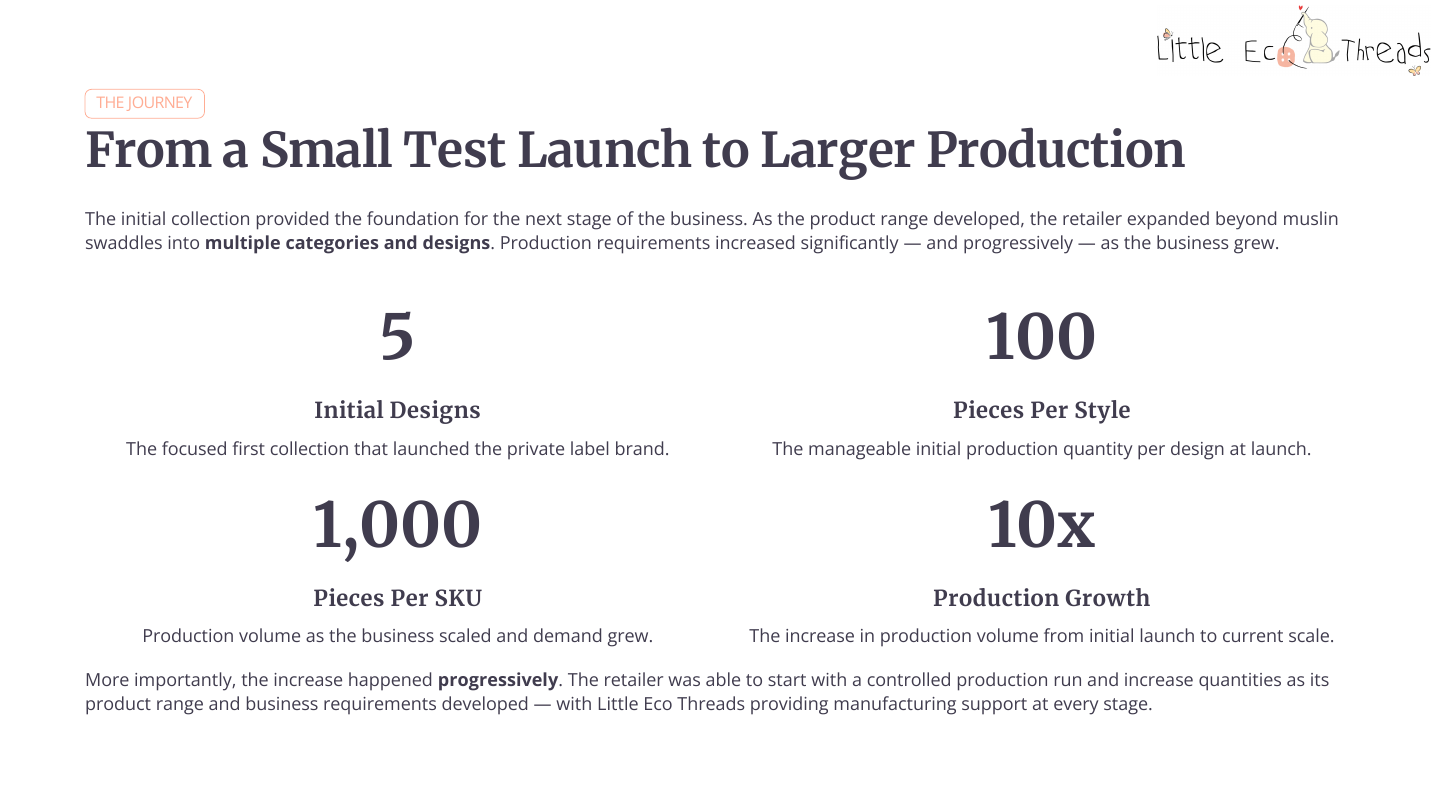
The Journey: From 100 Pieces Per Style to 1,000 Pieces Per SKU
Once the first collection reached the market, the retailer had a foundation for the next stage of growth. As customer response developed, the product range expanded beyond muslin swaddles into multiple baby essentials categories and designs.
Production volumes increased progressively:
- 5 initial designs launched the private label range
- Approximately 100 pieces per style kept the first run manageable
- 1,000 pieces per SKU became the later production volume
- Production grew by roughly 10x from the original test launch
The important part was the pace. The retailer did not need to jump from concept to high-volume production immediately. It could validate the range first, then increase quantities as confidence and demand grew.
The Results: A Growing Multi-SKU Baby Essentials Business
The retailer has progressed from a small, focused launch to a growing private label baby essentials business with multiple product categories and designs.
The clearest sign of progress was the shift from approximately 100 pieces per style to 1,000 pieces per SKU. That growth reflected stronger confidence in the product range, clearer market response, and a manufacturing setup that could support larger requirements.
For Little Eco Threads, the work was not only about producing more units. It was about helping the retailer move through each stage without losing consistency, quality, or control.
What Little Eco Threads Brought to the Process
The retailer needed a manufacturing partner that could support the business from first sample through larger production runs.
Little Eco Threads supported the process through:
- Product development: Helping turn the baby essentials concept into a production-ready collection, with attention to design, fabric, and market fit.
- Sampling: Preparing and refining products before production so the final output matched the brand's vision.
- Scalable production: Producing the initial collection and supporting larger quantities as demand grew.
- Quality control: Maintaining consistency from the first 100-piece run through higher-volume production.
- Certified and responsible manufacturing: Supporting international expectations for responsible sourcing, traceability, and ethical production.
- International market knowledge: Applying export experience across global markets, including Australia, the EU, and the US.
What Retailers Can Learn
This case study is a useful model for retailers considering a private label baby or kidswear launch.
Test before scaling
Start with manageable quantities and understand how customers respond before committing to larger runs.
Use market response to guide decisions
Customer demand helps identify which products are worth developing further.
Expand gradually
Once the concept is validated, growth can happen through additional categories, designs, and higher production volumes.
Choose a partner built for growth
Your manufacturer should be able to support both the first controlled production run and the larger requirements that come later.
Build Your Own Private Label Baby Brand
Whether you are launching your first private label product or expanding an existing collection, Little Eco Threads can help take your product from concept to production.
We support retailers through product development, sampling, manufacturing, quality control, and larger-scale production.