GOTS Certification Guide for Kidswear Brands
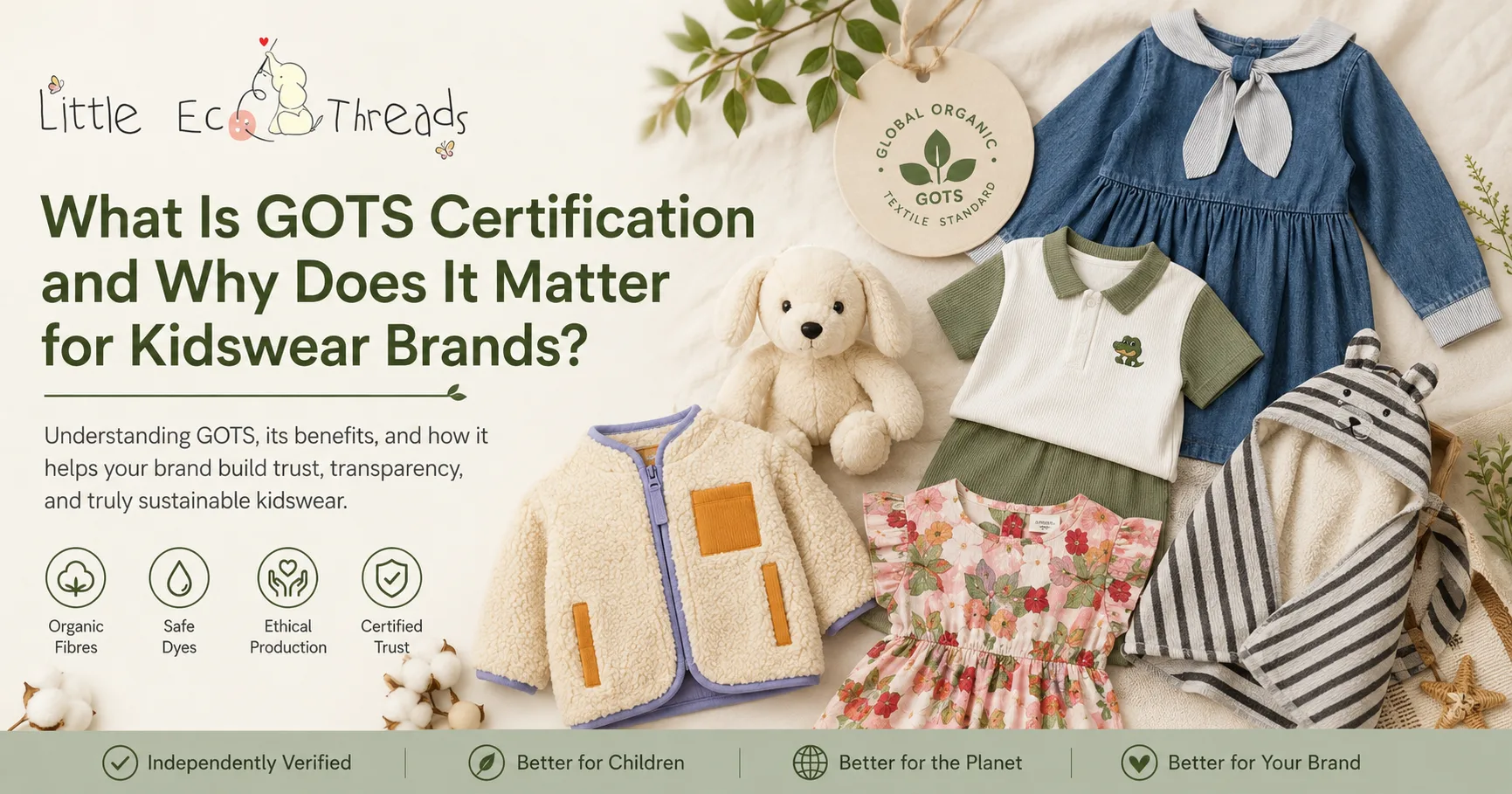
GOTS certification matters because words like "organic," "sustainable," and "eco-friendly" are easy to put on a hangtag. For kidswear brands, retailers, and founders sourcing baby or children's clothing, the harder question is whether the organic cotton claim has been checked, documented, and verified through the supply chain.
GOTS stands for Global Organic Textile Standard. Global Standards, the organisation behind GOTS, describes it as a standard for organic textiles with published material, processing, environmental, social, traceability, and labelling requirements inside the certified scope.
For children and babywear, that distinction is important. Parents care about what touches a child's skin. Retail buyers care about whether sustainability claims can be substantiated. Brand founders need a manufacturing partner who can explain what is certified, what is not certified, and which documents support the claim.
What Is GOTS Certification?
GOTS is a voluntary textile standard used for organic textiles. It is not the same as simply saying a garment is made from organic cotton.
Organic cotton describes how the fibre was grown. GOTS certification looks at what happens after the fibre enters textile processing. Depending on the certified scope, this can include spinning, knitting, weaving, dyeing, printing, finishing, cutting, sewing, trading, and labelling.
That is why a product can use organic cotton without the finished garment being GOTS certified. If the chain of certified operators breaks at the spinning mill, dye house, fabric supplier, garment factory, or trading stage, the finished product claim may not be supported.
For a kidswear brand, the practical question is not only "Do you use organic cotton?" It is "Can you show current GOTS documentation for the material, facility, and product scope involved in my order?"
What GOTS Certification Covers
GOTS certification is a framework for organic textile processing and traceability. It can cover more than the fibre itself when the full supply chain is properly certified.
| Area | What Brands Should Understand |
|---|---|
| Organic fibre content | GOTS is used for textiles containing certified organic fibres, with labelling rules depending on the organic fibre percentage and claim. |
| Processing stages | Spinning, knitting, weaving, dyeing, printing, finishing, cutting, sewing, and trading may need certification depending on the product route. |
| Chemical inputs | Processing chemicals, dyes, auxiliaries, and finishes must meet the relevant GOTS criteria within the certified scope. |
| Environmental criteria | Certified processing sites are assessed against environmental management requirements. |
| Social criteria | GOTS includes social criteria in certified operations, which helps connect organic claims with responsible sourcing expectations. |
| Traceability | Certified material must be documented through the supply chain so brands can support their product claims. |
| Labelling | Product labels and claims must match what the certificate and transaction documents actually support. |
This is where precision matters. GOTS certification does not mean every possible part of a garment has been assessed in every possible way. Certificate scope matters. Trims, packaging, branding claims, and mixed-material products need careful review before a brand makes a public claim.
Why GOTS Matters For Kidswear Brands
For general apparel, certification can be a differentiator. For organic kidswear and baby clothing, it is often closer to a trust signal buyers expect to see.
Kidswear is worn close to the skin, washed frequently, and often bought by parents who are cautious about material claims. If a brand says a baby bodysuit, romper, swaddle, or pajama is organic, buyers may reasonably ask what proof supports that claim.
GOTS helps brands answer that question with third-party documentation rather than marketing language alone. It can support:
- Organic cotton and organic kidswear claims
- Buyer confidence in sustainable kids clothing
- Stronger retailer due diligence
- Reduced greenwashing risk
- More credible sustainable fashion supply chain communication
- Clearer sourcing conversations with a manufacturer
Brands using GOTS certified organic cotton should still ask what the certification covers. A fabric certificate, a factory certificate, and finished product certification are not always the same thing.
Is Organic Cotton The Same As GOTS Certified Organic Cotton?
No. Organic cotton and GOTS certified organic cotton are related, but they are not identical.
Organic cotton usually refers to the farming stage. GOTS certified organic cotton refers to organic fibre moving through a certified textile supply chain under the relevant GOTS rules.
Here is the useful distinction:
| Term | Meaning |
|---|---|
| Organic cotton | Cotton grown under organic farming standards. |
| Certified organic fibre | Organic fibre status verified through a recognised organic certification route. |
| GOTS certified fabric | Fabric processed by certified operators within the relevant scope. |
| GOTS certified baby clothing | Finished baby clothing where the certified supply chain and labelling claim are properly supported. |
This is why documentation matters as much as the material. A brand should ask for current certificates, the scope, and transaction-level paperwork where needed. Without that, an organic cotton claim can become too vague for serious retail or compliance review.
GOTS Compared With GRS, OEKO-TEX, Sedex, SMETA And BSCI
GOTS is only one part of the certification and audit landscape. Other standards answer different questions.
| Standard Or Framework | Main Focus | How It Differs From GOTS |
|---|---|---|
| GRS | Recycled material content and chain of custody | GRS is for recycled inputs, not organic cotton. Textile Exchange says GRS includes a higher minimum recycled-content threshold and social, environmental, and chemical processing requirements. |
| OEKO-TEX STANDARD 100 | Testing textiles for harmful substances | OEKO-TEX is about tested product safety; it does not prove a fibre is organic or recycled. |
| Sedex and SMETA | Responsible sourcing and social audit methodology | Sedex and SMETA help assess supplier sites; they are not organic textile product certifications. |
| amfori BSCI | Social compliance monitoring | BSCI focuses on supplier social performance rather than certifying a textile fibre or finished garment. |
A strong kidswear manufacturer may work with several types of documentation depending on the product. GOTS and GRS certifications can support organic or recycled material claims, while Sedex, SMETA, and amfori BSCI are more relevant to factory-level ethical manufacturing and responsible sourcing.
What To Ask A Kidswear Manufacturer About GOTS
Before choosing a kidswear manufacturer, ask specific questions. The goal is to verify the claim, not just hear the word "certified."
- Is your facility GOTS certified, or is only the fabric supplier certified?
- Can you share the current certificate?
- What company, address, facility, and product categories are listed?
- Does the scope cover the product I want to produce?
- Which certified fabric supplier will be used?
- Can the certificate be verified through the certifying body or official database?
- Will transaction documentation be available for my order?
- Are trims, labels, and packaging included in the certified claim?
- Are OEKO-TEX STANDARD 100, GRS, Sedex, SMETA, or amfori BSCI documents relevant for this product?
- What claim can my brand safely make on the product page, label, and packaging?
These questions are especially important for private label baby clothing, where your brand name appears on the garment and the claim belongs to your business in front of the customer.
Common Mistakes With GOTS Claims
The biggest risk is treating GOTS as a broad marketing badge instead of a scoped certification.
Common mistakes include:
- Saying "GOTS certified" when only the raw cotton is organic
- Assuming a fabric certificate covers the finished garment
- Forgetting that each supply-chain operator may need valid certification
- Making claims about trims or packaging that are outside the certificate scope
- Using the GOTS name or logo without checking labelling approval requirements
- Treating Sedex, SMETA, or BSCI as product certifications
- Using "sustainable" language without matching it to documentation
For sustainable children's clothing brands, careful wording protects credibility. A precise claim supported by documents is stronger than a broad claim that cannot be verified.
Where Little Eco Threads Fits
Little Eco Threads works with babywear and kidswear brands that need practical production support, certified material options, and clearer documentation conversations before manufacturing begins.
For founders comparing organic kidswear suppliers, the right partner should help you understand:
- Which organic cotton options are available
- Whether GOTS certified fabric is suitable for the product
- What documentation can be shared
- Whether GRS is relevant for recycled materials
- When OEKO-TEX STANDARD 100 testing may support skin-contact reassurance
- How certification choices affect MOQ, cost, lead time, and sampling
This matters because certification is only useful when it connects to real production. A manufacturer still needs strong sampling, quality control, communication, and realistic planning.
If your brand is developing organic babywear, sustainable kidswear, or private label baby clothing, request a production quote and share your fabric, certification, MOQ, and launch requirements.
FAQ: GOTS Certification For Kidswear
What does GOTS certification mean?
GOTS certification means a textile product, material, process, or facility has been assessed against the Global Organic Textile Standard within a defined scope. Brands should check what the certificate covers before making a claim.
Is GOTS certification important for kidswear?
Yes, it can be very relevant for kidswear because baby and children's clothing is worn close to the skin and often marketed around organic or sustainable materials. GOTS gives brands stronger evidence behind those claims.
Is organic cotton automatically GOTS certified?
No. Organic cotton describes the fibre's farming origin. GOTS certification also involves certified textile processing, traceability, and labelling requirements through the relevant supply chain.
What is the difference between GOTS and OEKO-TEX STANDARD 100?
GOTS focuses on organic textile processing and certified organic claims. OEKO-TEX STANDARD 100 focuses on harmful-substance testing for textiles and components, regardless of whether the fibre is organic.
What is the difference between GOTS and GRS?
GOTS is used for organic textile claims. GRS, or Global Recycled Standard, is used for recycled material claims. A recycled polyester garment is not GOTS certified simply because it uses recycled content.
Is Sedex or SMETA the same as GOTS?
No. Sedex is a responsible sourcing platform and SMETA is an audit methodology. They can help review factory practices, but they do not certify organic textile content.
How can I verify whether a manufacturer is GOTS certified?
Ask for the current certificate, check the listed company and facility, read the scope, confirm the product category, and verify the certificate through the certifying body or official database before relying on the claim.