
Why GOTS Certification Matters for Dyeing
Why should you care about GOTS certification for baby clothes? Here’s why:
- Safety First: Conventional dyeing leaves harmful residues like azo dyes, formaldehyde, and heavy metals in fabrics. GOTS-certified dyeing bans these chemicals, making clothes safer for babies’ sensitive skin.
- Eco-Conscious Practices: GOTS requires wastewater treatment and low-impact dyes, reducing pollution and conserving resources.
- Ethical Standards: GOTS certification ensures fair wages and safe working conditions for workers.
- Trustworthy Labeling: With annual inspections and strict rules, GOTS certification guarantees transparency and quality.
For parents, this means peace of mind knowing their baby’s clothes are safer, and for brands, it’s a way to stand out with proven ethical practices.
Problems with Standard Dyeing Methods for Baby Clothing
Toxic Chemical Residues in Fabrics
The standard dyeing process in the textile industry relies heavily on azo dyes, which make up 60% to 70% of all synthetic dyes used globally. Unfortunately, these dyes often contain harmful substances like aromatic amines, benzidine-based dyes, and heavy metals such as lead, mercury, and cadmium. Even after the dyeing process, fabrics can retain toxic residues, including formaldehyde, phthalates, flame retardants, and chemical fixatives.
Tests on imported children's clothing have revealed formaldehyde levels exceeding 500 ppm - far above the recommended safety limit of 75 ppm set by international standards. While pre-washing can help, it only removes about 60% of surface-level chemical residues.
"Some of these dyes have been found to release aromatic amines, which are considered carcinogenic and may pose a risk of cancer development." - Reshma Koradia, Founder, Bébénca Organics
Allergies and Health Problems in Infants
Infants' delicate skin is particularly vulnerable to the chemicals in dyed fabrics. Their skin is thinner and more permeable than that of adults, allowing harmful substances to penetrate more easily. Additionally, newborns have a higher surface area-to-body weight ratio - three times that of adults - making them more susceptible to the effects of these chemicals.
Dr. Rashmi Sarkar, Professor and Head of Dermatology at Maulana Azad Medical College, explains: "Children's skin has unique characteristics that make it more susceptible to irritation from chemicals. The stratum corneum - the outermost protective layer - is thinner and more permeable in young children, allowing substances to absorb more readily into deeper skin layers".
The health risks go beyond immediate reactions like rashes or contact dermatitis. Long-term exposure to these chemicals can lead to more serious issues, including cell mutations and cancers affecting vital organs like the bladder, liver, and kidneys.
Environmental Damage from Standard Dyeing
The environmental toll of conventional dyeing methods is staggering. These processes consume enormous amounts of water and often release untreated wastewater filled with toxic dyes and fixatives into nearby rivers. This wastewater contains heavy metals, formaldehyde, and petrochemicals, which severely harm aquatic ecosystems.
Adding to the problem, many of the chemicals used in standard dyeing are non-biodegradable, causing long-term environmental buildup. Plastisol prints, which contain PVC and phthalates, contribute to microplastic pollution. Even before the dyeing stage, cotton production requires 16% of the world’s insecticides despite using just 2% of global farmland.
"Conventional dyeing consumes massive amounts of water, uses toxic fixatives, and releases untreated wastewater into rivers." - Cotton Monk
While the European Union has implemented the REACH regulation to ban 24 carcinogenic azo dyes, the United States currently lacks a similar federal ban. This gap underscores the importance of third-party certifications to ensure safer practices. The environmental and health issues tied to standard dyeing methods highlight the urgent need for safer, more responsible alternatives.
Understanding GOTS Certification for Dyeing
GOTS Requirements and Standards
The Global Organic Textile Standard (GOTS) oversees every phase of textile production, from dyeing and manufacturing to trading. To achieve certification, textiles must contain at least 70% certified organic fibers for the "made with organic" label or 95% or more for the "organic" label.
The dyeing and finishing process is under the closest watch because it involves significant water and chemical usage, making it the most critical stage in textile production. Every chemical input - whether it's dyes, pigments, inks, or auxiliaries - requires approval from a GOTS-accredited certifier before use. By June 2020, more than 24,000 chemical inputs from over 700 suppliers had earned GOTS approval.
To maintain certification, manufacturers must provide detailed records of chemical use, water and energy consumption, and waste management. Annual on-site inspections ensure compliance with these requirements. This rigorous process applies to every chemical input, as further explained in the section on permitted dyes.
Permitted Dyes and Chemical Restrictions
GOTS enforces a strict "No hazard in, no hazard out!" principle, which ensures that harmful chemicals are excluded from both the production process and the final product. The standard bans substances like toxic heavy metals, formaldehyde, aromatic solvents, phthalates, functional nanoparticles, genetically modified organisms (GMOs), and azo dyes that release carcinogenic components. These restrictions are especially important for creating safer, eco-friendly products like baby clothing.
Only oxygen-based bleaching methods, such as those using peroxide or ozone, are allowed - chlorine-based bleaches are strictly prohibited. Similarly, printing methods cannot involve phthalates, aromatic solvents, or chlorinated plastics like PVC. To protect biodiversity, natural dyes derived from species listed on the IUCN Red List are also banned.
Synthetic dyes that are approved by GOTS must meet stringent toxicity and biodegradability standards. Many manufacturers prefer fiber-reactive dyes due to their high absorption rates and low heavy metal content. For sizing operations, at least 75% of the agents used must be of natural origin.
Labor and Environmental Requirements
GOTS extends beyond chemical regulations to include strong labor and environmental standards. The certification requires adherence to social criteria that promote fair labor practices. Harmful processes, such as sandblasting, are prohibited to protect workers' health.
Wet-processing facilities must treat wastewater in a fully operational Effluent Treatment Plant (ETP) before releasing it. These facilities are required to monitor key wastewater parameters to ensure safe disposal. Additionally, manufacturers must maintain detailed records on chemical usage, water and energy consumption, and sludge management.
The latest update, GOTS Version 8.0, was introduced in March 2026. This version includes stricter criteria for chemical use, climate considerations, and circularity requirements. By 2025, there were 17,800 GOTS-certified facilities worldwide, marking a 15% increase in certified operations globally.
Advantages of GOTS-Certified Dyeing for Baby Apparel
Safer Products for Baby Skin
Did you know that a baby's skin is about 30% thinner and more absorbent than an adult's? This makes infants much more vulnerable to harmful substances in clothing dyes. GOTS-certified dyeing addresses this concern by banning toxic heavy metals like lead, cadmium, chrome, and nickel, as well as formaldehyde and azo dyes, which can break down into carcinogenic compounds.
Another key feature of GOTS-approved dyes is that many are fiber-reactive. These dyes chemically bond with the fabric instead of just sitting on the surface, which means there’s less risk of dye transferring to a baby’s skin through sweat or friction. Additionally, GOTS standards ensure the pH levels in finished fabrics are regulated to minimize skin irritation. These steps align with GOTS's goal of creating safer and more sustainable products for babies.
"We see a significant number of children with contact dermatitis and unexplained rashes that can be traced back to clothing. Organic cotton, particularly GOTS-certified varieties, eliminates many common irritants and is what I recommend for children with sensitive skin or conditions like eczema." - Dr. Rashmi Sharma, Pediatric Dermatologist, Rainbow Children's Hospital
Reduced Environmental Impact
GOTS-certified dyeing isn’t just about baby safety - it’s also a win for the planet. Facilities certified by GOTS are required to treat wastewater to strict standards before releasing it, which helps protect local water systems and ecosystems. Plus, the fiber-reactive dyes used in this process are highly efficient, achieving at least 70% absorption and functioning at lower temperatures - just 86°F (30°C) - compared to conventional dyes that require boiling temperatures of 212°F (100°C). This results in significant energy savings.
Another major advantage is water conservation. Organic cotton production that incorporates GOTS-certified dyeing uses up to 95% less water than traditional methods. On top of that, GOTS mandates the use of oxygen-based bleaching instead of chlorine-based alternatives, reducing toxic residues in waterways. These eco-friendly practices are part of the rigorous GOTS guidelines.
Stronger Brand Reputation
For brands, the benefits of GOTS certification extend beyond safety and sustainability - it’s also a powerful tool for building trust. As the leading global standard for organic textiles, GOTS certification instantly signals credibility in the ethical fashion industry. It reassures parents that the products meet strict safety standards, which is especially important for those prioritizing their child’s health.
Moreover, GOTS certification helps brands avoid accusations of greenwashing by providing transparent, third-party verification of ethical production practices throughout the supply chain. This transparency resonates with conscious consumers who see their purchasing decisions as part of mindful parenting. For instance, in 2023, Nature Baby reported that 99% of its products were made from sustainable fibers, with 89% being certified organic - a testament to how GOTS certification can set a brand apart in the market.
"GOTS certification is backed by in-depth standards developed by credible organizations. Recognized internationally, it serves as a trusted benchmark for consumers seeking ethical and sustainable textiles." - Design Delight Studio
The Hidden Chemicals in Baby Clothing
GOTS-Certified Dyeing vs. Standard Dyeing Methods
Side-by-Side Comparison
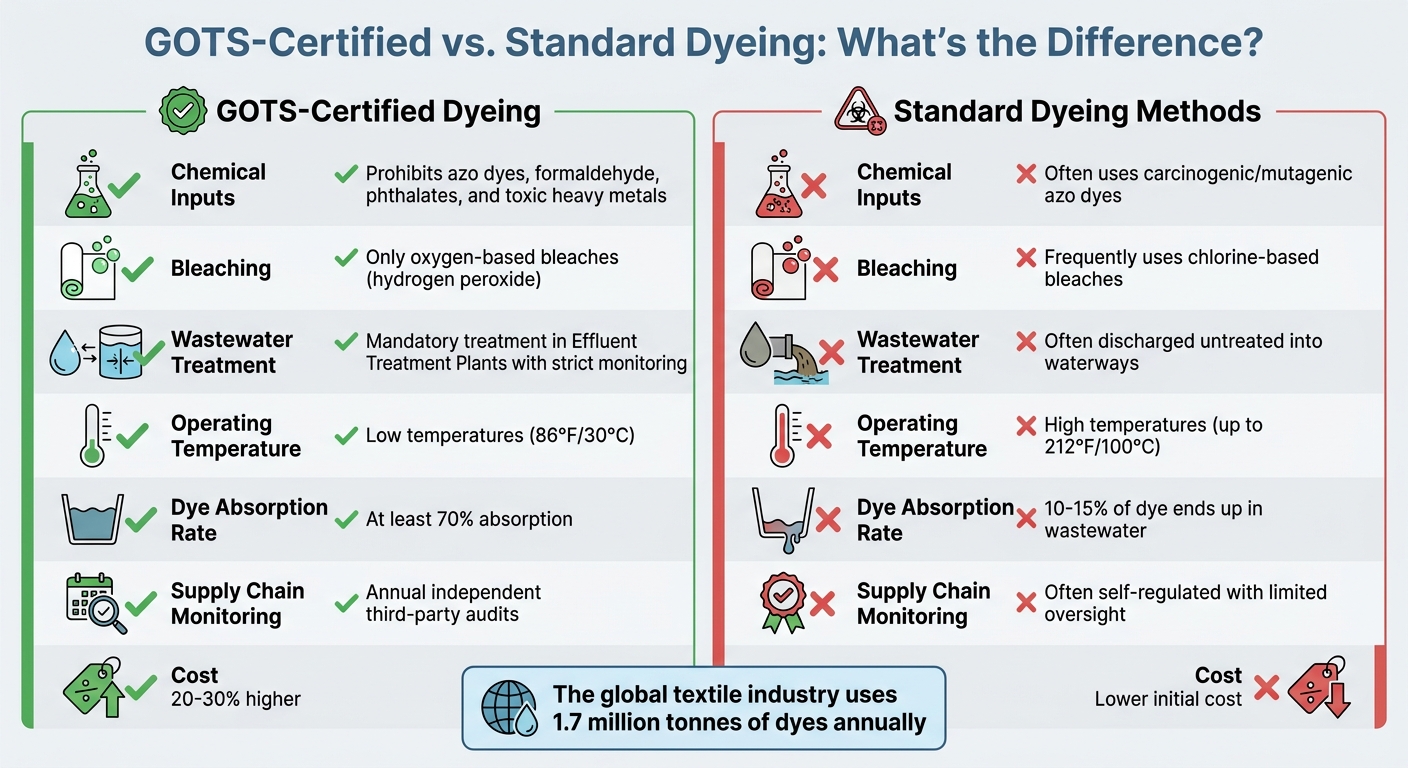
When it comes to choosing between GOTS-certified and standard dyeing methods, understanding their differences helps make safer and more environmentally conscious decisions - especially for baby clothing. These differences impact everything from chemical exposure to the broader environmental toll of production.
The standout distinction lies in chemical safety. GOTS-certified dyeing strictly prohibits harmful substances like azo dyes, toxic heavy metals, formaldehyde, and phthalates. In contrast, conventional methods often rely on these compounds.
As noted by Botanical Clothing:
"Using organic GOTS dyes is important because most dyes used today are still Azo dyes, which are carcinogenic, mutagenic (meaning they disrupt the DNA in a cell), and do not break down easily." - Botanical Clothing
Environmental practices also set these methods apart. GOTS-certified facilities are required to treat wastewater through Effluent Treatment Plants, which monitor factors like pH, temperature, and biological oxygen demand before releasing water back into the environment. On the other hand, standard dyeing processes - especially in regions with limited regulations - often discharge untreated chemical waste into local waterways. Additionally, GOTS-certified processes exclusively use oxygen-based bleaches, such as hydrogen peroxide, while conventional methods frequently rely on chlorine-based bleaches.
Energy use is another critical factor. GOTS-approved fiber-reactive dyes operate at lower temperatures - around 86°F (30°C) - compared to the boiling temperatures (212°F/100°C) required for standard dyes. This lower temperature not only saves energy but also reduces environmental strain. Furthermore, GOTS-certified dyes achieve a dye absorption rate of at least 70%, meaning less dye ends up as waste. Conventional methods, however, often waste 10–15% of the dye during the process. These differences translate to a safer product for sensitive baby skin and a smaller environmental footprint.
Here’s a side-by-side comparison of the key differences:
| Feature | GOTS-Certified Dyeing | Standard Dyeing Methods |
|---|---|---|
| Chemical Inputs | Prohibits azo dyes, formaldehyde, phthalates, and toxic heavy metals | Often uses azo dyes, which can be carcinogenic or mutagenic |
| Bleaching | Only oxygen-based bleaches (e.g., hydrogen peroxide) allowed | Frequently uses chlorine-based bleaches |
| Wastewater Treatment | Mandatory treatment in Effluent Treatment Plants with strict monitoring | Often discharged untreated into waterways |
| Operating Temperature | Low temperatures (approx. 86°F/30°C) for fiber-reactive processes | High temperatures (up to 212°F/100°C) required |
| Dye Absorption Rate | At least 70% absorption, reducing waste | 10–15% of dye typically ends up in wastewater |
| Supply Chain Monitoring | Annual independent third-party audits ensure full traceability | Often self-regulated with limited oversight |
While GOTS-certified dyeing can cost 20–30% more, this added expense ensures a safer, more environmentally responsible product. With the global textile industry consuming approximately 1.7 million tonnes of dyes annually, these considerations carry significant weight.
GOTS-Certified Dyeing at Little Eco Threads
Certified Fabric Testing and Color Matching
Little Eco Threads takes GOTS compliance seriously, following a strict chain-of-custody approach. Every step in their production - from spinning mills and dye houses to cut-and-sew factories - maintains active GOTS certification. This ensures no contamination from conventional fibers and guarantees the use of dyes exclusively approved on the GOTS "Positive List".
Their dyeing process uses fiber-reactive dyes that bond directly to fibers at relatively low temperatures (around 86°F/30°C). This is much lower than the 212°F (100°C) typically required by conventional methods. These low-impact dyes achieve a high absorption rate of at least 70%, which helps reduce wastewater runoff significantly.
For color consistency, Little Eco Threads follows Pantone standards, verifying accuracy through Scope and Transaction Certificates. Additionally, wastewater from the dyeing process is treated in effluent treatment plants, where parameters like pH, temperature, BOD, and COD are closely monitored.
Complete Certified Manufacturing Process
Beyond dyeing, Little Eco Threads ensures transparency at every stage of the manufacturing process, from initial design to final delivery. Their operations meet the latest GOTS Version 8.0 standards, which, starting in March 2026, will include DNA-based GMO screening for cotton and GPS-level data tracking to confirm deforestation-free sourcing.
Ethical practices are also a cornerstone of their operations. Facilities comply with strict guidelines to ensure safe working conditions, prohibit child labor, and provide living wages. These measures not only protect workers but also help reduce the risk of infants being exposed to harmful chemicals. As Leeline Apparel points out:
"GOTS is currently the only major standard that simultaneously audits environmental compliance and social welfare (living wages and safety) in the same certification."
Support for Boutique Clothing Brands
By partnering with a GOTS-certified manufacturer like Little Eco Threads, boutique clothing brands gain access to documented organic certification. This certification is crucial for maintaining transparency and avoiding accusations of greenwashing, as it provides verified data to back up sustainability claims.
Brands can confirm certifications by cross-referencing the unique license number in the GOTS Public Database, ensuring that the certification applies to the necessary processes, such as dyeing, rather than just cutting and sewing. To minimize risks before bulk production, Little Eco Threads employs a detailed sampling workflow, including CAD pattern creation, proto samples, and fit samples.
Finished textiles are carefully produced within strict pH limits to protect sensitive infant skin and avoid aggravating conditions like eczema. All garments are free from harmful substances such as heavy metals, formaldehyde, aromatic solvents, and azo dyes, which can release carcinogenic components. This commitment to chemical safety, environmental care, and ethical practices gives boutique brands a strong edge in the sustainable children's apparel market.
Conclusion
GOTS certification plays a key role in addressing the risks associated with conventional dyeing. By eliminating harmful substances like toxic heavy metals, formaldehyde, and carcinogenic azo dyes, and mandating oxygen-based bleaching and proper wastewater treatment, it ensures a safer, more transparent process for baby clothing production. What sets GOTS apart is its proactive approach - rather than merely testing finished products, it restricts hazardous inputs at the dye house level, ensuring contamination is avoided before it even touches delicate fabrics. These efforts not only protect infants but also strengthen the commitment to responsible practices across the supply chain.
What makes GOTS truly stand out is its dual focus on environmental and social accountability. As the only major standard auditing both within a single framework, it provides unparalleled assurance. Boutique brands, for instance, benefit greatly by collaborating with Little Eco Threads, which offers full chain-of-custody documentation to verify ethical production at every stage. With the introduction of Version 8.0 standards on March 1, 2027, measures like DNA-based GMO screening and deforestation-free sourcing will further enhance the certification's rigor.
Another noteworthy aspect is the efficiency of GOTS-approved fiber-reactive dyes. These dyes absorb at least 70% of the color at just 86°F, compared to conventional methods that need 212°F, leading to significant water and energy savings. This not only reduces energy consumption but also ensures the fabrics remain safe for infant skin. For boutique brands working with Little Eco Threads, this translates into a competitive edge in the sustainable children's apparel market, backed by reliable third-party verification and clear documentation of their dedication to safety and responsible practices.
FAQs
How can I verify a GOTS claim is real?
To confirm a GOTS claim, check that the product’s entire production process has been independently audited by accredited third-party organizations. This guarantees adherence to GOTS standards, such as restricted chemical use and proper wastewater management. Always review the official certification details to confirm legitimacy.
Does GOTS certification cover dyes and printing too?
Yes, GOTS certification does cover dyes and printing processes. It enforces stringent safety and environmental standards by regulating the chemicals used, prohibiting harmful substances, and encouraging eco-friendly practices. This ensures that the dyes in GOTS-certified textiles meet rigorous health and environmental criteria.
Is pre-washing enough if clothing isn’t GOTS-certified?
Pre-washing your clothes might seem like a good step, but it falls short when it comes to non-GOTS-certified clothing. The Global Organic Textile Standard (GOTS) goes beyond just cleaning; it enforces rigorous standards for environmental care, ethical labor practices, and chemical safety throughout the entire textile production process - including dyeing. Simply pre-washing can't ensure the same level of safety or responsibility.