
How Digital Printing Supports GOTS Standards
Digital printing aligns with the Global Organic Textile Standard (GOTS) by meeting strict requirements for chemical use, wastewater management, and production efficiency. Here's how it works:
- Chemical Safety: Only GOTS-approved inks and dyes are used, avoiding harmful substances like heavy metals, formaldehyde, and AZO dyes.
- Lower Resource Use: Digital printing minimizes water and energy consumption by up to 95% compared to traditional methods.
- Waste Management: Precision application reduces waste, making it easier to meet GOTS wastewater discharge limits.
- Certified Processes: Every step, from fabrics to printing facilities, must be GOTS-certified to label products as compliant.
This approach ensures safer, cleaner, and more efficient production, particularly for sensitive products like kids' clothing. Digital printing also supports small-batch, on-demand production, reducing overproduction and fabric waste.
For brands aiming to meet GOTS standards, combining certified fabrics, approved inks, and documented processes is essential. Digital printing offers a practical way to achieve compliance while maintaining high-quality output.
Digital Textile Printing Process - Direct fabric printing and Sublimation Printing Step by Step Exp.
Key GOTS Requirements in Textile Production
The Global Organic Textile Standard (GOTS) oversees every phase of garment production, with a particular focus on wet-processing stages. These stages - such as sizing, pre-treatment, dyeing, printing (including digital printing), finishing, and laundry - pose the highest environmental risks due to their heavy reliance on water and chemicals.
Chemical Input Controls
Strict regulations govern chemical usage. Every dye, ink, and auxiliary chemical must undergo assessment and approval by a GOTS-authorized certifier before use. As of June 2020, over 24,000 trade-named products from more than 700 suppliers had been approved by GOTS. This aligns with GOTS's core principle:
"This 'No hazard in, no hazard out!' policy ensures that no hazardous chemicals end up in the final product or in the environment." - Global Organic Textile Standard (GOTS)
Wastewater and Hazardous Substances
GOTS enforces rigorous standards for managing wastewater, directly tied to its chemical restrictions. These standards apply across all wet-processing activities, including digital printing.
A wide range of harmful substances is explicitly banned in printing and dyeing processes. These include heavy metals, formaldehyde, phthalates, aromatic solvents, specific colorants, allergenic dyes, and chlorinated plastics like PVC. For bleaching, only oxygen-based methods - such as peroxide or ozone - are allowed, completely excluding chlorine-based options.
Every wet-processing facility must operate a fully functional Effluent Treatment Plant (ETP), either on-site or through an external provider. Discharge must meet strict limits for parameters like pH, temperature, Biological Oxygen Demand (BOD), Chemical Oxygen Demand (COD), and color removal. If local environmental laws fall short of GOTS criteria, the stricter GOTS standards take precedence.
Key Requirements for Digital Printing Compliance
Digital textile printing, as part of the wet-processing chain, must comply with these GOTS standards. The table below outlines the critical requirements for wet-processing stages related to digital printing:
| Wet-Processing Stage | Standard |
|---|---|
| Pre-treatment | Only oxygen-based bleaches allowed; no ammonia or wool chlorination |
| Dyeing & Printing | No heavy metals, phthalates, PVC, or aromatic solvents; AOX limits apply |
| Sizing | Minimum 75% natural-origin sizing agents |
| Finishing | No synthetic inputs for anti-microbial, coating, or stiffening treatments |
| Wastewater | Functional ETP required; must meet BOD, COD, and pH discharge limits |
GOTS Version 8.0 Updates
With the release of GOTS Version 8.0 in March 2026, additional requirements will come into effect, emphasizing due diligence, stricter climate criteria, and circularity throughout the supply chain. Facilities must achieve full compliance by March 1, 2027.
How Digital Printing Meets GOTS Standards
Digital printing offers a modern solution that aligns with GOTS's strict environmental requirements by using ink efficiently and minimizing resource consumption. Here's how this process meets GOTS criteria.
Lower Resource Consumption
Digital printers are designed to be highly efficient, using up to 95% less energy compared to traditional printing methods. By applying ink only where it's needed, they eliminate the need for physical screens and the extensive washing associated with conventional techniques. This approach also supports on-demand production, helping to reduce overproduction and fabric waste.
Using GOTS-Approved Inks and Dyes
Direct-to-garment digital printing primarily uses water-based pigment inks, which avoid harmful substances like AZO dyes, heavy metals, and formaldehyde. However, it's essential that the entire production facility is GOTS certified. Without this certification, even organic fabric won’t meet GOTS standards. To confirm compliance, consult the GOTS public database and look for additional certifications like Eco Passport by OEKO-TEX® or ZDHC MRSL.
"GOTS certification not only verifies fiber content. It also ensures that the factories involved follow restrictions on chemical use, wastewater management, and labor standards." - Treehouse
Less Waste and Pollution
Digital printing operates directly from digital files, significantly reducing setup waste and eliminating the need for chemical treatments to remove excess paste. This precision not only lowers chemical use but also simplifies wastewater management, matching GOTS discharge requirements.
"Digital printing supports on-demand production, thereby reducing fabric waste and promoting a lower carbon footprint." - Springer Nature
Digital Printing vs. Screen Printing: Environmental Impact
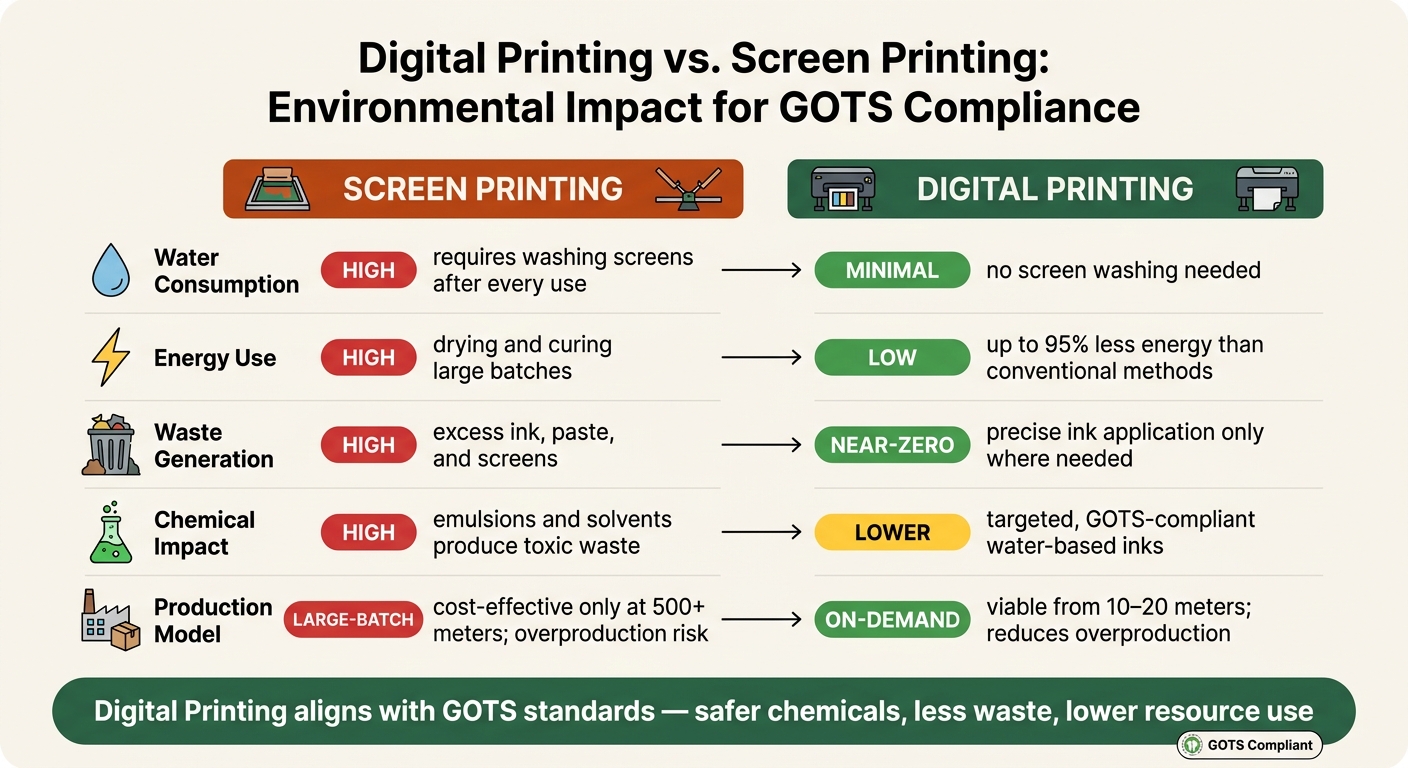
When it comes to GOTS-certified production, the printing method matters just as much as the fabric itself. Screen printing, in particular, poses notable environmental challenges. GOTS certification demands strict oversight of water usage, chemical handling, and waste management, areas where screen printing often falls short.
The standout difference lies in resource consumption. Screen printing requires a separate screen for each color in a design, and these screens need to be washed after every use. This process uses significant amounts of water and involves emulsions and solvents that produce harmful waste. On the other hand, digital printing eliminates the need for screens entirely. With no screens to clean and no leftover paste to dispose of, ink is applied only where it’s needed, making the process far more efficient and eco-friendly.
Beyond its environmental advantages, digital printing also offers greater production flexibility. Screen printing becomes cost-effective only for large-scale runs - typically over 500 meters - because of the high upfront costs of creating physical screens. Digital printing, however, can handle smaller runs, even as little as 10–20 meters, with comparable costs per meter. This capability makes it ideal for small-batch, on-demand production, reducing overproduction and waste.
Side-by-Side Comparison of Digital and Screen Printing
Here’s a quick breakdown of how these two methods stack up in terms of environmental impact:
| Environmental Factor | Screen Printing | Digital Printing |
|---|---|---|
| Water Consumption | High (requires washing screens) | Minimal (no screen washing needed) |
| Energy Use | High (drying and curing large batches) | Low (streamlined, on-demand process) |
| Waste Generation | High (excess ink, paste, and screens) | Near-zero (precise ink application) |
| Chemical Impact | High (emulsions and solvents with toxic waste) | Lower (uses targeted, GOTS-compliant inks) |
| Production Model | Large-batch (risk of overproduction) | On-demand (reduces overproduction risk) |
These differences highlight why GOTS prioritizes strict controls over water, chemicals, and waste. Digital printing aligns closely with these standards, making it a more sustainable choice.
As researchers Akshay Vade and Ashok Athalye from Springer Nature explain:
"Digital printing stands as a beacon of innovation that can significantly lower the environmental footprint of the textile industry while ensuring high-quality, efficient production."
This distinction becomes even more important for GOTS-certified kids' clothing. Under GOTS Version 7.0, certified entities must actively monitor their energy use, waste, and emissions. Digital printing makes meeting these requirements much simpler, streamlining compliance while maintaining high standards.
Steps to Set Up GOTS-Compliant Digital Printing
Following GOTS standards in digital printing involves several detailed steps, starting with sourcing materials and ending with thorough documentation of the entire process.
Source GOTS-Certified Organic Fabrics
The first step is to use GOTS-certified organic fabrics. According to GOTS, raw fibers must meet standards accredited by the IFOAM Family of Standards and be verified at every stage before printing. Choose the correct label grade for your product:
- "Organic": Requires at least 95% certified organic fibers.
- "Made with Organic": Requires a minimum of 70% organic fibers, with the remaining fibers meeting GOTS criteria.
Always source materials from GOTS-certified suppliers and ensure you receive a Transaction Certificate (TC) for every batch. This certificate is critical proof that the fabric meets GOTS standards. Keep in mind that certified fabrics alone aren’t enough - every input used must also comply with GOTS requirements.
Use Certified Inks and Equipment
Digital printing is classified as part of GOTS’s "Wet-Processing" stage. This means all chemical inputs - like inks, pigments, and auxiliaries - must meet strict standards for biodegradability and toxicity. GOTS explicitly bans harmful substances such as toxic heavy metals (e.g., lead, cadmium, mercury), formaldehyde, aromatic solvents, and AZO dyes that release carcinogenic amines.
To label your final product as GOTS-certified, your entire printing process must also be certified. As Cemil Gündüz from DTF Printer USA explains:
"To label the final product as GOTS certified, GOTS would also need to certify your entire printing process, including your DTF inks and your facility."
This means you’ll need to source inks from GOTS-approved suppliers and secure a valid Letter of Approval for each. To verify a supplier’s certification, search their GOTS license number in the public database at global-standard.org. Once you’ve ensured your inks and equipment meet these standards, focus on maintaining a clear and documented chain of custody.
Keep Chain-of-Custody Records
Maintaining accurate records is a cornerstone of GOTS compliance. Two primary documents are required throughout the entire supply chain:
| Document | Purpose | Key Details It Must Include |
|---|---|---|
| Scope Certificate (SC) | Verifies that your facility is GOTS-certified | Certified products, production sites, and expiry date |
| Transaction Certificate (TC) | Tracks the movement of goods between companies | Quantity, buyer/seller details, fiber origin, and SC numbers |
Every entity in the supply chain, from fabric weavers to digital printers, must hold a Scope Certificate. Without this, the finished garment cannot carry a GOTS label. Keep a close eye on certificate expiration dates, as they require annual renewal and on-site audits. Additionally, maintain records for all chemical inputs, such as inks and curing agents, to ensure every material used is GOTS-approved.
As Stiftung Warentest, a respected German consumer testing organization, highlights:
"GOTS is the only one among the tested certifications to offer complete transparency and traceability."
Thorough and up-to-date documentation isn’t just a formality - it’s a requirement for achieving and maintaining GOTS compliance.
Digital Printing in GOTS-Certified Kids' Apparel: Examples
Real-world examples show how GOTS-compliant digital printing, when paired with certified fabrics, inks, and rigorous documentation, can lead to more sustainable production in kids' apparel.
Take The Tribe Kids, for instance. In January 2024, this children's apparel brand fully embraced digital printing as the cornerstone of its production model. By using GOTS-certified textiles and lead- and azo-free dyes, they significantly reduced chemical waste. They also launched a "Zero Landfill Waste" initiative, repurposing fabric scraps into eco-friendly products. The brand emphasizes:
"Digital printing reduces chemical waste compared to traditional printing techniques, providing a more sustainable and environmentally friendly option."
Similarly, Shirt-King, a textile printing company in Teltow, Germany, implemented GOTS-certified digital printing services in 2023. Partnering with Stanley/Stella, they created a supply chain rooted in organic cotton for producing printed hoodies and T-shirts. Their process prioritizes water and energy efficiency, ensuring that garments are not only sustainable but also allergy-friendly and colorfast after multiple washes. As they explain:
"Our GOTS-certified production guarantees that strict environmental requirements are met during the manufacture and finishing of the textiles. This includes refraining from harmful chemicals, the economical use of water and energy as well as the use of organic cotton."
These examples underline how combining digital printing with certified materials and detailed documentation can align with GOTS standards in kids' apparel. They also pave the way for a more integrated approach, as seen in the practices of Little Eco Threads.
Little Eco Threads' Approach to Digital Printing
Inspired by these industry examples, Little Eco Threads has developed a holistic approach to sustainable kids' apparel production. As a GOTS-certified manufacturer, the company incorporates digital printing - especially all-over printing - into a seamless production process that spans fabric sourcing to final delivery.
With GOTS, SEDEX, and GRS certifications, Little Eco Threads ensures that every production stage, including printing, undergoes third-party audits. This commitment to compliance allows brands to confidently label their garments as GOTS-certified, easing the operational challenges faced by boutique brands producing printed kids' clothing.
Why Digital Printing Matters for GOTS Certification
Digital printing plays a key role in meeting GOTS standards, thanks to its environmental and safety advantages. By avoiding harmful substances like lead, cadmium, and carcinogenic AZO dyes, digital printing helps protect both workers and end-users. This is particularly crucial for children's clothing, as children's skin is thinner and more absorbent than adult skin, making them more susceptible to chemical residues often found in traditionally printed fabrics.
Modern digital printing processes are also far more efficient. They use up to 95% less energy compared to conventional textile machinery, while significantly cutting down on water consumption and waste. These benefits not only align with GOTS sustainability goals but also highlight the importance of ensuring the entire production process meets certification requirements.
It’s worth noting that for a product to carry the GOTS label, every step of its production must occur in certified facilities. As Caspar Create aptly states:
"A certified fabric deserves a certified print."
Take, for example, Little Eco Threads, a manufacturer certified by GOTS, SEDEX, and GRS. They manage the entire production chain - from sourcing certified fabrics to digital printing and final delivery - so boutique brands don’t have to juggle multiple certified vendors to remain compliant.
For brands wanting to verify a manufacturer's certification, the GOTS public database provides a comprehensive list of certified facilities, complete with names and license numbers. This makes it easy to confirm that certifications are both current and valid.
FAQs
Can I use digital printing and still label my garment as GOTS?
Yes, garments can carry the GOTS label if the digital printing process uses GOTS-certified inks and adheres to the environmental and social criteria outlined by GOTS. It's crucial that every stage of production complies with these standards to retain certification.
What proof do I need that the inks and fabrics are GOTS-approved?
To ensure GOTS approval, you'll need either certification labels or documentation provided by GOTS-accredited certifiers. These serve as proof that the inks and fabrics comply with GOTS standards while preserving their organic quality.
Does digital printing change how a factory must treat wastewater for GOTS?
Digital printing, especially pigment-based inkjet printing, eliminates the need for water in the dyeing process. This drastically cuts down on wastewater, making it easier to meet GOTS compliance standards and promoting environmentally conscious manufacturing.