
The India UK Free Trade Agreement: What It Means for Childrenswear Sourcing
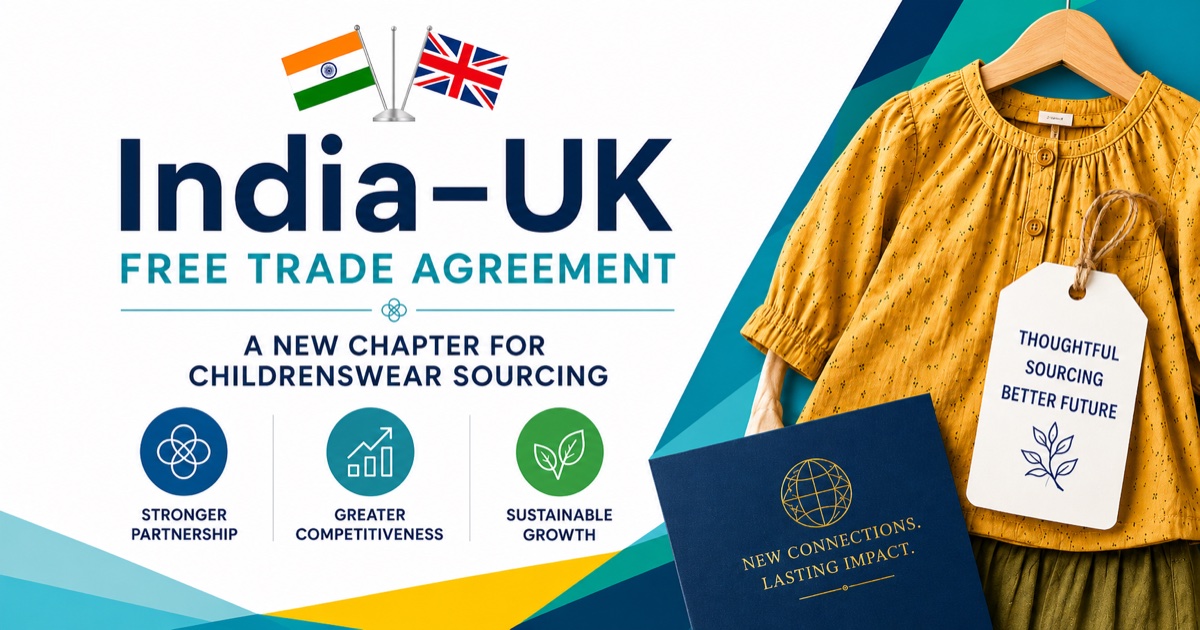
For buying teams that have spent years circling India as a sourcing destination without quite committing, the calculation has now fundamentally changed.
The India-UK FTA, signed in May 2025 and entering into force on 15 July 2026, removes one of the most persistent friction points in UK India trade: the import duties of up to 12% that applied to Indian garments and textiles entering the UK market.
Around 99% of Indian exports by value now qualify for tariff free access. For the apparel sector specifically, that is not an incremental improvement. It is a structural shift in how Indian manufacturers compete.
Here is what the change means at a glance:
- Duties removed: up to 12% gone on Indian garments entering the UK.
- In force from: 15 July 2026.
- Scale: around 99% of Indian exports by value now qualify for tariff free access.
- Forecast: analysts expect India's textile and apparel exports to the UK could roughly double by 2030.
A Sourcing Destination That Almost Worked
To understand why this matters, it helps to understand why India was so often on the shortlist but so rarely on the order form.
India is the world's second largest textile exporter, with strengths that few competing countries can match:
- Raw material base: domestic cotton, silk, and technical fibres.
- Manufacturing range: everything from artisan level handcraft to high-speed industrial production.
- Export track record: a long, well documented history of shipping complex, high-specification apparel to demanding markets.
Yet in the UK market, Indian apparel carried a consistent price disadvantage. While competitors like Bangladesh and Cambodia benefited from duty free access through preferential trade arrangements, Indian goods faced tariffs of up to 12%. Buying teams would run the landed cost numbers and watch India slip quietly down the ranking.
That disadvantage was real, but it was never the full story. India grew its UK apparel market share from around 5% to 6% between 2020 and 2023 while carrying that tariff burden. The underlying capability was there. What was missing was the commercial parity to reflect it.
The FTA closes that gap.
What the Numbers Look Like Now
The practical impact becomes clear quickly when you work through the landed cost arithmetic.
A children's garment that previously cost £11.20 to import from India with a 12% duty factored in now costs £10.00. On a single unit, that is a modest saving. Across a seasonal order of several thousand pieces, it represents a meaningful shift in margin and pricing headroom.
Industry analysts are now forecasting that India's textile and apparel exports to the UK could roughly double by 2030, with this trade agreement providing necessary price competitiveness.
Bilateral trade between the two countries was already running at over £40 billion annually. Both governments have set a target to double that figure by 2030, describing the FTA as the primary mechanism for getting there.
For sourcing teams currently reviewing their cost structures, the question is no longer whether India is competitive. It is whether they are positioned to move quickly enough.
Why Childrenswear Is a Different Conversation
The tariff removal matters across apparel categories, but childrenswear has its own specific set of pressures that make this moment particularly significant.
Parents buying children's clothing, especially in the UK, where millennial and Gen Z parents now dominate household spending decisions, are more rigorous in their purchasing than any previous generation. Questions about fabric origin, manufacturing conditions, and sustainability credentials have moved from niche concerns to mainstream expectations.
The organic and ethically sourced childrenswear segment has been growing at 8 to 12% annually, significantly ahead of the broader market, which remains roughly flat at around £7.85 billion.
This creates a particular sourcing challenge. It is not enough for an Indian manufacturer to be price competitive. They need to be:
- Compliance-ready across target markets.
- Quality consistent from season to season.
- Capable of product development that premium and sustainable childrenswear brands require.
The FTA changes the economics. It does not change the standards.
The manufacturers best placed to benefit are those who understood this and invested accordingly, building the operational infrastructure that the UK market requires before the trade environment made it commercially urgent to do so.
Little Eco Threads, based in India and specialising in baby and children's apparel, accessories, and nursery textiles, is a useful reference point here. With over 26 years of export manufacturing experience and an active client base across Europe, North America, and Australia, the company represents the category of Indian childrenswear manufacturer that has spent years developing compliance infrastructure, quality systems, and product development capability aligned to international market requirements.
The FTA does not make companies like this competitive. It makes the commercial case for working with them considerably stronger.
The Supply Chain Diversification Context
The FTA also arrives at a moment when UK brands have been actively rethinking how their supply chains are structured and why.
The disruptions of recent years have reinforced a lesson that many sourcing teams already understood in theory but struggled to act on in practice: concentration in one or two manufacturing countries creates fragility. When something goes wrong, whether through geopolitical instability, a logistics crisis, or sudden regulatory change, the brands most exposed are those with no alternatives already developed.
The industry response has been a genuine push toward diversification. Sourcing teams are looking for additional manufacturing relationships in countries with the scale, capability, and reliability to absorb meaningful order volumes. And here, India's position is genuinely distinctive:
- Depth: the capacity to handle significant volume across a wide range of product categories.
- Stability: a domestic raw material base that reduces vulnerability to upstream supply disruptions.
- Experience: a mature export manufacturing sector with decades of service to demanding international markets.
For UK brands looking to reduce their concentration risk, India is not simply another option on a list. It is one of the few countries with the capability to serve as a genuine primary or secondary sourcing hub across multiple categories.
The FTA makes that argument significantly easier to make internally.
The Regulatory Environment Coming Into View
There is one further factor that buying teams would be unwise to set aside: the regulatory environment that is emerging around supply chain transparency.
The EU's Corporate Sustainability Due Diligence Directive, phased in from 2027, will require brands to demonstrate due diligence on the labour and environmental practices throughout their supply chains. The UK is widely expected to follow with equivalent requirements.
For brands that have already built supplier relationships grounded in transparency, documentation, and verified standards, this is a manageable transition. For those that have not, it is a significant operational and reputational risk.
Working with Indian manufacturers who have invested in export compliance and international quality standards does not automatically resolve every future regulatory obligation. But it does mean the foundational supplier relationship is built on the right infrastructure, which matters when requirements tighten.
The Practical Case for Moving Early
Sourcing relationships in childrenswear take time to build.
The first season of working with a new manufacturer is typically exploratory, learning each other's ways of working, stress testing communication, and developing the product together. The seasons that follow are where the real value emerges: a factory that understands your brand's quality standards, your compliance requirements, and the rhythm of your development calendar.
That trust takes time. Brands that begin building it now will have something meaningful in place by the time the full commercial benefits of the FTA are flowing through the supply chain. Brands that wait will be entering a more competitive conversation, competing for the attention and capacity of manufacturers who have already committed to longer term partners.
The India UK FTA entered into force on 15 July 2026. The structural economics of sourcing childrenswear from India have changed. The question for buying teams is not whether to take that seriously. It is whether they take it seriously early enough to build the supplier relationships that will matter in two or three seasons' time.
For UK childrenswear brands beginning to explore what that looks like in practice, manufacturers like Little Eco Threads, with established international export experience, a broad product range across baby and children's apparel, and the quality infrastructure that UK buying teams require, represent the kind of sourcing partner worth understanding as this new trade environment takes shape.
Sources
- UK Department for Business and Trade
- India Ministry of Commerce and Industry, Fibre2Fashion
- Mordor Intelligence Childrenswear Market Report 2025 to 2031
- Euromonitor Childrenswear in the United Kingdom 2025