Building a Kidswear Brand in Denmark: What to Look for in a Manufacturing Partner
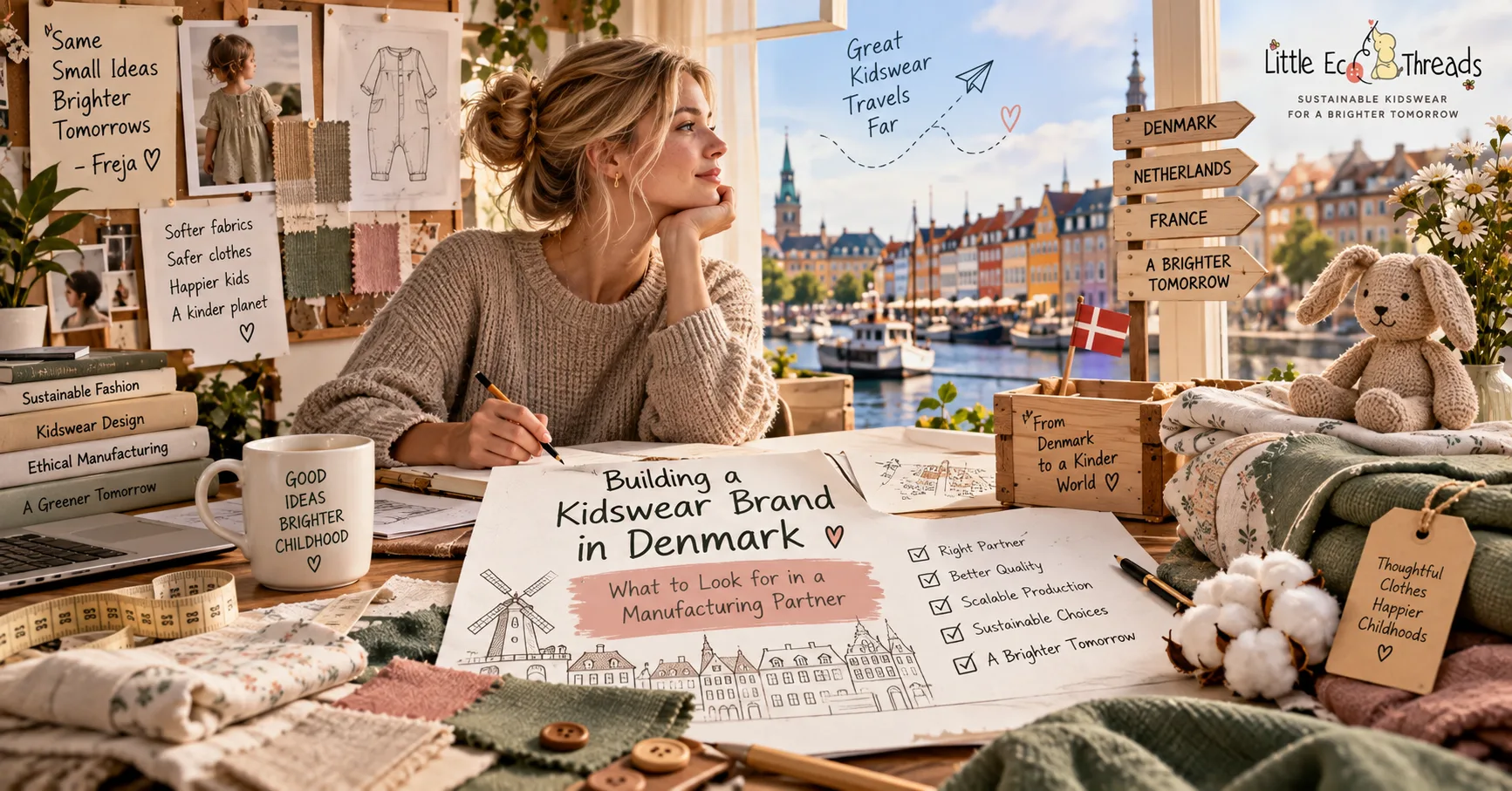
Imagine a Danish founder named Freja. For the past year, she has been working on a small kids clothes collection: soft rompers, comfortable dungarees, simple everyday pieces, and muted colours that fit the calm Scandinavian customer she wants to reach.
Her fabric samples are pinned to a board. Her social media following is slowly growing. She has a clear idea of the parent she wants to serve. But one question still decides whether the brand becomes a real product business:
Who is going to make the clothes?
For a growing kidswear brand, the answer is rarely as simple as choosing the cheapest factory or the closest supplier. The right kidswear manufacturer affects product quality, unit cost, lead time, compliance risk, and how confidently a founder can scale once orders begin to grow.
This guide explains what Danish founders should look for in a manufacturing partner, especially when building a brand for Denmark first while keeping nearby European markets in mind.
Start With the Kids Clothes Brand, Not the Factory
Before comparing factories, define the brand clearly. What are you selling? Who is buying it? What price point must the finished garment support? A premium organic babywear line sold through Danish boutiques will need a different partner from a volume-focused basics brand selling through online marketplaces.
Collection shape matters too. Many new brands start with simple jersey products before adding jackets, dresses, winter pieces, or layered outfits. For example, early t shirt production can help founders test fit, fabric, label placement, and washing performance before they commit to more complex garments.
If your concept includes a shirt & t shirt capsule, a t shirt with shirt layering set, or a shirt with t-shirt bundle for gifting, your supplier should be able to explain how both pieces will behave after washing. Fabric shrinkage, colourfastness, trims, and size grading need to work together, not only look good in one sample.
Look Beyond the Lowest Production Quote
Once a brand requests quotes, it is tempting to choose the lowest number. But unit price is only one part of the real cost of production. A cheap quote paired with weak sampling, inconsistent stitching, slow replies, or unclear packaging support often becomes expensive later.
For kidswear, quality problems can also become safety problems. Loose trims, weak seams, poorly attached buttons, rough labels, or drawstring details can damage trust quickly. Parents expect children's clothing to be comfortable, durable, and made with care.
Instead of asking only for the cheapest price, ask what is included:
| Question | Why it matters |
|---|---|
| Is sampling included or charged separately? | Sampling quality predicts production quality. |
| Is the MOQ per style, colour, size, or total order? | This affects cash flow and inventory risk. |
| Are fabric tests or certificates available? | Sustainability and safety claims need support. |
| What quality checks happen before shipment? | Problems are cheaper to fix before goods leave the factory. |
| Who handles labels, trims, and packaging? | Branding details influence the final customer experience. |
The right manufacturing partner should explain these details clearly before production begins.
Fabric Knowledge Shapes the Finished Product
Fabric is where a kidswear brand's positioning becomes real. Organic cotton is popular because it feels soft, breathable, and familiar to parents buying baby and children's clothing. But a fabric name on a spec sheet is not enough. The supplier should understand weight, shrinkage, weave, hand feel, care performance, and documentation.
Muslin textile is a good example. It is light, breathable, and useful for warm-weather babywear, swaddles, dresses, rompers, and soft summer separates. But not every muslin is equal. Thread count, weave density, finishing, and washing performance all affect whether a garment still looks good after repeated use.
Viscose textile can work for soft dresses and drapey tops, but it behaves differently from cotton in shrinkage and garment care. Some brands also explore textile cupro, a regenerated cellulose fabric sometimes chosen for a silk-like hand feel. These fabrics can be useful, but they need the right product fit and the right care instructions.
The core question is consistency. A fabric that feels beautiful in one sample but changes noticeably across bulk lots can create customer complaints. A serious manufacturer should help the brand control fabric weight, hand feel, colour continuity, and testing documentation across repeat orders.
Product Naming Matters Beyond Denmark Too
Manufacturing decisions are technical, but a Danish kidswear brand may eventually sell beyond Denmark. A founder may write product names in English or Danish, but buyers in France, Belgium, the Netherlands, Germany, or Denmark may search in local language terms.
For French-speaking markets, search demand can include manteau fille, pyjama bebe, robe fille, bebe pyjama, vetement garcon bebe, coupe vent fille, ensemble pour bebe, manteau hiver pour garcon, and doudou. Product categories such as long bibs and cardigans clothing can also reveal how specific buyers become when they know exactly what they need.
For Dutch-speaking buyers, terms such as inkoop kleding, kleding groothandel, b2b kleding groothandel, kelding inkopen, and kleding leverancier can signal wholesale or sourcing intent. English searches such as netherlands clothing brands, dutch brands fashion, t shirt clothing brands, sustainable fashion brands, best marketplaces for eco-friendly products, and brand on clothing can also show how founders research the market before contacting suppliers.
This does not mean every product page should be stuffed with keywords. It means founders should understand how buyers describe products, then use clear naming, accurate category labels, and buyer-friendly descriptions. A strong kidswear brand makes products easy to understand in every market it serves.
MOQ Is a Business Decision, Not Just a Factory Rule
Minimum order quantity is one of the first numbers a founder hears from a factory. It deserves careful attention because it controls cash flow, inventory risk, and how quickly a young brand can test new products.
A high MOQ can force a founder to buy more inventory than the market has validated. This is especially risky in children's clothing because each style may be split across several sizes and colours. A modest run can quickly become many SKUs.
Low-MOQ support helps brands test demand before scaling. Ask whether MOQ is calculated per style, per colour, per size, or across the full order. Also ask whether the factory can combine related pieces, such as t-shirts, bibs, and simple babywear, within a first collection.
For Danish founders comparing India, Portugal garment manufacturers, clothing suppliers Portugal, or local Scandinavian and European production, MOQ should be evaluated alongside fabric availability, sampling speed, communication, lead time, and export experience. A nearby factory is not automatically better, and an overseas factory is not automatically riskier. The details decide.
Sampling and Product Development Prevent Expensive Mistakes
Sampling is where a design meets reality. A proper product-development process starts with a tech pack, then moves through prototype samples, fit corrections, fabric approvals, size grading, and final pre-production approval.
For children's clothing, grading deserves special attention. A style that fits well in one size may not scale cleanly across a full baby or kids size range. Armholes, crotch depth, neck openings, sleeve length, rise, and body width all need careful checking.
This matters for both simple and complex products. A basic t-shirt still needs accurate measurements and good stitching. A layered outfit, padded jacket, winter coat, or private label babywear set needs even more control because more components can go wrong.
A capable manufacturer should help identify problems early, not after bulk production has started.
Private Label Support Should Be Clear Before You Order
Many founders want the factory to support labels, hangtags, packaging, trims, and sometimes custom fabric printing. That is where private label baby clothing support becomes important.
Ask what the manufacturer can provide in-house and what must be sourced separately:
- Woven neck labels
- Care labels
- Size labels
- Swing tags
- Branded polybags or paper packaging
- Custom trims, buttons, and zippers
- Fabric printing or embroidery
- Gift-box packaging
Private label support is not only about putting a brand on clothing. It is about making the final product feel consistent when it arrives with the customer.
Sustainability Claims Need Documentation
Parents increasingly care about how clothes are made, but sustainability language needs evidence. If a brand says a garment is organic, recycled, low-impact, responsibly sourced, or ethically made, the claim should be supported by supplier documentation.
Certifications can help, but founders should check what a certificate actually covers. A factory may hold a certification for one process or facility without every fabric or garment automatically being certified. Ask for current documentation, confirm the scope, and keep records tied to the order.
This is especially important for founders building around sustainable kidswear manufacturing, organic cotton, recycled materials, and responsible production. The same discipline applies in adjacent product categories, from babywear to ethical workwear: do not rely on broad claims when documented proof is possible.
Quality Control Should Run Through the Whole Order
Quality control should not appear only at the end of production. It should begin with incoming fabric inspection and continue through cutting, stitching, measurement checks, finishing, packing, and pre-shipment review.
A good children's clothing manufacturer should be able to explain how it checks:
- Fabric defects, shade variation, and shrinkage
- Measurements against the approved tech pack
- Seam strength and stitching consistency
- Button, snap, trim, and label attachment
- Print, embroidery, and colour placement
- Packing accuracy by style, colour, and size
- Final inspection before shipping
Intentional design details need clear standards too. A distressed or troue t-shirt should have a defined inspection standard so a deliberate design feature is not confused with a real defect.
Communication and Transparency Matter More Than Location
A factory can have strong machinery and still be difficult to work with if communication is unclear. Slow replies, vague timelines, and undocumented decisions create risk.
Working across time zones, whether with India, Portugal, or another production hub, requires structure. Founders should agree on communication rhythm, sample approval steps, document ownership, and production milestones before placing an order.
Useful questions include:
- Who is the day-to-day contact person?
- How quickly are messages usually answered?
- How are sample changes documented?
- When are production photos shared?
- What happens if a fabric, trim, or delivery date changes?
- Who approves final packaging before shipment?
The best supplier relationships are not built on perfect conditions. They are built on clear documentation and early communication when something changes.
Questions to Ask Before Choosing a Kidswear Manufacturer
Bring a structured checklist into early supplier calls:
- What children's product categories do you produce most often?
- What is your MOQ by style, colour, and order?
- Can you support t-shirts, babywear, sleepwear, bibs, dresses, coats, and accessories?
- Which fabrics can you source consistently?
- Can you provide documentation for organic, recycled, or certified materials?
- How many sampling rounds should a new style usually need?
- How do you handle size grading for baby and children's clothing?
- What quality-control checks happen before shipment?
- Can you support private label packaging and trims?
- What lead times should we expect in normal and peak seasons?
- Do you have experience exporting to Denmark and nearby European markets?
- What happens if goods fail inspection?
Working With Little Eco Threads
Little Eco Threads works with baby and children's clothing brands on fabric sourcing, sampling, low-MOQ production, private label support, quality control, and bulk production.
If you are building a kids clothes brand and need a practical partner for organic cotton, muslin, babywear, sleepwear, bibs, dresses, or everyday kidswear, you can contact Little Eco Threads to discuss your first collection, fabric options, and production plan.
FAQ
What should a new kidswear brand look for in a manufacturer?
Look for children-specific production experience, clear communication, realistic MOQs, strong sampling, fabric knowledge, quality-control systems, and documentation for any sustainability or safety claims.
Is the cheapest manufacturer usually the best option?
No. A low unit price can become expensive if sampling is weak, measurements are inconsistent, communication is slow, or quality checks are incomplete. Compare total production risk, not only price.
Can a small brand start with t-shirts before expanding?
Yes. T-shirts and simple jersey pieces are often useful for testing fit, fabric, brand labels, and customer demand before adding more complex garments such as jackets, coats, and layered outfits.
Should Danish brands only manufacture in Denmark or Europe?
Not necessarily. Some Danish brands choose European factories for shorter lead times, while others work with overseas partners for fabric access, category expertise, or pricing. The right choice depends on MOQ, quality, timeline, documentation, and communication.
How important are multilingual product keywords?
They are useful for market understanding and product naming. Terms such as robe fille, pyjama bebe, inkoop kleding, or kleding leverancier can reveal how buyers search, but they should be used naturally and only where relevant.
When should a founder contact a manufacturer?
Contact manufacturers once the brand concept, target customer, rough product list, price position, and initial fabric direction are clear. You do not need everything finished, but you should know enough to ask specific questions.
Final Thoughts
Think back to Freja, looking at the small collection pinned to her board. The question in front of her is not only, "Which factory can make these clothes?" It is, "Which partner can help this brand grow without losing quality, clarity, or trust?"
A good kidswear manufacturer is more than a supplier. The right partner helps turn ideas into reliable products, supports better decisions before money is committed, and gives a founder the confidence to move from first samples to repeat production.