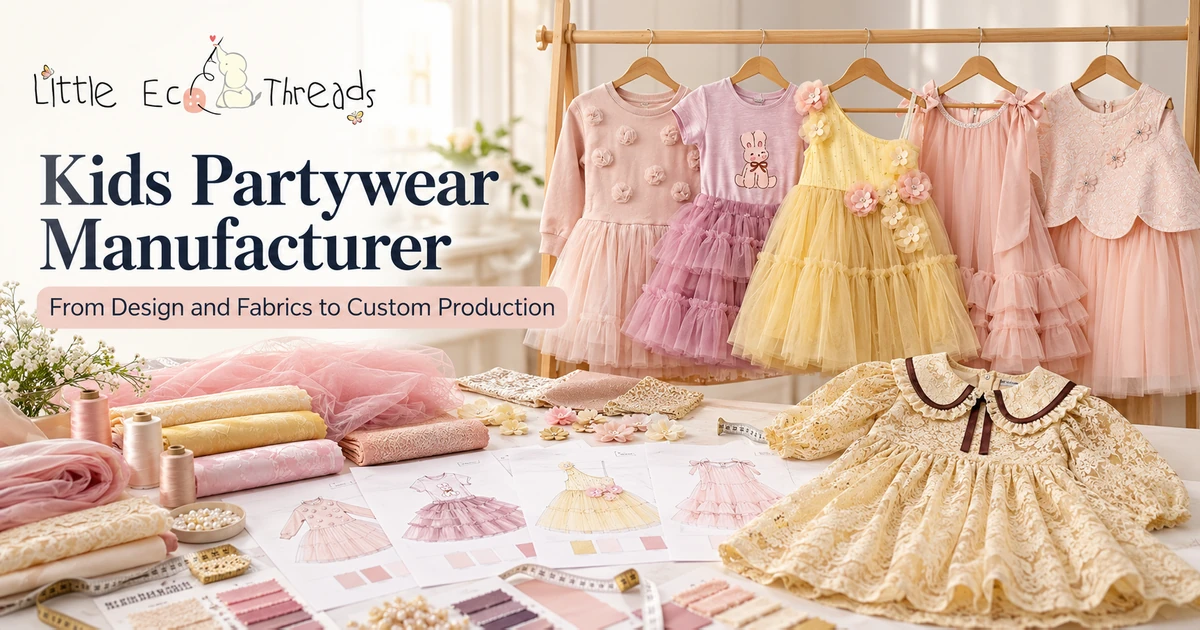
Kids Partywear Manufacturer: From Design and Fabrics to Custom Production
A growing kidswear brand may decide to launch a partywear collection for weddings, birthdays and festive seasons. The designs may look simple at first. There could be a tiered dress, an embroidered kurta set, or a smart shirt and shorts set. But once production starts, many questions come up.
Which fabric will keep its shape without feeling too stiff? Can the same colour be matched across different fabrics? How much embroidery can be added without increasing the cost and production time too much? What is the minimum order quantity for each style and colour? Will the manufacturer make samples before starting bulk production? How should the garments be packed so they arrive looking fresh? Most importantly, if the collection performs well, can the same manufacturer handle the next season?
These questions can decide whether a partywear collection becomes a profitable product range or creates an inventory problem.
Choosing a kids partywear manufacturer is not only about finding a factory. It is also an important part of product development. Brands need to consider design, fabric selection, customisation, sampling, quality control and future orders.
This article explains the key points of kids partywear manufacturing, from choosing designs and fabrics to customisation, sampling, quality checks and repeat orders. It also explains what brands should look for in a reliable kids clothing manufacturer. For brands that want to start with partywear and later expand into other children’s clothing categories, a baby and kidswear manufacturer such as Little Eco Threads can be a suitable manufacturing partner.
Designing Kids Partywear for Manufacturing
A design can look right on a sketch and still be difficult to produce. Partywear is especially prone to this because so much of its appeal comes from detail: layered skirts, frills, pleats, appliqué, bows, linings and decorative trims. Each one adds cutting time, sewing operations and room for variation between pieces.
Take a tiered dress with a lined bodice, gathered frills and embroidery on every tier. The first sample looks excellent. At 500 pieces, the same dress means longer sewing times, higher fabric consumption and a greater chance that the tiers will not match from one garment to the next. A simpler base dress with one carefully placed embroidered panel can achieve a similar premium appearance with far better production efficiency.
Comfort needs the same attention. Children run, sit and fall asleep in party clothes. Scratchy linings, stiff neckline seams and heavy chest embellishment can make a beautiful garment one a child refuses to wear, which means returns and weak reviews. Closures deserve thought too: zips, buttons, snaps and ties all behave differently in production and in use, especially in smaller sizes.
Good product development asks manufacturing questions at the design stage. How many operations does this style need? Where should embroidery sit so it does not interfere with seams? Which decorative elements define the look, and which can be simplified without anyone noticing?
This is where a manufacturer that offers product development earns its place. Little Eco Threads works with brands on custom kidswear, looking at sketches and specifications from a production point of view and suggesting adjustments to construction, trims and embellishment before samples are cut. That conversation costs little early and saves a great deal later.
Choosing the Right Fabric for Kids Partywear
There is no single best fabric for kids partywear. The right choice depends on the garment, the occasion and the market.
Cotton remains the base of many collections because it is breathable, soft on skin and accepts print and embroidery well. Organic cotton offers similar comfort with a stronger sustainability story, although availability, lead time and price can differ from conventional cotton. Cotton jersey suits stretch-based styles such as party rompers or fitted tops, but it lacks the structure of a woven fabric, so it is a poor choice for a full skirt that needs to hold its shape.
Muslin has a soft, light drape and suits newborn occasion pieces, though it needs careful finishing to look polished. Linen brings texture and a refined look to summer celebrations and boys' occasion sets, but it creases easily and can feel coarse unless it is well washed or blended. Blends can improve drape or reduce creasing, but they change breathability and may weaken sustainability claims.
Fabric also affects production in ways that are easy to miss. Dense embroidery on a very light fabric can pucker. A swatch that looks right may shrink or lose colour after washing. Dyed or printed colours may not match across cotton, muslin and lining in the same outfit. Custom or specialised fabrics usually carry higher minimums and longer lead times than fabrics a manufacturer already sources regularly.
For brands that sell on sustainability, the claim needs paper behind it. Little Eco Threads works with sustainable material options including organic cotton, muslin, cotton jersey and linen, depending on the product. Credentials such as GOTS, GRS, Sedex and OEKO-TEX Standard 100 are relevant here, but certification applies to specific materials, products and processes, not automatically to everything a factory produces. Brands should ask which certificate covers which fabric and request documentation for the exact materials they are buying, rather than accepting a general sustainability claim.
Customisation and Private Label Kidswear: Three Levels
Customisation is a spectrum, and where a brand sits on it shapes MOQ, development time and cost.
Basic private label
The brand takes an existing or proven design and adds its own labels, hangtags, packaging and selected colours. Sampling is quick and risk is lower, which suits brands testing a market.
Semi-custom
The manufacturer's existing patterns are used, but the brand changes colours, adds prints or embroidery, adjusts trims or applies its own branding. This gives a distinct look without building patterns from zero. Development takes longer, and minimums usually depend on the fabric, print or embroidery involved.
Fully custom
The brand develops its own designs, patterns, fabrics, prints, embroidery, measurements, labels and packaging. This offers the strongest differentiation and the most complexity: more sampling rounds, longer timelines, higher development cost and, often, higher minimums.
None of these is better than the others. A brand with limited capital may do well with semi-custom work, while a brand with a strong design identity may justify fully custom kids clothing. The mistake is choosing full customisation for every style in a first collection.
Little Eco Threads supports private label kidswear at each of these stages, from existing designs with a brand's own labels and packaging to custom prints, embroidery and colours. Minimums vary with the level of customisation, so they are confirmed project by project rather than fixed in advance.
MOQ and Production Planning for Wholesale Kids Partywear
MOQ is rarely a single number. In partywear it can apply by style, size, colour, fabric, print, embroidery and even packaging, and these minimums stack up.
A brand planning six styles in four colours may think it is placing a modest order. If each colour needs its own fabric dyeing, or each print has its own minimum, the total commitment can be far larger than expected, and slow-selling colours become stock the brand carries for months.
Practical ways to keep the first order under control:
- Start with fewer styles and add more once the first collection sells.
- Limit colourways. Two well-chosen colours often work harder than five.
- Share fabrics across styles so one fabric minimum covers several designs.
- Use proven fabric options before developing custom ones.
- Test one hero design with the strongest customisation and keep supporting styles simpler.
- Keep customisation focused. One embroidery design across several styles is easier to manage than a different one for each.
- Scale after the first collection performs, using real sales data to decide reorders.
Working with a low MOQ kidswear manufacturer makes this approach realistic for startups and boutique brands. Little Eco Threads offers low MOQ options where applicable, but the right quantity depends on the fabric, the level of customisation and the product, so it should be discussed against your actual tech pack rather than assumed.
Timelines need the same discipline. Partywear is date-driven: weddings, festivals and holidays do not move. Work backwards from the selling date, allowing time for sampling, revisions, fabric sourcing, bulk production, finishing, packing and shipping. Add a buffer for approvals, the most common source of delay.
Sampling and Product Development
Sampling is where partywear collections are won or lost. A sample proves the garment can be made; it should also show it can be made repeatedly, at the agreed cost.
Each sample round should be checked for fit across the size range, fabric hand and drape, colour against the approved reference, embroidery placement and density, construction, trim quality, finishing, measurements and packaging. Brands often approve a sample because it looks beautiful, then discover in bulk that the embroidery has shifted, the lining twists or the colour looks different in daylight.
A production-ready sample is different from an attractive one. It has confirmed measurements and a clear specification, approved fabric and trim sources, defined embroidery placement, and a construction method that sewing teams can follow consistently. Ideally it is made in the actual bulk fabric.
Little Eco Threads supports brands through product development and sampling, helping turn a concept or tech pack into a pattern, a sample and finally an approved reference for bulk. Brands can speed this up with clear specifications, colour references and size charts, and by consolidating feedback into one round.
Quality Control for Children's Partywear
Quality control for partywear goes well beyond whether the garment looks good. Because the product is decorative, there are more points where something can go wrong. Checks should cover:
- Stitching quality and seam strength, particularly at armholes, waistbands and closures
- Measurements against the size chart
- Colour consistency within and between batches
- Embroidery quality, density and print placement
- Trims, buttons, snaps and zips
- Loose threads, fabric defects and cleanliness
- Shrinkage after washing, final finishing and packaging
Children's clothing adds a safety layer. Small decorative parts, ribbons, drawcords, buttons and embellishments can create hazards for young children, and requirements vary by market and product category. A garment suitable for one market may need changes for another. Brands should tell their manufacturer which countries they will sell in at the start of development, and confirm testing and compliance requirements for each product rather than assuming one standard covers everything.
It also helps to agree inspection points in advance: inline checks during production, a final inspection before packing, and a shared view of what is acceptable and what is not. Little Eco Threads applies quality control across its baby and kidswear production, and brands can discuss the inspection process and any third-party checks they require.
Why a Broader Kidswear Manufacturer Can Be an Advantage
Many partywear brands start with occasion pieces and are soon asked for more: everyday kidswear that sells between events, seasonal collections, babywear, newborn products, gift sets, swimwear or sleepwear. If each category needs a different supplier, the brand takes on more sourcing, more sampling coordination, more quality variation and more separate shipments.
Little Eco Threads is a baby and kidswear manufacturing partner rather than a partywear-only factory. Its work spans baby bodysuits, rompers, bibs, swaddles, muslin products, sleepwear, swimwear, gift sets and wider children's apparel and textile products. For a partywear brand, that has practical uses. A christening outfit can sit alongside a muslin swaddle and bib in a newborn gift set, and a festive collection can be followed by linen summerwear or swimwear, with fabrics, labelling and packaging kept consistent.
A broader manufacturer is not automatically better, and a specialist may suit a single-category brand. But for brands that expect to grow, working with a partner that already understands the wider baby and kidswear range simplifies development and makes reorders easier.
Questions to Ask a Kids Partywear Manufacturer
Before committing, a sourcing team should ask:
- What is the MOQ per style and colour, and does it change with print or embroidery?
- Which fabrics are available, and can custom fabrics or prints be developed?
- Can you handle embroidery, appliqué and other embellishments?
- What does sampling include, and what does it cost?
- What is the realistic production lead time, including sampling and approvals?
- Which processes are handled in house and which are outsourced?
- What quality control process is followed?
- Can you provide certification documentation for the exact materials and products I am buying?
- Can you handle private label branding, labels and custom packaging?
- What happens when I reorder, and are fabrics and colours kept consistent?
- Can you support additional kidswear categories as my brand grows?
The answers matter, but so does how they are given. A manufacturer that explains trade-offs and raises concerns early is usually easier to work with than one that agrees to everything.
Why Brands May Choose Little Eco Threads
A good children's partywear manufacturer should offer more than production. It should provide design support, fabric knowledge, customisation options, a clear sampling process, quality control and the ability to support the brand as it grows.
Little Eco Threads works with brands looking for this combination. It is a B2B baby and kidswear manufacturer and kids partywear supplier that provides product development, custom manufacturing and private label support. Brands can explore sustainable fabric options, custom prints, embroidery and colours. Low MOQ options may also be available depending on the product and order requirements. The company can also support branding, labels and packaging.
Little Eco Threads also has experience working with international B2B customers. This can help brands manage the documentation and shipping requirements involved in selling across different markets.
A growing brand needs more than a factory that can produce one garment. It needs a manufacturing partner that can help develop, produce and grow a collection over time. The right partner should be able to support the brand when it moves from its first collection to the second and third season.
Brands should still confirm the details for their specific products before placing an order. This includes MOQ, production time, certifications and testing requirements. Samples and direct communication with the manufacturer can help brands understand what to expect before moving into bulk production.
Conclusion
Choosing a kids partywear manufacturer should not be based only on the lowest price, lowest MOQ or largest product range. A low price may sometimes mean lower quality, while a large product range does not always mean that the manufacturer can make your specific designs well.
Instead, look at the manufacturer's design support, fabric knowledge, customisation options, sampling process, quality control and production management. MOQ flexibility, private label services and the ability to handle repeat orders are also important.
It is also useful to choose a manufacturer that can support your brand as it grows. You may start with partywear and later add other baby and kidswear products to your collection.
For brands developing baby and kidswear collections, Little Eco Threads can be a B2B manufacturing partner worth considering. Share your designs, preferred fabrics and expected quantities to understand whether the manufacturer is the right fit for your brand.