Kidswear Manufacturing for Germany, the Netherlands, and Denmark
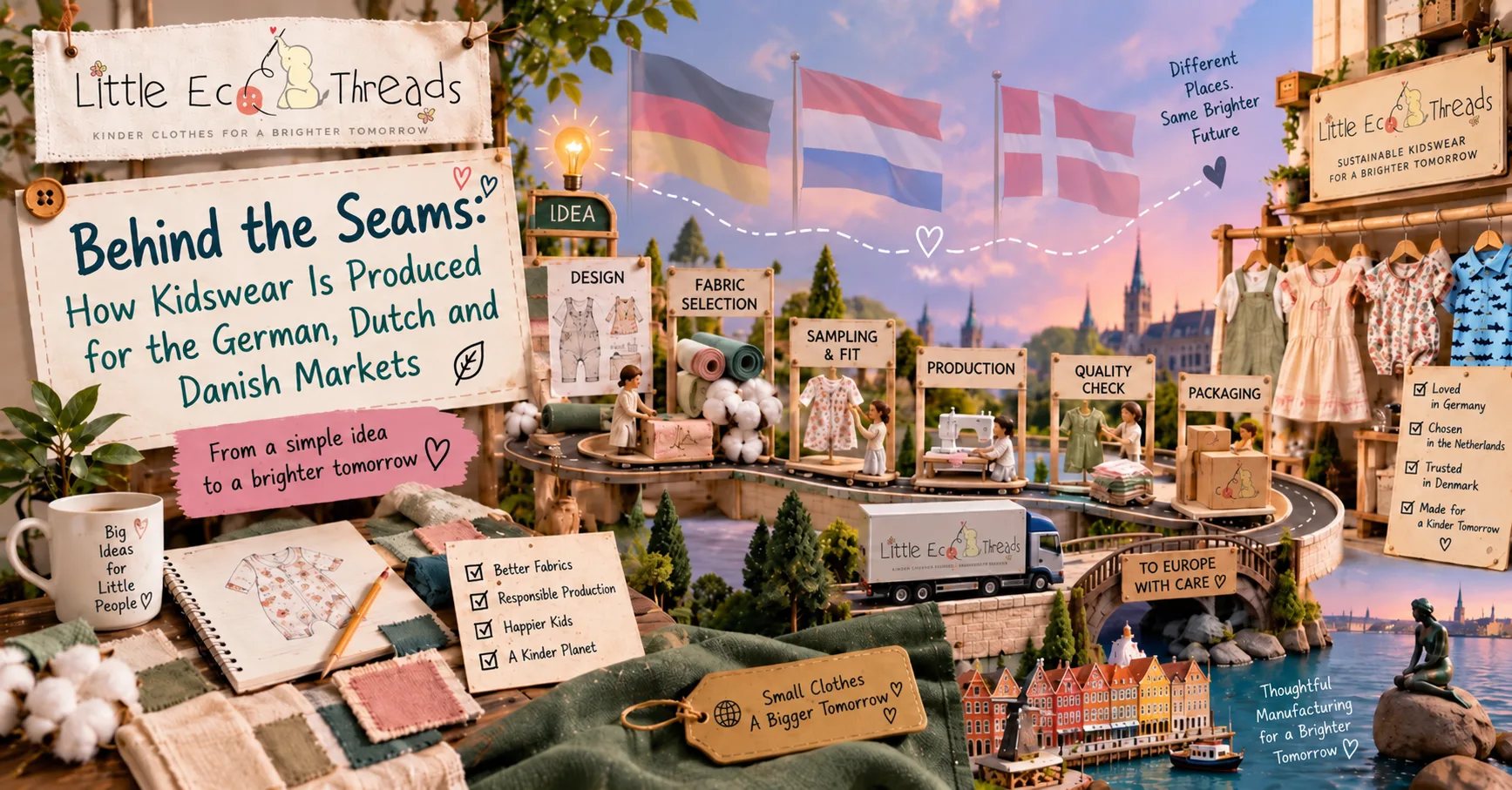
A finished romper in a shop or a bodysuit on an online store can look simple. The customer sees the shape, colour, size, and price. Behind that finished garment, however, a kidswear manufacturer has usually worked through fabric selection, fit, sampling, grading, production planning, quality checks, finishing, and packaging.
For brands selling into Germany, the Netherlands, and Denmark, that production journey matters. These markets are not identical, but buyers often care about clear product information, reliable construction, responsible material choices, and evidence that baby and children's clothing has been made carefully.
This guide explains how kidswear is produced for European-facing brands, what to consider before bulk production, and how to think about multilingual search intent such as Kinderbekleidung Hersteller, kinderkleding fabrikant, and boernetoej producent when positioning your sourcing content.
Kidswear Manufacturing Starts With a Product Idea
Before any fabric is cut, a product is only a set of decisions. A founder may begin with "a comfortable everyday romper for babies," but a manufacturer still needs practical answers:
- What age range is it for?
- Is it a bodysuit, romper, sleepsuit, dress, top, or set?
- Is the product for summer, winter, gifting, retail basics, or premium boutique selling?
- Does it need stretch, breathability, structure, warmth, or layering?
- What price point should the garment support?
- Is the brand targeting Germany, the Netherlands, Denmark, or several EU markets?
- What sustainability claims will the brand want to make?
A capable kidswear manufacturer helps turn these decisions into a producible garment. The earlier those details are clarified, the easier it is to avoid sample delays, cost surprises, and quality problems later.
Choosing Fabrics for Children's Clothing
Fabric choice is one of the most important decisions in kidswear production. Children's clothing is washed often, worn hard, and used against more sensitive skin than most adult clothing. A fabric needs to be assessed for softness, breathability, wash durability, shrinkage, colourfastness, pilling, and care requirements.
"Sustainable fabric" is not one category. Organic cotton, recycled polyester, Tencel or lyocell, linen, bamboo viscose, and certified cotton options behave differently and support different claims. A brand developing organic kidswear or sustainable baby clothing should understand both the origin of the fabric and how it performs in the finished garment.
This matters for German-language search intent such as Bio Babykleidung, Kinderkleidung aus Bio-Baumwolle, and nachhaltige Kinderbekleidung. It also matters for Dutch and Danish searches such as biologische babykleding, biologische kinderkleding, duurzame babykleding, oekologisk babytoej, and oekologisk boernetoej. The language may change, but the sourcing question is similar: can the brand explain what the fabric is, how it is made, and why it suits children?
From Design Sketch to Technical Product
A sketch can make a garment look finished before it is ready for production. A factory cannot cut fabric from a drawing alone. It needs technical instructions that define measurements, pattern pieces, seams, trims, labels, colour references, fabric details, and finishing requirements.
This stage is especially important for a children's clothing manufacturer. Children's sizing changes quickly across age groups, and babywear proportions are not simply scaled-down adult proportions. A neckline for a six-month-old, a romper opening for a toddler, and a pyjama waist for an older child all need different construction decisions.
For brands researching Kinderkleidung Hersteller, kinderkleding producent, or a babywear manufacturer, the useful question is not only "Can you make this?" It is "Can you translate this idea into a clear technical product that can be sampled and repeated?"
Sampling Shows What the Sketch Cannot
The first physical sample is where an idea meets fabric. A design may look complete on paper, then change when the material drapes, stretches, shrinks, or sits on the body.
During sampling, a brand should review:
- Fit against the intended size chart
- Fabric feel against skin
- Stitching quality and seam placement
- Neck openings, snaps, buttons, or zippers
- Print or embroidery placement
- Colour accuracy
- Label comfort
- Wash behaviour
- General finishing
Most kidswear products need more than one sample round. That is normal. Sampling helps brands solve fit, construction, and fabric issues before bulk production, where every mistake becomes more expensive.
Grading Across Baby and Kids Sizes
After one sample fits well, the pattern still needs to work across the size range. Grading means adjusting a base pattern up and down into each size while keeping proportions correct.
Children's grading needs care because children change shape as they grow. A newborn, a twelve-month-old, and a four-year-old are not the same body at different scales. A garment that fits one sample size well may still fail across the full range if grading is handled poorly.
For brands targeting Germany, the Netherlands, and Denmark, size consistency matters because online returns can quickly become expensive. Clear size charts, sample reviews, and careful grading are part of dependable kidswear production.
Moving From Sample to Bulk Production
Approved samples do not automatically guarantee good bulk production. Scaling from one sample to hundreds or thousands of units introduces new risks: fabric dye-lot variation, marker planning, cutting accuracy, sewing consistency, trim matching, finishing, packing, and batch-level inspection.
This is where bulk production needs structure. A single sample can receive extra attention; a full order needs systems that keep unit five hundred close to unit one.
Brands looking to Kinderbekleidung produzieren lassen, kinderkleding produceren, or move into larger kidswear production should ask how the manufacturer controls consistency during production, not only how the first sample is made.
Quality Control Before European Retail
By the time a garment reaches a customer, many checks should already have happened. A good quality-control process usually reviews fabric defects, measurements, stitching, seam strength, colour consistency, trims, labels, finishing, packaging, and overall appearance.
For Germany, the Netherlands, and Denmark, quality control also supports retailer confidence. Not every buyer in these markets has the same expectations, but European retail partners commonly ask practical questions about material composition, construction, safety, care, and consistency.
Quality control is not only about avoiding defects. It protects the brand's reputation, reduces returns, and helps a brand speak honestly about how the product was made.
Sustainability Is Built Across the Process
Sustainability is often discussed as if it begins and ends with organic cotton. In reality, it is spread across fabric choice, durability, cutting efficiency, production planning, packaging, chemical management, and quality control.
A garment made from organic cotton but poorly constructed may not be sustainable in practice if it pills, twists, or becomes unusable quickly. A durable garment with careful construction, good fit, and lower waste in cutting may support a stronger sustainability story.
This is why sustainable kidswear manufacturing should be treated as a process, not a label. The same applies to search terms such as sustainable kidswear manufacturer, Hersteller fuer nachhaltige Kinderbekleidung, duurzame kinderkleding fabrikant, and baeredygtigt boernetoej. Buyers are not only looking for nice words; they need production choices that can be explained.
What Makes Germany, the Netherlands, and Denmark Different?
Germany, the Netherlands, and Denmark are three separate markets, not one generic "Europe" market. Still, brands often see recurring themes across all three: practical product information, material clarity, quality, and responsible production.
Germany. Brands may need to provide clear answers about fibre composition, care labels, origin, certification scope, and product quality. Search behaviour can include terms such as Kinderbekleidung Hersteller, Kinderkleidung Hersteller, nachhaltige Kinderbekleidung Hersteller, Bio Babykleidung, and Kinderkleidung aus Bio-Baumwolle.
The Netherlands. Dutch-focused brands often value function, comfort, and easy everyday use. Search terms may include kinderkleding fabrikant, duurzame kinderkleding, kinderkleding laten maken, duurzame kinderkleding fabrikant, biologische babykleding, and kinderkleding producent.
Denmark. Danish kidswear often leans toward practical comfort, simple design, and responsible materials. Relevant search terms may include boernetoej producent, baeredygtigt boernetoej, oekologisk babytoej, and oekologisk boernetoej.
The throughline is not a single colour palette or style. It is that the product needs to be well developed, well documented, and well made.
EU Product Safety and Labelling Considerations
Children's clothing sold in the EU may need to account for chemical, safety, and labelling requirements depending on the product, trims, fibres, and claims being made. This is not legal advice, and brands should verify the rules for their specific products before production.
Three official EU references are especially useful starting points:
- The European Commission explains the EU's REACH framework, which addresses chemicals and restrictions relevant to products placed on the EU market.
- EUR-Lex summarises the EU general product safety rules, including the General Product Safety Regulation that applies from December 13, 2024.
- EUR-Lex publishes Regulation (EU) No 1007/2011 on textile fibre-labelling requirements, which is relevant to fibre names and related textile labelling rules.
A production partner can flag likely areas to check, but the brand placing the product on the market should confirm its own compliance position with qualified advisors, test labs, or regulatory specialists.
Where a Manufacturer Fits Into the Process
It is easy to think of a manufacturer as only the company that sews the clothing. In practice, a capable sustainable kidswear manufacturer can support material decisions, sample development, grading, custom manufacturing, private label development, production planning, finishing, packing, and shipment readiness.
Little Eco Threads works across babywear manufacturing and children's apparel categories such as rompers, bodysuits, sleepsuits, dresses, tops, trousers, and other baby and kidswear pieces. For founders without technical production experience, a partner that can explain tradeoffs early can make the development process far smoother.
Questions to Ask Before Production Begins
Before committing to a manufacturer, brands should ask:
- Which babywear and kidswear categories do you produce most often?
- Which fabrics can you source, and how are they documented?
- Can you support samples before bulk production?
- How is grading handled across sizes?
- What happens when a sample needs revision?
- What quality checks happen before, during, and after production?
- Can you support private label, custom trims, labels, or packaging?
- What is the minimum order quantity by product or style?
- Which sustainability information can you provide?
- Which compliance documents should our brand verify for Germany, the Netherlands, or Denmark?
- What production timelines should we expect?
These questions help a brand compare options realistically. They also reveal whether the manufacturer can support the product from first idea to finished garment.
FAQ
What does a kidswear manufacturer do before bulk production?
A kidswear manufacturer may help review the product idea, advise on fabrics, develop samples, confirm measurements, prepare patterns, grade sizes, check trims, and plan production before the bulk order begins.
Is Germany different from the Netherlands and Denmark for kidswear?
Yes. The markets have different retail cultures and languages, but all three generally reward clear product information, reliable quality, and practical material choices. Brands should avoid assuming one European strategy fits every country.
What EU rules should children's clothing brands check?
Brands should review relevant product safety, chemical, fibre labelling, drawstring, flammability, and market-specific rules depending on the garment. For EU selling, REACH, general product safety, and textile fibre-labelling rules are useful starting points.
Can one manufacturer support both custom and private label kidswear?
Some manufacturers can support both. Custom manufacturing is better for original product development, while private label can help brands start faster from existing base styles. The right choice depends on budget, timeline, differentiation, and target market.
Final Thoughts
The finished garment is only the visible part of kidswear production. Behind it are decisions about fabric, fit, sampling, grading, stitching, quality control, compliance, packaging, and market positioning.
For brands entering Germany, the Netherlands, or Denmark, choosing the right manufacturing partner is not just about finding someone to sew. It is about finding a partner that can support product development, documentation, and production quality from first idea to final shipment.
Little Eco Threads works with baby and children's clothing brands on sustainable kidswear, babywear manufacturing, organic kidswear, private label, and custom manufacturing. To discuss a European-focused collection, contact Little Eco Threads with your product idea, target market, preferred fabric, and expected order size.