MOQ vs Quality: Finding the Right Manufacturing Balance
Balancing MOQ (Minimum Order Quantity) and quality is one of the biggest challenges for small clothing brands, especially those focusing on eco-friendly materials. Here's what you need to know:
- MOQ Basics: Factories often require a minimum number of units per style or color to cover production costs. Traditional MOQs are high (1,000+ units), but many manufacturers now accept smaller runs (50–300 pieces).
- High MOQs Impact: Larger orders lower per-unit costs but can lead to cash flow issues and unsold inventory for small brands.
- Quality Certifications: Certifications like GOTS (organic cotton) and GRS (recycled materials) are crucial for eco-conscious buyers but often come with higher MOQs due to material sourcing requirements.
- Cost Breakdown: Certified fabrics are 20–60% more expensive than conventional options. For example, a GOTS-certified organic hoodie costs $21–$29 per piece at an 80-unit MOQ.
- Small-Batch Benefits: Lower MOQs allow brands to test designs, respond to feedback, and reduce financial risk. However, they come with higher per-unit costs and limited access to custom-certified materials.
- Production Timelines: Small-batch production is faster (3–8 weeks) compared to larger certified runs (12–24 weeks).
Key Takeaway: Start small by focusing on a few standout designs. Use stock-certified fabrics to keep MOQs low while meeting quality standards. This approach helps you manage costs, test demand, and build a reliable brand foundation.
MINIMUM ORDER QUANTITY (MOQ) in Clothing Manufacturing
Understanding the MOQ and Quality Trade-off
Navigating the balance between MOQ (Minimum Order Quantity) requirements and maintaining high-quality standards is a tricky financial challenge for small brands. Manufacturers lower per-unit costs by spreading fixed expenses - like pattern creation and machine setup - across larger production runs. But here's the catch: larger orders mean tying up capital in inventory that might not sell. This issue becomes even more complex when sustainable fabric certifications demand higher volumes.
For example, materials like GOTS-certified organic cotton often require larger production runs to justify the specialized processes involved. As a result, manufacturers raise MOQs to cover these additional costs. Grace Thompson from Argus Apparel sums it up:
MOQ determines the smallest number of garments a factory will produce by design or color. For small or emerging brands, unexpectedly high MOQs can tie up precious capital, hinder experimentation, and lead to excess inventory.
The numbers tell the story: inventory costs can make up 25% to 30% of a sustainable children's clothing brand's total expenses. Worse, cash flow problems - often tied to poor inventory management - are a key reason why up to 90% of fashion startups fail. When brands commit to large production runs without testing the market, they risk sinking a significant portion of their budget into styles that may not resonate with customers.
And yet, certifications like GOTS are non-negotiable if you're catering to eco-conscious buyers. These certifications guarantee products are free from harmful chemicals and ethically produced - qualities that encourage customers to pay 20% to 60% more for certified items. This creates a clear trade-off: lower MOQs allow brands to test designs and adapt quickly, while certifications provide the credibility needed to command premium prices.
Small-batch production offers flexibility and room for creativity, while mass production provides cost efficiency but increases the risk of unsold inventory. For boutique children's wear brands, the challenge lies in finding that perfect balance - producing enough to keep costs manageable while staying agile enough to respond to market feedback.
1. Minimum Order Quantity (MOQ)
Cost Efficiency
MOQ refers to the smallest quantity of garments a factory will produce for a specific design or color. Traditional factories often require 1,000 to 5,000 units per style, but many startup-friendly manufacturers now accept smaller runs of 50 to 300 pieces per style. While smaller production runs can increase per-unit costs due to fixed setup expenses, they help reduce the risk of overstock and unsold inventory.
For example, a basic organic t-shirt (160 gsm single jersey) typically costs between $7.00 and $9.50 per piece at a 50-unit MOQ. Similarly, an organic heavyweight hoodie (350 gsm French terry) costs around $21.00 to $29.00 per piece at an 80-unit MOQ. Since fabric accounts for 60% to 70% of total production costs, opting for stock fabrics and colors instead of custom-dyed materials can help you control costs while avoiding higher minimums. These cost considerations also play a role in your choice of certifications for sustainable production.
Sustainability Certifications
Small brands can now access GOTS (Global Organic Textile Standard) and OEKO-TEX certifications with MOQs as low as 50 pieces. To confirm the authenticity of these certifications, request the GOTS scope certificate number and a Transaction Certificate (TC) for each order. However, keep in mind that 100% GOTS organic cotton fabric typically costs 30% to 45% more than conventional cotton.
For brands targeting the U.S. market, compliance with the Consumer Product Safety Improvement Act (CPSIA) is mandatory for children's clothing. By aligning small-batch production with these certifications, boutique brands can ensure product quality while maintaining flexibility in production volumes.
Flexibility for Small Brands
Lower MOQs give small brands the ability to manage cash flow effectively and experiment with new designs. This approach allows you to test market demand, adjust garment fit based on customer feedback, and refine designs without overcommitting to large quantities. It’s particularly useful for introducing new styles or seasonal color variations.
For instance, a typical first GOTS-certified collection for a boutique brand - featuring 4 to 8 styles with 50 to 150 pieces per style - can cost between $5,400 and $15,000, including certification and shipping. Starting with simple designs, such as plain t-shirts or leggings, can reduce setup complexity, making manufacturers more open to smaller MOQs for certified materials.
Production Lead Times
Small-batch production offers relatively quick turnaround times. Sampling generally takes 2 to 4 weeks, while bulk production requires 3 to 6 weeks. Shipping can add another 1 to 3 weeks, depending on your location. This faster timeline allows you to stay responsive to customer preferences and seasonal trends, a key advantage compared to the average 85-day lead time for larger orders.
2. Quality Standards (GOTS, GRS)
Sustainability Certifications
Producing high-quality goods while sticking to sustainability principles requires adherence to well-recognized standards. Two key certifications lead the way: GOTS (Global Organic Textile Standard) and GRS (Global Recycled Standard). These certifications rely on third-party verification to ensure product claims are trustworthy.
GOTS focuses on organic fiber content, requiring products to use between 70% and 95% or more organic fibers. It's widely regarded as the top standard for children's clothing due to its strict bans on harmful substances like toxic chemicals, heavy metals, and formaldehyde. This makes it an excellent choice for protecting the sensitive skin of babies and children.
On the other hand, GRS certifies the recycled content in products. It goes further by enforcing rules around environmentally friendly processing methods and chemical usage. Both certifications utilize a chain of custody system that tracks a product through every stage of production, ensuring transparency and accountability. Additionally, each order must include a Transaction Certificate (TC) to validate compliance. Looking ahead, the industry is preparing for the Materials Matter Standard, which will unify certification processes starting December 31, 2026, with full implementation expected by late 2027.
Cost Efficiency
Choosing GOTS-certified organic cotton comes with a price premium, often ranging from 20% to 60% more than non-certified alternatives. The exact cost difference depends on the fabric type. For instance, organic interlock fabric (200-240 GSM) costs 45% to 60% more, while organic French terry is priced 35% to 50% higher than conventional options.
These higher costs reflect the expenses tied to organic farming and safer production practices. However, the benefits are clear: GOTS-certified organic interlock, made with 40/2 yarn count, offers exceptional softness and durability. This makes it ideal for baby clothing and loungewear, where comfort and longevity are key. While the price tag is higher, these certifications provide an opportunity to stand out in a competitive market by delivering both safety and quality.
Flexibility for Small Brands
For smaller brands, adhering to certification standards might seem daunting, but it's increasingly manageable. Manufacturers now offer GOTS-certified production with minimum order quantities (MOQs) as low as 50 to 100 pieces per style. This is a game-changer for smaller players in sustainable fashion.
To keep inventory lean while maintaining compliance, brands can opt for stock fabrics that manufacturers already have on hand. This approach bypasses the high MOQs - often 500 to 1,000 meters - typically required for custom-dyed certified materials. This flexibility makes it easier for emerging brands to embrace sustainable practices without overextending their resources.
Advantages and Disadvantages
Deciding between lower MOQs (Minimum Order Quantities) and strict quality certifications isn't straightforward. Each option affects your brand's budget, adaptability, and sustainability reputation in different ways.
Lower MOQs let you experiment with new designs without committing to large inventories. For example, you could start with 50 to 100 pieces per style, gather real customer feedback, and quickly adjust if a design doesn’t hit the mark. However, the downside is the higher cost per unit. Producing just 10 units means setup fees can add around $21.00 per piece, while at 50 units, that cost drops to $4.20 per unit. Additionally, production efficiency takes a hit - sewing technicians only reach peak productivity by day four, something that’s rarely achieved in smaller runs.
On the other hand, high-quality certifications like GOTS (Global Organic Textile Standard) and GRS (Global Recycled Standard) offer premium branding opportunities and access to organic materials. But they come with higher minimum order requirements. Fabric mills producing certified textiles often require larger commitments, pushing up your garment order volumes to justify the purchase of certified raw materials. The upside? Lower per-unit costs and the ability to market your products as genuinely sustainable. Larger certified runs significantly cut down per-unit expenses compared to small-batch production.
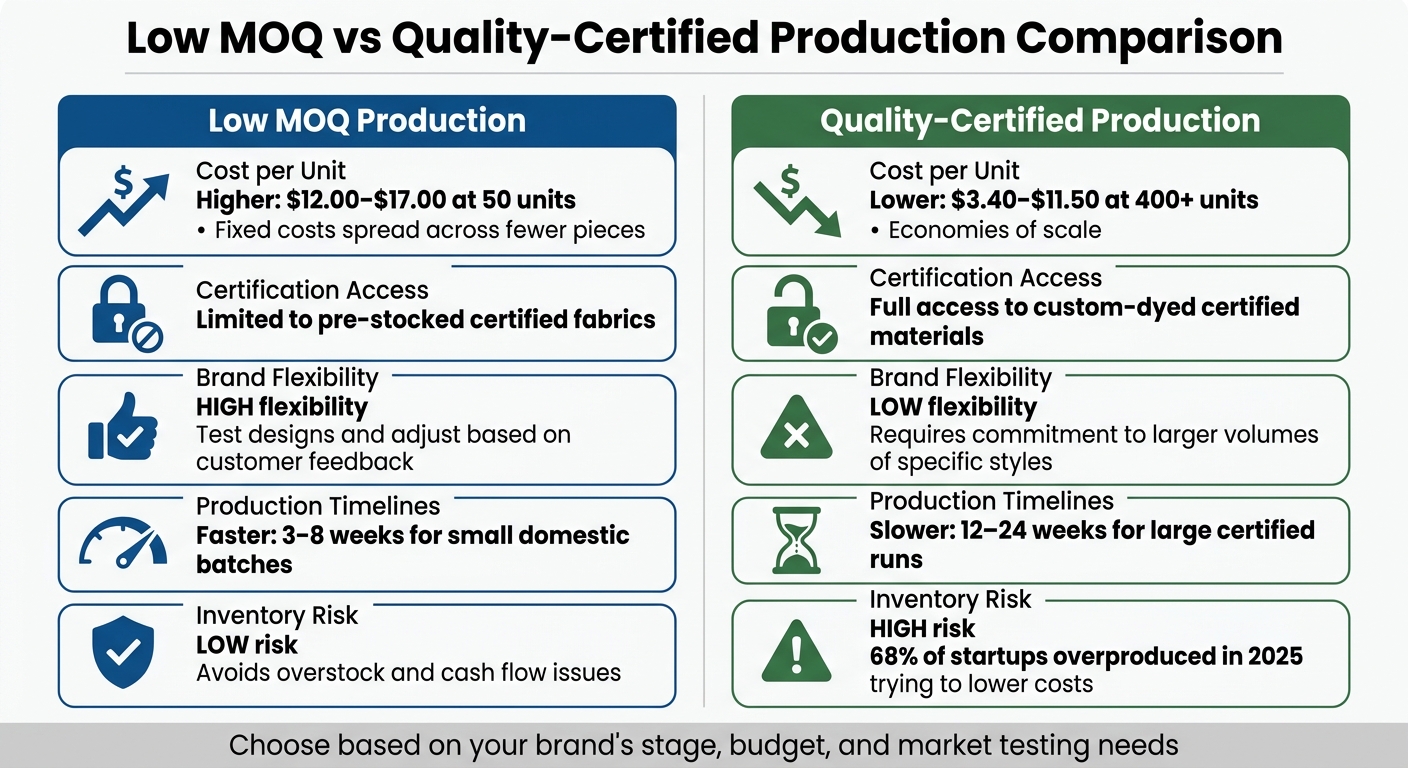
Here’s a quick comparison of the trade-offs:
| Feature | Low MOQ | Quality-Certified Production |
|---|---|---|
| Cost per Unit | Higher ($12.00–$17.00 at 50 units) due to fixed costs spread across fewer pieces | Lower ($3.40–$11.50 at 400+ units) with economies of scale |
| Certification Access | Limited to pre-stocked certified fabrics | Full access to custom-dyed certified materials |
| Brand Flexibility | High - test designs and adjust based on customer feedback | Low - requires commitment to larger volumes of specific styles |
| Production Timelines | Faster - 3 to 8 weeks for small domestic batches | Slower - 12 to 24 weeks for large certified runs |
| Inventory Risk | Low - avoids overstock and cash flow issues | High - 68% of startups overproduced in 2025 trying to lower costs |
This breakdown highlights the trade-offs between flexibility and the cost benefits of certified materials. It also emphasizes the strategic decisions small brands face. Industry expert David Kim offers practical advice for navigating these challenges:
Design your first collection around the MOQ reality, not the other way around. If you can only afford 100 units total, launch one amazing style in two colors.
This approach allows you to meet manufacturer requirements while maintaining high-quality standards, even with limited resources.
Conclusion
Finding the right balance between MOQs and quality certifications calls for a mix of smart planning and strategic decisions. For instance, you can consolidate fabric choices by using a single organic cotton blend across multiple products like t-shirts, hoodies, and joggers. This helps meet fabric minimums (typically around 500–1,000 meters) without overcommitting. Another great option is to work with stock fabrics that are already woven and certified, which eliminates the need for custom dyeing and its associated high MOQs.
Focusing on certifications like GOTS and GRS early on is a smart move. These not only ensure product safety but also allow for premium pricing - something parents value highly in children's apparel. Plus, manufacturers are often more open to smaller initial orders (as low as 50–100 units) if you present a clear plan for long-term growth and repeat business.
You can also pool fabric orders or collaborate with sourcing agents to access mills that offer lower minimums. Timing your orders during factory slow seasons - typically January to February or July to August - can also lead to more flexibility on MOQs. Together, these approaches can help streamline production while maintaining high standards.
Don’t forget to test your products rigorously before committing to bulk orders. This includes tests like five washes or pull tests on buttons to ensure safety and durability. In the world of children's wear, success doesn’t necessarily come from having the biggest budget; it often comes from designing smartly around MOQ challenges while prioritizing the certifications that matter most to parents. Start small - focus on one standout style in two colorways instead of spreading your resources thin across multiple designs. By blending efficient MOQ strategies with top-tier certifications, you can build a brand that's both nimble and trustworthy.
FAQs
How can I negotiate a lower MOQ without sacrificing quality?
Simplifying your product design can be a smart move when negotiating a lower MOQ (Minimum Order Quantity). By reducing complexity and standardizing materials, you make it easier and more cost-effective for manufacturers to produce your product. Opt for materials that are readily available, as this helps avoid extra sourcing costs that could drive up the price.
Building long-term relationships with manufacturers can also work in your favor. Over time, manufacturers may offer more flexible terms and prioritize quality assurance, even for smaller production runs. Another tip? Look for manufacturers who specialize in handling low MOQs. These suppliers often have the expertise to maintain high standards while accommodating smaller orders.
What proof should I ask for to verify GOTS or GRS claims?
To confirm GOTS or GRS claims, ask for third-party certification or official documentation. This could include a certification label or a certificate from a recognized authority. These documents serve as proof that the materials meet the necessary standards and verify the authenticity of the organic or recycled content.
When should a brand transition from small batches to larger certified runs?
When demand levels out and scaling becomes more economical, transitioning to larger certified production runs is a smart move. Early on, smaller batches work well because they offer flexibility and allow for testing. But as sales stabilize, larger orders can help lower per-unit costs, meet certification standards like GOTS, and align with expanded distribution plans. This shift supports better margins, consistent quality, and compliance with certification needs, all while keeping sustainability in focus.