Organic Cotton Baby Clothing Manufacturer Guide
Choosing an organic baby clothing manufacturer is one of the most important sourcing decisions a babywear brand can make. If you need an organic cotton baby clothing manufacturer, the right partner helps you build soft, durable, parent-trusted products with clear certification documentation, realistic minimums, and dependable production. The wrong partner can leave you with vague organic claims, inconsistent fabrics, poor fit, and delays that hurt your launch.
This guide explains how to evaluate an organic cotton baby clothing manufacturer before placing an order. It covers GOTS certified organic cotton, muslin swaddles, babywear product categories, private label support, customization, MOQs, and the practical questions to ask before you commit.
What An Organic Cotton Baby Clothing Manufacturer Should Prove
Organic babywear is not only about fabric softness. It is about traceability, documentation, product suitability, and production control.
A credible manufacturer should be able to explain:
- Which organic fabrics it can source.
- Which certifications apply to the fabric, facility, or finished product.
- Whether documentation is current and available for buyers.
- How it manages sampling, fit, trims, labels, and packaging.
- What minimum order quantity applies to each product category.
- How quality is checked before bulk goods ship.
This matters because baby clothing is handled differently from general apparel. Babies have sensitive skin, garments are washed frequently, and parents expect safety, comfort, and transparency. A babywear manufacturer should understand newborn sizing, soft seam finishing, shrinkage, breathable fabrics, and quality checks for baby and toddler use.
Start With GOTS Certified Organic Cotton
If your brand wants to sell organic baby clothes, begin by asking what can actually be certified. GOTS is a recognized standard for textiles made with organic fibers and covers environmental and social criteria across textile processing. A manufacturer should be clear about whether GOTS applies to the yarn, fabric, processing unit, garment facility, or the finished product.
For a product to carry a GOTS claim, the supply chain needs to be checked carefully. Ask for certification documents, transaction certificates where relevant, and clarity on whether trims, dyes, prints, and labels fall within the certification scope.
Little Eco Threads works with GOTS certified organic cotton and supports brands that need certified organic cotton clothing, GOTS certified baby clothing, and GOTS certified fabric sourcing for baby and children's collections.
Certification should never be treated as a logo exercise. It should support the actual claim your brand intends to make on the product page, hangtag, care label, and wholesale documentation.
Choose Fabrics Based On Babywear Use
Organic cotton is a strong starting point, but different baby products need different fabric structures. A bodysuit, swaddle, bib, romper, quilt, and sleepwear set cannot all be evaluated with the same fabric checklist.
Common organic babywear fabric questions include:
- Is the fabric soft enough for newborn skin?
- What GSM is available?
- Does the fabric shrink after washing?
- Does it hold color and print clearly?
- Is the fabric breathable enough for the product's use?
- Can the supplier document the organic cotton source?
- Are labels, snaps, threads, and trims suitable for baby clothing?
Muslin is especially important in newborn ranges. It is a lightweight woven cotton fabric that softens with washing, which is why muslin swaddles, organic baby swaddles, organic cotton swaddles, muslin baby clothes, and muslin burp cloths are common in baby collections. If you are developing baby swaddles, ask about weave density, shrinkage, print durability, and edge finishing.
For broader babywear ranges, organic cotton jersey works well for baby bodysuits, baby rompers, and baby sleepwear. Corduroy can work for structured toddler pieces. linen is useful for breathable warm-weather sets, while denim can support durable toddler and kidswear pieces when the construction is designed carefully.
Check Product Range Before You Scale
A strong baby and children's clothing manufacturer should support more than one starting product. Many brands begin with organic newborn clothes or organic cotton baby clothes, then expand into accessories, sleepwear, toddlerwear, and giftable products.
Useful categories to check include:
- Baby rompers and organic baby rompers.
- Baby bodysuits and organic baby bodysuits.
- Baby sleepwear and PJ sets.
- burp cloths, organic burp cloths, and muslin burp cloths.
- bib sets, baby bibs, and feeding accessories.
- baby gift sets for retail and wholesale gifting.
- knitwear, summer wear, and swimwear for seasonal collections.
Range matters because changing factories every time you add a category slows product development. A sustainable baby clothing manufacturer with broad baby clothing manufacturing experience can help your brand keep fabrics, trims, packaging, and quality control more consistent across collections.
Little Eco Threads supports babywear manufacturing, kidswear manufacturing, and baby clothing production across apparel and accessories, which is useful for brands planning beyond one launch.
Confirm Custom And Private Label Capability
If you are building a brand, not buying generic stock, customization is central. Ask whether the manufacturer supports custom children's clothing, custom baby clothes manufacturing, pattern development, size grading, embroidery, smocking, custom prints and colourways, and branded packaging.
Private label support matters too. A good partner should be able to produce private label baby clothing with woven labels, printed labels, hang tags, care labels, packaging, and carton markings aligned with your brand requirements.
Before sampling, ask:
- Can you work from a tech pack, sketch, or reference sample?
- Can you match our brand size chart?
- Can you develop custom baby clothing from scratch?
- Can you create custom prints and colourways?
- Can you source organic cotton clothing manufacturer materials to specification?
- Can you manage labeling and packing for wholesale or direct-to-consumer channels?
For baby brands, small details matter. Neck openings, snaps, bindings, drawstrings, elastics, trims, and embroidery placement should be reviewed carefully before bulk production.
Understand MOQ Before You Compare Prices
Minimum order quantity affects cash flow, inventory risk, and the number of styles you can launch. A low unit price can still be a poor commercial decision if the MOQ forces you into more inventory than you can sell.
For growing brands, a low MOQ baby clothing manufacturer can make it easier to test organic baby clothing, private label baby clothes, baby swaddles, bib sets, or baby gift sets before committing to larger production.
That does not mean every product should have the same minimum. MOQs usually vary by fabric, dyeing method, print, trims, packaging, and complexity. A custom baby clothing manufacturer may have one MOQ for simple muslin swaddles, another for printed organic cotton babywear, and another for heavily customized sleepwear or knitwear.
When you request a production quote, compare the full sourcing picture: fabric quality, certification documentation, sampling support, minimums, quality control, packaging, lead time, and scalability.
Review Quality Control For Baby Clothing
Quality control is especially important for baby apparel because parents notice fabric feel, fit, stitching, and wash performance quickly. A manufacturer should be able to explain its inspection process in practical terms.
Ask how the factory checks:
- Fabric defects before cutting.
- Shrinkage and colorfastness.
- Stitching, seams, hems, and bindings.
- Snaps, buttons, labels, and trims.
- Print placement and embroidery finishing.
- Measurements across sizes.
- Packing, labeling, and carton details.
For organic cotton baby clothing, quality control should also support claim integrity. Documentation, material handling, and production records should align with the certification claims your brand plans to make.
Watch For Red Flags
Some issues are worth taking seriously before you place a purchase order.
Red flags include:
- Organic claims with no documentation.
- Certification logos shown without current certificates.
- Unclear answers about fabric sourcing.
- No sample process before bulk production.
- MOQ or pricing that changes without explanation.
- Limited experience with baby and children's apparel.
- No clear private label or packaging workflow.
- No quality-control standard explained in writing.
A cheap quote is not useful if the manufacturer cannot prove what it is producing or keep quality consistent.
Why Little Eco Threads Is Worth Considering
Little Eco Threads is an organic clothing manufacturer and kidswear manufacturer for brands that need babywear, children's clothing, and private label production with sustainable materials and flexible development support.
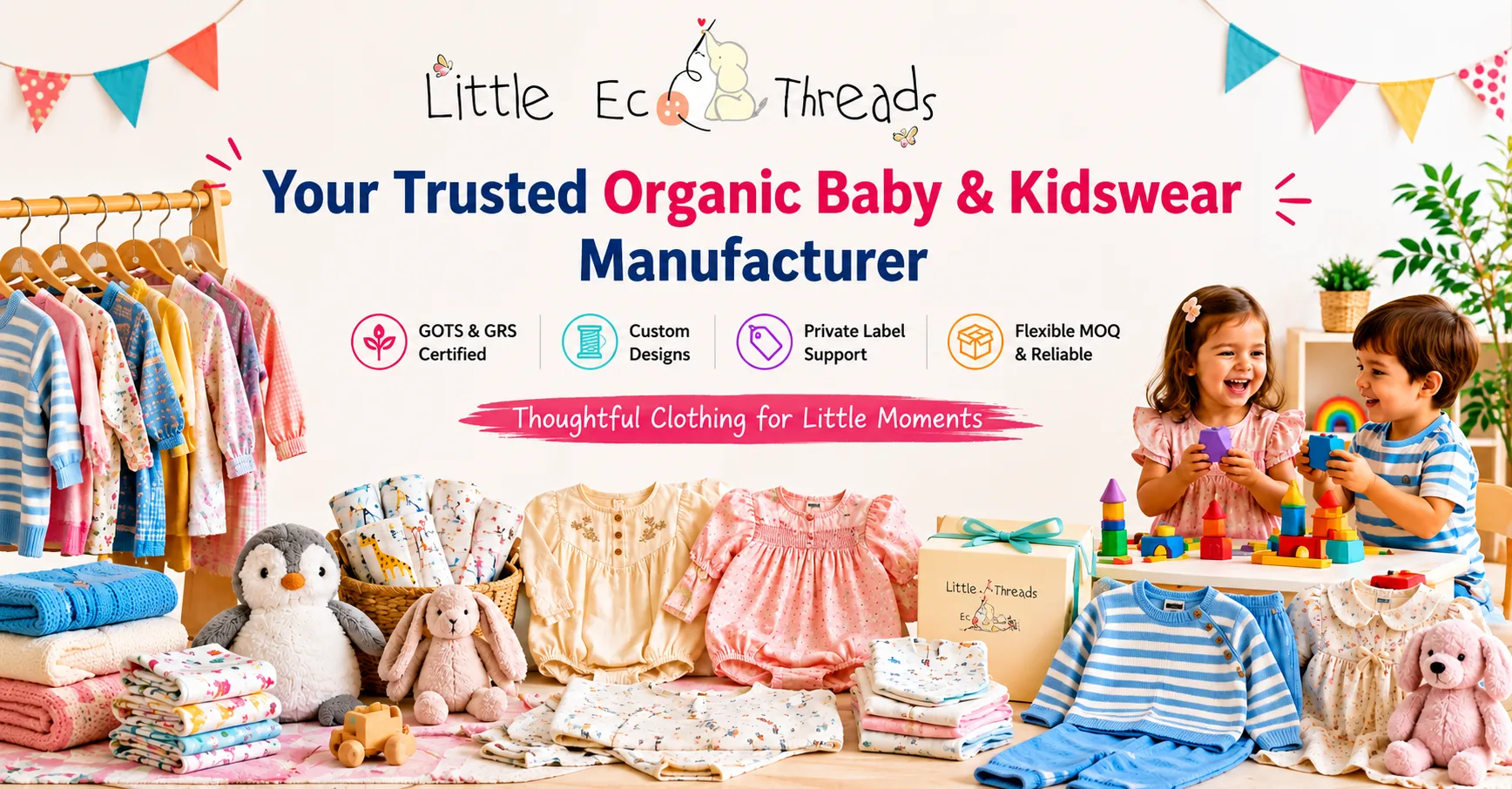
The range includes muslin swaddles, baby swaddles, burp cloths, bib sets, baby gift sets, rompers, bodysuits, sleepwear, knitwear, summer wear, swimwear, linen, denim, and more. The team can also support custom prints and colourways, embroidery, smocking, branded labels, and packaging.
For brands comparing baby apparel manufacturer options, the practical advantage is being able to develop baby and kidswear collections with one production partner instead of managing separate suppliers for every category.
To evaluate fabrics before production, you can request fabric swatches. To plan pricing, MOQ, and lead times for a specific collection, request a production quote with your target products, fabric preferences, size range, and expected launch timeline.
Frequently Asked Questions
What is an organic baby clothing manufacturer?
An organic baby clothing manufacturer produces baby garments and accessories using organic fabrics such as organic cotton. A good manufacturer should also help with sourcing documentation, sampling, quality control, labeling, and production planning.
Is GOTS certified organic cotton important for baby clothes?
GOTS certified organic cotton is important when a brand wants stronger support for organic textile claims. It helps buyers understand that organic fiber and processing requirements have been reviewed through a recognized certification system.
What is muslin fabric used for in babywear?
Muslin fabric is commonly used for baby swaddles, burp cloths, lightweight blankets, bibs, and other newborn accessories because it is breathable, soft, and practical for repeated washing.
Can a manufacturer make private label baby clothes?
Yes, if the manufacturer offers private label baby clothing support. Ask about custom labels, care labels, hang tags, packaging, size grading, and whether the supplier can follow your brand's product specifications.
What should I send before asking for a quote?
Send product types, target fabrics, size range, quantity per style, reference images or tech packs, certification needs, packaging requirements, and your target delivery date. This helps the manufacturer give a more accurate MOQ, sampling, and production estimate.