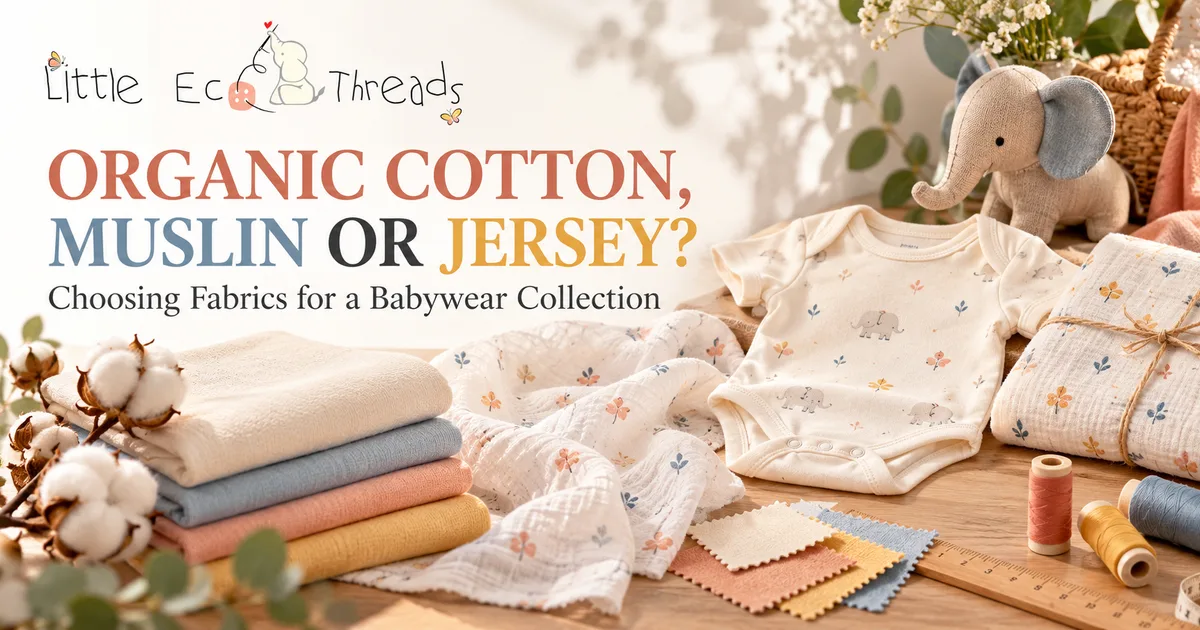
Organic Cotton, Muslin or Cotton Jersey? Choosing Fabrics for a Babywear Collection
Fabric Selection Is a Product Development Decision
Choosing fabric for a babywear collection is rarely a matter of picking the softest option on a swatch card. Fabric affects how a garment is cut, sewn, finished, priced, tested and cared for. It also determines which material claims a brand can accurately make on a label or wholesale line sheet.
Organic cotton, muslin and cotton jersey often appear together in sourcing conversations, but they describe different things. Organic cotton describes how a fibre was grown. Muslin describes a woven fabric, often made from cotton. Jersey describes a knitted structure. A brand may use organic cotton to make both muslin and jersey, so the practical question is which construction suits each product and whether any fibre or certification claim can be evidenced.
This guide is for founders launching a babywear label, brands expanding a range and buyers comparing options before sampling begins. Little Eco Threads is a baby and children's apparel manufacturer based in Noida, India. The focus here is on fabric and product-development decisions that brands should consider before moving into production.
Organic Cotton: Understanding the Material
Organic cotton is cotton grown under applicable organic farming standards. These standards generally restrict the use of certain synthetic pesticides and fertilisers and prohibit genetically modified seed. The key distinction for a brand is that organic cotton describes the fibre's production status; it does not, by itself, describe the fabric construction or certify a finished garment.
After harvesting, cotton is spun into yarn and then knitted or woven. It may also be dyed, printed, finished and sewn. Those stages affect yarn quality, fabric weight, shrinkage, colour fastness and the chemicals used in processing. The word “organic” alone does not guarantee a particular level of softness, durability, chemical safety or performance.
How organic cotton is used in babywear
Organic cotton can be made into a range of constructions. Brands may specify it for knitted bodysuits, rompers and sleepwear, as well as woven fabrics such as muslin. A newborn collection might use knitted organic cotton for a bodysuit, hat and trousers, while a matching swaddle or bib uses woven muslin. Blends are also possible, but the composition needs to be stated accurately because it affects both performance and the claims a brand can make.
What brands should evaluate
- Fibre versus certification. Confirm whether the fabric is made from organic cotton or whether a certification covers the fabric, processing stages or finished product. Check exactly what the certificate applies to.
- Traceability. Ask how the supplier documents fibre origin and composition, including the percentage of each fibre in a blend.
- Consistency. Natural fibres can vary between lots. Agree colour, hand-feel and physical sample approvals before bulk production.
- Cost and availability. Fabric mills may have minimum quantities, and organic options may affect costs and available colourways. Check these constraints while planning the collection.
- Processing requirements. Organic farming does not automatically settle questions about dyes, finishes or processing residues. These require separate controls and, where applicable, testing.
Muslin: Lightweight Fabric for Newborn Essentials
Muslin is a woven fabric, commonly made with a plain weave in which weft yarns pass alternately over and under warp yarns. Babywear muslin is often lightweight and relatively open, with a gauzy texture that may become more pronounced after washing. However, weight, yarn fineness and weave density vary, so the word “muslin” alone is not a complete fabric specification.
Where muslin is used
Muslin is commonly used for swaddles, burp cloths, bibs, receiving blankets and lightweight blankets. Some collections also use it for summer garments and other lightweight products. A brand could develop several prints or solid colours for muslin swaddles and extend the same fabric into coordinating bibs and burp cloths. Before doing so, it should confirm that the fabric performs appropriately for each intended use.
Product-development considerations
Because muslin is woven, it behaves differently from a knitted fabric. It has limited natural stretch, and an open weave may distort or fray at cut edges if it is not handled and finished appropriately.
- Shrinkage. Agree washing methods and shrinkage tolerances during sampling. Confirm finished dimensions after washing, not only before.
- Layers and weight. Single-layer and multi-layer constructions behave differently and have different costs. Specify the required layers, weight and relevant yarn details.
- Edge and seam finishing. Hemming, overlocking or binding affects appearance, durability and how a swaddle or bib handles in use.
- Printing. An open or gauzy surface can make fine details and colour registration more challenging. Test the artwork on the actual fabric before approving production.
Muslin is often described as soft and airy, but those qualities depend on the yarn, weave and finishing. They should be assessed on a sample rather than assumed from the fabric name.
Cotton Jersey: A Knit Fabric for Everyday Babywear
Jersey is a knitted fabric. Unlike a woven fabric, where two sets of yarn cross at right angles, a knitted yarn forms interlocking loops. Single jersey generally has a smoother face and a more textured reverse. The loop structure allows stretch, while recovery depends on the yarn, knit construction, finishing and any added elastane.
Where cotton jersey is used
Cotton jersey is widely used for bodysuits, rompers, sleepsuits, tops, leggings and hats. For example, a newborn bodysuit needs a neckline that can stretch during dressing and return towards its original shape. Ribbed and other knitted structures may be selected for cuffs, necklines or garments where a different level of stretch and structure is required.
Why “cotton jersey” is not a full specification
Two jersey fabrics can behave very differently. Brands should confirm the details rather than choosing by name alone.
- Composition. Specify whether the fabric is cotton, organic cotton or a blend, and state the fibre percentages.
- Weight. Weight is commonly expressed in grams per square metre (GSM). The appropriate weight depends on the product, season, layering and intended fit.
- Yarn and construction. Yarn type, stitch density and whether the fabric is single jersey, rib or interlock affect hand feel, stability and potential pilling.
- Finishing. Pre-shrinking, brushing and other treatments can change how the fabric behaves after washing.
- Manufacturing quality. Knits may twist or skew after washing if they are not stabilised and cut carefully. Cutting, sewing and finishing are as important as the base fabric.
Snaps, necklines and seams interact with stretch, so garment construction and fabric should be developed together. When evaluating a babywear manufacturing partner, brands should ask how fabric specifications are checked and how samples are approved before bulk production.
Organic Cotton vs. Muslin vs. Cotton Jersey: How Should Brands Compare Them?
These terms describe different layers of a material decision and should not be treated as three equivalent alternatives. Organic cotton describes the fibre's production status; muslin generally describes a woven fabric; and jersey describes a knitted fabric. The useful comparison is between fabric constructions, while fibre composition and certification are assessed separately.
| Comparison | Organic cotton | Muslin | Cotton jersey |
|---|---|---|---|
| What the term describes | The production status of cotton fibre | A fabric type, generally a lightweight woven | A knitted fabric structure |
| Construction or material | Can be made into woven or knitted fabrics | Often a plain, relatively open weave; usually cotton | Interlocking yarn loops; stretch depends on construction and composition |
| Typical babywear uses | Any product made from a suitable organic-cotton fabric | Swaddles, burp cloths, bibs and lightweight blankets | Bodysuits, rompers, sleepsuits, tops, leggings and hats |
| Potential development advantages | Can support an organic-fibre product position when documented | Useful for lightweight cloth products and layering; print suitability should be tested | Stretch can suit garments that need movement and close fit |
| Limitations to consider | Does not alone establish quality, chemical safety or certification; cost and lot variation may matter | Shrinkage, edge finishing and print detail need control; limited stretch | Weight, yarn and finishing vary; shrinkage, twisting and skew need control |
| Questions to ask | Is the fibre composition documented? What certification, if any, covers the material or product? | What are the weight, layers and wash treatment? How are edges finished? | What are the composition, GSM and knit structure? How is shrinkage managed? |
How to Choose Fabric for a Babywear Collection
Not every factor carries equal weight for every product. Start by identifying the two or three requirements that matter most for each item, then test those requirements during sampling.
Start with the product and how it is used
A swaddle, bib and bodysuit have different needs. For a swaddle or burp cloth, wash behaviour, weight, edge finishing and print quality may be central. For a bodysuit or romper, stretch, recovery, neckline shape and snap placement may matter more. For sleepwear, check the fit and flammability requirements of the destination market early because requirements can vary by market and garment type.
Specify the fabric fully
A useful specification goes beyond a fibre or fabric name. It should state composition, weight, construction, relevant yarn details, finishing and wash treatment, and it should be approved against a physical sample. “Organic cotton jersey” or “muslin” is a starting point, not a complete specification.
Plan for colour, print and embroidery
Test decoration on the actual fabric. Prints behave differently on open wovens and stretch knits; shade can vary between lots; and embroidery may require stabilisation on a lightweight or stretchy base. Confirm these requirements before committing to the fabric and artwork.
Consider care, durability and product positioning
Babywear is often washed repeatedly, so assess shrinkage, shape retention and colour fastness after washing. The right balance also depends on the target customer and price point. A premium gift range and an everyday basics collection may have different priorities, but both need specifications that match the product's intended use.
Protect consistency and check market requirements
A good sample is not enough if bulk production varies. Agree approval stages, inspection points and tolerances before production begins. Confirm the applicable testing and certification requirements for the destination market and product type. In the United States, for example, certain children's products are subject to requirements under CPSC rules, and a Children's Product Certificate may be required where applicable. Brands should confirm the exact obligations for each product with the relevant regulator, testing laboratory or qualified compliance adviser.
Certification and Material Verification
Choosing a material and verifying a claim about it are separate steps. A supplier may describe a fabric as organic cotton, but a brand that wants to market a product as organic or certified needs evidence that matches the exact material, product and claim.
What GOTS covers
The Global Organic Textile Standard (GOTS) is a processing standard for textiles made from organic fibres. Its requirements cover relevant processing stages and include environmental and social criteria, with independent certification. GOTS has different label grades and minimum organic-fibre content requirements. A brand considering a GOTS claim should verify the current standard, applicable label grade, certification scope and whether the relevant supply-chain entities and goods are covered. Do not assume that a supplier's general certification automatically covers every fabric or finished product.
What OEKO-TEX STANDARD 100 covers
OEKO-TEX STANDARD 100 is a textile product-testing label focused on harmful substances. Requirements depend on intended use and product class; the class for products intended for babies and toddlers has particularly strict limits. It does not establish that a fibre is organic and is not a substitute for social or environmental auditing.
Why the two are not interchangeable
GOTS addresses organic-fibre status and processing requirements, while OEKO-TEX STANDARD 100 focuses on testing textiles for harmful substances. A product may hold one, both or neither, and each makes a different claim. When a supplier cites a certification, request the certificate, check its validity and scope against the issuer's records, and confirm that it applies to the specific fabric and style. Neither certification replaces legal testing or compliance obligations in the destination market.
How Little Eco Threads Fits into the Picture
For brands developing babywear and children's apparel, fabric selection is one part of a wider product-development decision. Little Eco Threads is positioned in the babywear and children's apparel manufacturing sector, with a focus on helping brands develop products for their collections. The material, construction, finishing and product requirements should be discussed together so that the chosen fabric is suitable for the intended item.
A brand considering a manufacturing partner should bring a clear brief to the discussion: the product type, target age group, intended market, fabric composition, preferred weight, colour or print requirements, expected care performance and any relevant testing or certification needs. If these details are not final, the initial conversation can identify which specifications need to be resolved before sampling.
Little Eco Threads should be evaluated against the specific requirements of the proposed collection, just as any manufacturing partner should. Confirm current product capabilities, available materials, customisation options, certification scope and production terms directly with the company before making decisions or communicating claims to customers.
Conclusion: Choose the Fabric for the Product, Not Just the Name
Organic cotton, muslin and cotton jersey are not interchangeable labels. Organic cotton describes the fibre's production status, while muslin and jersey describe different fabric constructions. A well-planned collection may use more than one of them, depending on whether the product is a swaddle, bib, bodysuit, romper or another babywear essential.
For brands, the most reliable approach is to define the product's needs, write a complete fabric specification, assess physical samples, test relevant performance and verify any material or certification claims. Little Eco Threads can be part of that discussion for businesses exploring babywear and children's apparel manufacturing. Start with the product brief and confirm the material and production details before moving to bulk production.