
Organic Cotton vs Conventional Cotton: Cost Comparison for Children's Clothing Brands
When deciding between organic and conventional cotton for children's clothing, one of the biggest questions for brands is the organic cotton price compared with conventional cotton. Organic cotton is generally more expensive upfront because of lower yields, labor-intensive farming, certification fees, and additional processing requirements. However, it offers longer-lasting fibers, reduced chemical exposure, and aligns with growing consumer demand for safer, eco-conscious products. Conventional cotton is cheaper but comes with hidden costs like shorter fiber lifespan, potential reputational risks, and environmental concerns.
Key Takeaways:
- Organic Cotton: Costs $0.85–$1.10 per pound; durable, chemical-free, and appeals to health-conscious buyers.
- Conventional Cotton: Costs $0.60–$0.65 per pound; cheaper but linked to higher waste and ethical concerns.
- Hybrid Approach: Use organic for essentials like baby clothes, conventional for outer layers to balance costs.
Quick Comparison:
| Criteria | Organic Cotton | Conventional Cotton |
|---|---|---|
| Cost per Pound | $0.85–$1.10 | $0.60–$0.65 |
| Durability | Stronger fibers; lasts longer | Weaker fibers; wears out faster |
| Certification Costs | High (e.g., GOTS certification) | Lower (optional certifications) |
| Chemical Use | None (chemical-free farming) | High (pesticides, insecticides) |
| Brand Appeal | Safer, aligns with eco-conscious buyers | Budget-friendly, but reputational risks |
For brands, organic cotton supports long-term quality and trust, while conventional cotton offers short-term savings. A balanced strategy can help manage costs while meeting customer expectations.
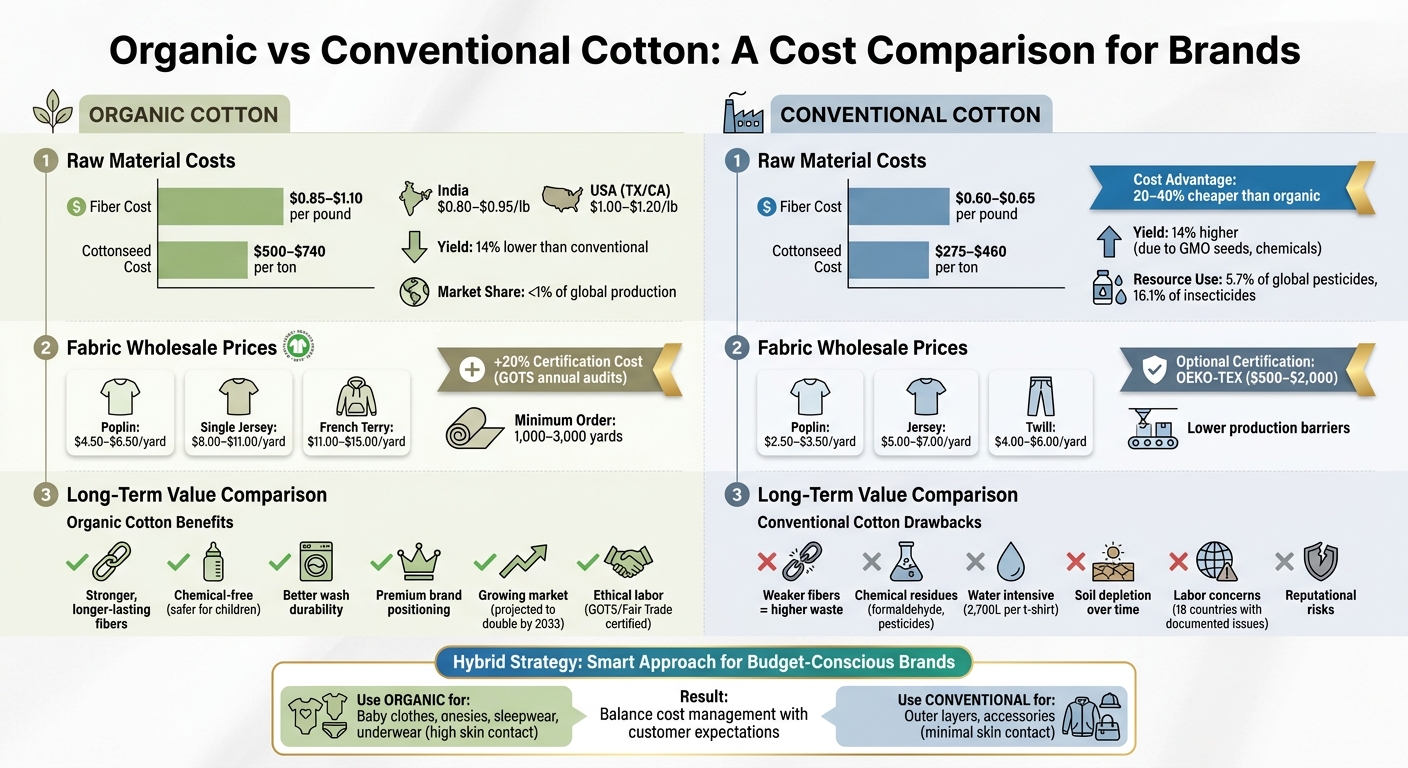
1. Organic Cotton
Raw Material Costs
As of January 2026, the organic cotton price ranges from $0.85 to $1.10 per pound, which is about 20–40% more than conventional cotton, priced at $0.60 to $0.65 per pound. Similarly, organic cottonseed is priced at $500 to $740 per ton, significantly higher than conventional seed at $275 to $460 per ton, reflecting a premium of 60–80%. These higher costs stem from factors like 14% lower yields, labor-intensive methods such as hand-weeding and hand-picking, and the mandatory three-year chemical-free transition period required for organic certification.
Regional differences also play a role in pricing. For instance, organic cotton from India is among the least expensive at $0.80 to $0.95 per pound, while U.S.-grown organic cotton from states like Texas or California typically costs $1.00 to $1.20 per pound. Additional costs arise from maintaining supply chain segregation, as organic cotton must be kept separate from conventional cotton during processes like ginning and spinning. Given that organic cotton accounts for less than 1% of global production, its prices are particularly vulnerable to regional demand spikes and seasonal variations.
Production and Certification Expenses
The cost of achieving GOTS (Global Organic Textile Standard) certification adds another layer of expense. For brands using GOTS certified organic cotton, requirements such as annual audits and Transaction Certificates can increase production costs.
Production facilities also face added challenges. Machines must be thoroughly cleaned between processing organic and conventional cotton, and smaller production runs for organic cotton often require minimum orders of 1,000 to 3,000 yards for woven fabrics to offset these costs. For brands producing organic kidswear, additional requirements around non-toxic dyes and gentler processing can further increase production expenses while helping maintain the quality and integrity of organic cotton clothing. Wholesale fabric prices under GOTS standards reflect these added costs: poplin costs $4.50 to $6.50 per yard, single jersey ranges from $8.00 to $11.00 per yard, and French terry is priced at $11.00 to $15.00 per yard.
Long-Term Cost Implications
While organic cotton comes with higher upfront costs, its long-term benefits can make it a worthwhile investment for brands building sustainable kidswear collections. Organic cotton boasts longer, stronger fibers that hold up better to repeated washing, a particularly valuable feature for children's clothing. This durability can lead to savings over time, as garments last longer and maintain their quality.
From a branding perspective, GOTS certification offers a clear, credible way to demonstrate your commitment to sustainability. This transparency helps differentiate your brand in a market increasingly wary of vague claims like "natural" or "eco-friendly." With the organic cotton market projected to nearly double by 2033, GOTS certification also supports premium pricing by aligning your brand with growing consumer demand for verified sustainable products.
2. Conventional Cotton
Raw Material Costs
Conventional cotton stands out for its lower raw material price and production costs. As of January 2026, conventional cotton fiber is priced between $0.60 and $0.65 per pound, while organic cotton ranges from $0.85 to $1.10 per pound - a difference of 20–40% in savings. Similarly, cottonseed costs hover around $275 to $460 per ton, compared to $500 to $740 per ton for organic cotton.
These cost advantages stem largely from the use of genetically modified seeds, synthetic fertilizers, and chemical pesticides, which increase yields by about 14%. Additionally, machine harvesting, as opposed to labor-intensive hand-picking, further reduces expenses. For children's clothing brands, this cost efficiency makes conventional cotton an attractive option. However, the trade-off is significant: conventional cotton uses just 2.4% of global agricultural land but consumes 5.7% of global pesticides and 16.1% of insecticides.
These savings on raw materials also translate into reduced production costs, making conventional cotton a budget-friendly choice.
Production and Certification Expenses
Conventional cotton avoids the high costs associated with organic certification. Unlike organic cotton, it does not require annual audits, transaction certificates, or strict supply chain segregation mandated by certifications like GOTS (Global Organic Textile Standard). Instead, some manufacturers opt for OEKO-TEX Standard 100 certification, which focuses on chemical safety but is optional and much cheaper - costing around $500 to $2,000 per product line.
These reduced certification expenses are reflected in wholesale fabric prices. Conventional cotton fabrics are significantly cheaper, with poplin costing $2.50 to $3.50 per yard, jersey priced at $5.00 to $7.00 per yard, and twill estimated at $4.00 to $6.00 per yard. For children's clothing brands, these lower costs can be appealing, though the presence of chemical residues in conventional cotton may pose risks to sensitive infant skin.
Long-Term Cost Implications
While conventional cotton offers upfront savings, the long-term costs tell a different story. The market price fails to account for what the Environmental Justice Foundation calls the "true costs" of production. Continuous use of synthetic fertilizers depletes soil health, requiring higher inputs over time just to maintain yields. A stark example of unsustainable practices is the Aral Sea, which has lost 90% of its volume due to excessive cotton irrigation.
From a brand perspective, conventional cotton comes with reputational risks. The industry has documented cases of forced and child labor in at least 18 countries, and there is growing demand for transparent supply chains. Additionally, conventional cotton's shorter and weaker fibers may lead to higher waste during production, potentially offsetting some of the initial cost advantages. Producing just one conventional cotton t-shirt consumes approximately 2,700 liters (713 gallons) of water. Moreover, heavy pesticide use contributes to chronic illnesses among workers, which could result in future legal or regulatory challenges.
Organic Cotton vs. Regular Cotton: Pros and Cons
Deciding between organic and conventional cotton involves weighing several factors. Here's a side-by-side comparison that highlights the financial and ethical considerations discussed earlier.
| Factor | Organic Cotton | Conventional Cotton |
|---|---|---|
| Upfront Production Costs | Challenges: Organic cotton comes with higher production costs, leading to noticeably higher retail prices. | Advantages: Lower raw material costs and fewer certification expenses help keep prices down. |
| Long-Term Value | Advantages: Known for its durability, reducing the need for frequent replacements and returns. | Challenges: Shorter, weaker fibers result in higher waste, more rejects, and faster garment wear. |
| Environmental Impact | Advantages: Organic farming methods consume less water and energy while producing fewer emissions. | Challenges: Heavy reliance on chemicals (16.1% of global insecticides) and significant water usage. |
| Market Appeal for Sustainable Children's Clothing | Advantages: Hypoallergenic and chemical-free, making it attractive to parents and premium brands. | Challenges: Residual chemicals, like formaldehyde and pesticides, can irritate sensitive skin, potentially harming brand trust. |
| Labor & Ethics | Advantages: Certifications such as GOTS and Fair Trade ensure ethical practices, including fair wages and banning child labor. | Challenges: Reports of forced and child labor highlight ongoing transparency issues in the supply chain. |
As Basico Branco aptly puts it, "The cheapest program often gets expensive after QC, reprints, and customer fallout".
While conventional cotton offers lower initial costs, organic cotton's durability and appeal often translate to better long-term value, aligning with sustainable business goals. This balance is critical for brands competing in the children’s clothing market and investing in sustainable kidswear manufacturing.
Conclusion
The decision between organic and conventional cotton comes down to your brand's priorities and long-term goals. While organic cotton may cost 20–30% more upfront, its durability and verified certifications can boost value over time.
One major advantage is durability. Unlike conventional cotton, organic fibers aren't weakened by harsh chemicals, meaning they withstand repeated washes better. For children's clothing, which often endures heavy use, this durability is a big plus. It allows garments to maintain their quality longer, supporting higher retail prices and reducing markdowns. These factors can lead to healthier margins despite the higher production costs.
For brands with limited budgets, a hybrid strategy can strike the right balance. Use organic cotton for high-contact essentials like onesies, sleepwear, and underwear, where its benefits really stand out. For items like outer layers or accessories, where skin contact is minimal, conventional cotton can help keep costs manageable. This approach lets you highlight the appeal of organic materials without overextending your budget.
Testing is also key. Order small samples to evaluate factors like shrinkage, dye consistency, and pilling. Make sure to confirm certifications such as GOTS or OCS to avoid falling for misleading "greenwashed" claims. Additionally, direct-to-consumer models can help absorb higher production costs by cutting out middleman markups, making premium organic products more affordable for your customers.
Ultimately, your material choice reflects your brand's values. If your focus is on safety and sustainability, investing in organic cotton can build trust and long-term loyalty. For brands working with a sustainable kidswear manufacturer, the choice of fabric should also be discussed early with the manufacturer because fabric availability, certification, MOQ, and production requirements can affect the final cost. On the other hand, if cost-effectiveness is your priority, a thoughtful mix of conventional and organic fibers may better align with your immediate needs as you grow.
FAQs
How much does switching to organic cotton raise my unit cost?
Switching to organic cotton often comes with a 20–40% increase in unit costs. This difference in organic cotton price comes from more expensive harvesting and processing methods, such as hand-picking and careful cleaning, compared with conventional cotton. As a result, organic cotton basics tend to be 20–30% pricier than their conventional counterparts, though in some cases, the cost difference can climb closer to 40%. Brands need to weigh these added expenses carefully when deciding whether to transition to organic materials.
Which certification should I use: GOTS, OCS, or OEKO-TEX?
The best certification depends on what you’re aiming for. GOTS (Global Organic Textile Standard) is a strong choice for brands focused on eco-friendly practices, as it covers the entire supply chain with strict environmental and social standards. OCS, on the other hand, confirms organic fiber content but doesn’t include social or processing criteria, making it a more affordable option. Meanwhile, OEKO-TEX focuses on chemical safety in finished products but doesn’t touch on farming or social aspects, making it more of a complementary certification to pair with others.
What’s the best hybrid mix of organic and conventional for kids’ clothing?
For brands developing sustainable kids clothing, the right combination should balance health, environmental considerations, and affordability. A blend of 30% to 50% organic cotton mixed with conventional cotton can help achieve this balance. This mix helps reduce exposure to harmful chemicals while keeping costs manageable. It merges the safety benefits of organic cotton with the cost-effectiveness of conventional materials, creating a smart and thoughtful choice for children's clothing.