7 Questions to Ask Before Choosing a Baby Clothing Supplier
When picking a baby clothing supplier, your decision affects more than just inventory - it impacts product safety, quality, and your brand's reputation. Babies' sensitive skin requires clothes free from harmful chemicals like PFAS, formaldehyde, and heavy metals. To ensure safety and compliance, ask these 7 key questions:
- What certifications does the supplier have? Look for GOTS, OEKO-TEX Standard 100, or GRS certifications to confirm safe, eco-conscious fabrics.
- Can they provide safety compliance documents? Ensure they meet CPSIA standards, including batch-specific test reports and CPC documentation.
- What is their fabric sourcing and testing process? Verify the use of certified materials and request lab reports for chemical safety and durability.
- Do they follow ethical labor practices? Request third-party audit reports (e.g., SEDEX, BSCI) and ensure fair wages and safe working conditions.
- What customization and quality control options are offered? Ask about private labeling, tech packs, and strict quality control measures like AQL 1.5.
- What are their production lead times and MOQs? Confirm timelines (6–12 weeks typical) and minimum order quantities (300–500 pieces per style).
- How do they handle communication and problem-solving? Evaluate their responsiveness, transparency, and ability to manage production issues.
These questions help you assess supplier reliability, ensuring they align with safety standards, ethical values, and quality expectations.
What Sustainability Certifications Does Your Supplier Hold?
Sustainability certifications are a crucial way to verify that a supplier meets established environmental and safety standards. They go beyond marketing claims, offering concrete proof of accountability. When it comes to baby clothing, three certifications stand out: GOTS (Global Organic Textile Standard), GRS (Global Recycled Standard), and OEKO-TEX Standard 100. Each one addresses a specific aspect of production, such as organic fiber use, recycled materials, or chemical safety. Let’s break them down:
- GOTS: This certification evaluates the entire supply chain for organic textiles. Products labeled "Organic" must contain at least 95% certified organic fibers, while those marked "Made with Organic" require a minimum of 70%. Compliance is ensured through annual inspections and residue testing.
- GRS: Focused on recycled content, GRS mandates that at least 50% of a product's material be recycled. It also includes social and chemical audits to ensure broader accountability.
- OEKO-TEX Standard 100: This certification tests finished products for over 100 harmful substances, including formaldehyde, PFAS, and heavy metals. For baby clothing, suppliers must achieve Class I certification, which has the strictest limits on chemical residues and ensures saliva resistance.
Understanding Certification Types
To ensure authenticity, it’s important to distinguish between a Scope Certificate and a Transaction Certificate:
- Scope Certificate: Confirms that a factory is authorized to produce certified goods.
- Transaction Certificate: Acts as a receipt, linking your shipment to a certified fiber lot. It must align with your purchase order and invoice weight.
David Wu, a Senior Apparel Production & Quality Assurance Consultant at LeelineWear, highlights a common issue with certification misuse:
"A factory buys 1,000 yards of GRS fabric, gets one certificate, then uses that same PDF to 'verify' 10,000 yards for five different clients. The Fix: Audit the Transaction Certificate."
Verifying Certification Claims
Use official tools to confirm the validity of a supplier's certifications. Databases like the OEKO-TEX Label Check and the Textile Exchange Public Database (covering GOTS, GRS, and OCS) are excellent resources. Always match certification details with your commercial invoice and confirm that the validity covers your production run. For OEKO-TEX specifically, ensure the certification explicitly applies to "finished articles" rather than just raw materials, as components like zippers, buttons, and threads may require separate documentation.
Lastly, be cautious of generic "eco-friendly" labels or self-issued seals. Authentic certifications are provided by accredited third-party organizations like Control Union, Intertek, or SGS. The OEKO-TEX Buying Guide also offers a searchable directory of companies with valid, up-to-date certifications. These steps can help you assess your supplier’s credibility with confidence.
Can You Provide Safety Compliance Documentation?
Safety compliance documentation is a must when sourcing baby clothing for the U.S. market. The Consumer Product Safety Improvement Act (CPSIA) outlines strict requirements that suppliers need to follow. The cornerstone of compliance is the Children's Product Certificate (CPC). This self-issued document certifies that a product meets all relevant safety regulations. A CPC must include key details, such as product identification, applicable rules, manufacturer/importer information, contact details for the record keeper, manufacturing and testing dates/locations, and the information of a CPSC-accepted lab.
To support the CPC, every production batch requires third-party test reports from a CPSC-accredited lab. These reports confirm that the product complies with the listed safety standards. Fredrik Gronkvist, Co-founder of Compliancegate.com, underscores the importance of batch-specific testing:
"A test report is only valid for the very same products that you are importing to the United States. That means you must collect the sample from the production batch and submit it to the laboratory for testing".
Avoid generic test reports. Each batch must undergo specific testing. Trusted labs include Eurofins, UL, SGS, and QIMA, but always verify their accreditation on the CPSC website.
Another critical requirement is compliance with flammability standards. General clothing textiles must meet 16 CFR Part 1610, while children's sleepwear (sizes 0–14) is subject to stricter rules under 16 CFR Parts 1615 and 1616. Infant garments sized nine months or smaller are exempt from sleepwear-specific flammability rules but must still comply with general textile standards. Fabrics with plain surfaces and a weight of at least 2.6 ounces per square yard are usually exempt from flammability testing and classified as "Class 1" (normal flammability). However, never accept "Class 3" textiles, which are highly flammable and unsafe.
In addition to flammability, you’ll need documentation proving compliance with lead and phthalate limits. Lead content in substrates must be below 100 ppm, and surface coatings cannot exceed 90 ppm. Phthalates like DEHP and DBP are restricted to 0.1% in children's products. In 2022, over 5 million product units were recalled in the U.S., many due to lead violations or safety risks. Also, ensure that tracking labels are included. These labels must be permanently attached to the product and packaging, showing the manufacturer’s name, production location, date, and batch or run number.
Be prepared to provide test records within 24 hours if requested by U.S. Customs to avoid shipment delays. Testing costs typically start at $300 per style, depending on the product’s complexity. For compliance with California Proposition 65, which restricts over 800 toxic substances, expect testing costs of approximately $200 per style. Additionally, be aware of drawstring safety rules (16 CFR Part 1120). Children's upper outerwear in sizes 2T to 12 cannot have drawstrings in the hood or neck area due to strangulation risks.
Complete and accurate safety compliance documentation reflects a supplier's commitment to meeting the rigorous standards of the U.S. baby clothing market.
What Is Your Fabric Sourcing and Testing Process?
To ensure quality and safety while aligning with sustainable practices, it's important to carefully evaluate your supplier's fabric sourcing and testing methods. Start by confirming whether they use certified organic or recycled materials. For instance, fabrics with a GOTS certification must contain at least 95% organically grown natural fibers like cotton, wool, linen, or hemp. Always request the GOTS license number and verify it through the official GOTS Public Database. This step ensures the materials meet rigorous standards and sets the foundation for thorough, batch-specific testing.
Be cautious of vague claims like "organic-inspired" or "natural" unless backed by a valid certification number. Keep in mind, organic fabrics often cost 20–50% more than conventional textiles due to the added expense of certifications and labor.
In addition to reviewing safety documentation provided by your supplier, confirm that their fabric testing protocols meet established chemical and durability standards. Testing is just as critical as sourcing. Request batch-specific lab reports from the past 12 months for your fabric lot. These reports should prove compliance with chemical safety standards, such as appropriate pH levels and the absence of harmful substances like formaldehyde, heavy metals, and non-AZO-free dyes. Recent lab reports not only verify chemical safety but also reinforce your dedication to ethical and sustainable production. While certifications like GOTS, OEKO-TEX, and ISO demonstrate adherence to standards, experts stress the importance of up-to-date, fabric-specific lab reports for added assurance.
For durability, ask for pre-washed fabric swatches and 3-wash test results to evaluate shrinkage and colorfastness. These tests are particularly crucial for organic cotton, as they determine whether the fabric maintains its vibrancy and integrity after washing.
Physical testing should also include GSM (grams per square meter), weave quality, and seam strength, aiming for a target AQL (Acceptable Quality Limit) of 1.5. If possible, request video demonstrations showcasing fabric elasticity and seam durability to get a clearer understanding of its performance.
How Do You Ensure Ethical Labor Practices?
When assessing a supplier, ethical labor practices are just as important as fabric quality and safety standards. Ensuring that workers are treated fairly, paid appropriately, and work in safe environments is essential to maintaining a responsible supply chain.
To verify this, request third-party audit reports from platforms like SEDEX or BSCI. Don’t rely solely on membership claims - ask for audit reports from the past 12 months to confirm compliance with fair wages, safe working conditions, and strict bans on child or forced labor.
Certifications such as GOTS (Global Organic Textile Standard) and Fair Trade also play a crucial role. GOTS ensures humane working conditions, prohibits child labor, and requires safe, hygienic workplaces while supporting worker rights and community empowerment. Similarly, Fair Trade certification guarantees fair wages, the right to unionize, and labor protections throughout the supply chain. Always verify certification details through official databases to ensure authenticity.
If in-person factory visits aren’t feasible, ask for a signed code of conduct and consider requesting a live video tour to observe working conditions firsthand.
Transparency is a key indicator of a supplier's ethical commitment. A responsible supplier should provide visibility into every stage of production - from sourcing raw materials to spinning, dyeing, and final assembly. As Neu Nomads points out:
"The biggest indicator of sustainability in manufacturing is visibility. Does that brand make it clear where their factories are located? Can you see who is making their dresses? If it's all hush hush, that's a red flag".
Suppliers who openly share factory locations and sourcing details demonstrate genuine accountability. This level of openness strengthens trust and ensures the sustainability and integrity of your baby clothing supply chain.
What Customization and Quality Control Options Do You Offer?
After completing fabric and safety evaluations, the next step is to focus on customization options and quality control measures to finalize your supplier assessment.
Customization plays a huge role in bringing your brand's vision to life. Start by asking about private labeling options such as custom neck labels, hang tags, and care labels - these elements help reinforce your brand identity. Additionally, inquire about pattern grading services to ensure your designs are accurately scaled across all sizes, from newborn to toddler. This step is crucial for maintaining consistency in fit and appearance.
Explore whether the supplier offers tech pack support. A tech pack translates your design sketches into detailed production instructions, including fabric details, stitching specifications, and precise measurements. Don’t forget to ask about customized packaging options, like branded mailers, boxes, or inserts, which can elevate the unboxing experience for your customers. These thoughtful details not only enhance your brand but also ensure technical precision during production, reducing errors and aligning your creative vision with the final product.
When it comes to quality control, it’s essential to establish clear checkpoints throughout the production process. These should start with fabric receipt and continue through pre-shipment inspections, with agreed defect limits and documented evidence for any issues. For baby clothing, many experts recommend targeting a stricter acceptable quality level (AQL) of 1.5 for seams and trims, as these areas are particularly important for safety and durability.
Request size samples to confirm consistent fit across all ranges. Additionally, verify lab reports specific to your fabric lot to ensure it meets safety standards and is free from harmful chemicals like azo dyes and formaldehyde. To safeguard your investment, consider structuring contracts so that the final payment - typically around 30% - is only released after a successful pre-shipment quality inspection. This approach ensures accountability and protects your brand’s commitment to excellence.
What Are Your Production Lead Times and Minimum Order Quantities?
Managing production lead times is a key part of keeping cash flow steady and ensuring inventory planning runs smoothly. For organic baby clothing, the typical production timeline is 6–12 weeks, which includes several stages:
- Sampling: 7–14 days
- Fabric procurement: 2–4 weeks
- Cutting and sewing: 2–6 weeks
- Quality control: 1 week
Shipping adds another 1–3 weeks, depending on the destination and shipping method used. These timelines can be shortened by using ready-to-use stock fabrics, which can save 2–4 weeks on fabric procurement.
"Using ready-to-use organic fabrics can reduce your lead time by 2–4 weeks, especially if sampling and approvals are completed early." – Ninghow
When it comes to minimum order quantities (MOQs), these numbers often define how flexible your production process can be. In the fashion industry, orders below 500 units are considered low MOQ, while anything over 5,000 units is categorized as high MOQ. For organic cotton baby clothing, MOQs usually fall between 300 and 500 pieces per style. However, garments with more intricate designs may require higher MOQs - 100+ units for complex items, compared to 50 units for simpler pieces like rompers. Some manufacturers may allow splitting MOQs across different sizes, offering a bit more flexibility.
To stay on track, it’s wise to include a 7–14 day buffer for unexpected delays. Additionally, requesting photo or video updates at critical production milestones - such as fabric arrival, cut panels, the first 10 finished pieces, and mid-run samples - can help ensure deadlines are met without sacrificing quality.
How Do You Handle Communication and Problem-Solving?
Clear and dependable communication is just as important as meeting safety and quality standards. When you make a deposit, you're not just securing production; you're also investing in a supplier's ability to communicate effectively and solve problems efficiently.
Before committing to any agreement, take the time to evaluate how well they communicate. A simple way to test this is by sending three specific questions through email or messaging. Pay attention to their response time and the clarity of their answers. Do they ask follow-up questions to ensure they fully understand your needs? This step is key, as it complements your earlier checks on safety and quality. As an expert from BabyClothingFactory.com wisely notes, "Slow or unclear replies equal delays later."
Suppliers who use direct communication channels like WhatsApp, Slack, or email tend to resolve issues faster than those relying solely on formal methods. Be proactive - ask them about their history with production delays and how they escalate issues. A trustworthy supplier will keep you informed about potential delays early on and offer actionable solutions, like rearranging production priorities or adjusting schedules, to keep things on track.
If visiting the supplier in person isn't feasible, digital tools can help bridge the gap. Request a live video walkthrough of their operations to confirm everything is running smoothly. You can also set key production checkpoints - such as fabric delivery, cut panels, and the first batch of finished pieces - that require photo documentation and formal approval via email or messaging. These checkpoints can significantly reduce rejects, sometimes by as much as 60%.
"A good manufacturer doesn't hide problems. They manage them." – Garment Resources
Supplier Evaluation Framework
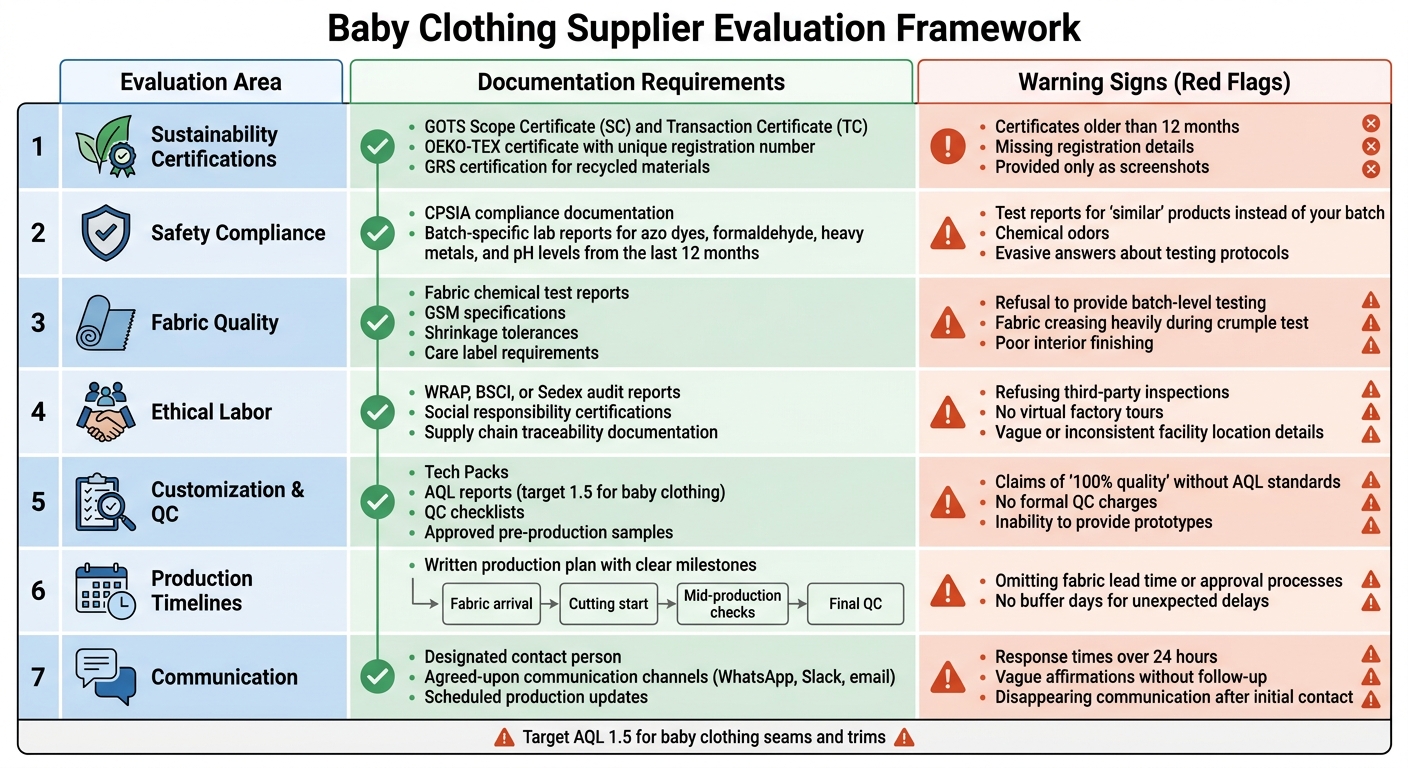
This framework brings together essential criteria for assessing suppliers, focusing on sustainability, safety, quality, and communication. It’s designed to simplify your evaluation process and ensure key standards are met.
| Evaluation Area | Documentation Requirements | Warning Signs (Red Flags) |
|---|---|---|
| Sustainability Certifications | GOTS Scope Certificate (SC) and Transaction Certificate (TC); OEKO-TEX certificate with unique registration number; GRS certification for recycled materials | Certificates older than 12 months, missing registration details, or provided only as screenshots |
| Safety Compliance | CPSIA compliance documentation; batch-specific lab reports for azo dyes, formaldehyde, heavy metals, and pH levels from the last 12 months | Test reports for "similar" products instead of your batch; chemical odors; evasive answers about testing protocols |
| Fabric Quality | Fabric chemical test reports; GSM specifications; shrinkage tolerances; care label requirements | Refusal to provide batch-level testing; fabric creasing heavily during a crumple test; poor interior finishing |
| Ethical Labor | WRAP, BSCI, or Sedex audit reports; social responsibility certifications; supply chain traceability documentation | Refusing third-party inspections; no virtual factory tours; vague or inconsistent facility location details |
| Customization & QC | Tech Packs; AQL reports (target 1.5 for baby clothing); QC checklists; approved pre-production samples | Claims of "100% quality" without AQL standards; no formal QC charges; inability to provide prototypes |
| Production Timelines | Written production plan with clear milestones (e.g., fabric arrival, cutting start, mid-production checks, final QC) | Omitting fabric lead time or approval processes; no buffer days for unexpected delays |
| Communication | A designated contact person; agreed-upon communication channels (e.g., WhatsApp, Slack, email); scheduled production updates | Response times over 24 hours; vague affirmations without follow-up; disappearing communication after initial contact |
Key Points to Remember
-
Always verify certificates using official databases like GOTS or OEKO-TEX directories instead of accepting screenshots. As the Global Organic Textile Standard explains:
"Any claim to be compliant to GOTS... is invalid until an independent Certification Body has checked... and attested – through formally issued certification documents".
-
Test reports are batch-specific and only valid for the production batch being imported. Testing costs vary depending on the style and complexity of the product.
-
Baby clothing requires stricter quality standards. While AQL 2.5 is standard for most apparel, aim for AQL 1.5 for seams and trims in babywear to ensure higher safety levels.
-
If a supplier cannot explain their AQL standards or refuses to provide mid-production photos at critical checkpoints, consider it a serious red flag.
This structured framework ensures you choose suppliers who align with your ethical priorities and meet safety standards, helping you maintain a consistent and thorough evaluation process.
Conclusion
Selecting a baby clothing supplier is about more than just business - it's about safeguarding your brand and the well-being of the infants wearing your products. As Athleisure Basics puts it:
"Choosing a production partner is the most critical decision your brand will make this year".
The seven questions highlighted in this guide act as your first layer of protection against potential quality issues, safety violations, and ethical lapses that could erode customer trust.
Conducting a thorough evaluation ensures not only compliance with standards but also preserves your brand's reputation. Careful vetting helps you separate a simple vendor from a true manufacturing partner, while also reducing risks that could lead to product recalls - an issue that affects millions of children's items every year due to safety failures. Skipping key evaluation steps or encountering poor communication can lead to costly mistakes, such as a 22% rise in hidden expenses from rework and emergency shipping fees. Additionally, nearly 25% of apparel startups report that bulk orders often fail to match the quality of their prototypes.
By asking about CPSIA compliance, fabric testing, and quality control processes, you're taking critical steps to protect against hazards like choking risks, toxic materials, and other dangers that could harm infants.
As Lianchuang Baby Clothes wisely states:
"Picking the right baby clothing supplier is part process, part relationship".
The way a supplier responds to your questions reveals their technical expertise, transparency, and dedication to building a meaningful, long-term partnership.
FAQs
How can I confirm a supplier’s certificates are real?
To confirm the validity of a supplier’s certificates, start by checking the certification number or supplier details directly in the certifier’s official database or website. Don’t just trust logos or labels - they can be misleading. Instead, use the certifier’s verification tools to ensure the certificate is genuine. Always double-check the details provided by the supplier to make sure the certificate meets established standards.
Which tests should I run for each production batch?
For every batch of baby clothing, it's crucial to carry out rigorous safety and quality tests. These should include chemical and heavy metal testing, as well as checks on fabric integrity and durability. Make sure to request up-to-date lab certifications, such as GOTS (Global Organic Textile Standard) or OEKO-TEX, to confirm the materials meet safety standards.
Additionally, inspect the clothing for seam strength, finishing quality, and wash resistance to guarantee the items can endure regular use without compromising safety or appearance. Always obtain test reports, sample photos, and clear timelines from your supplier to ensure everything aligns with safety and quality expectations before moving forward with distribution.
What contract terms help protect me if quality fails?
To safeguard your interests when quality issues arise, it's essential to include clear contract terms that address quality assurance, inspections, and remedies. Outline the expected quality standards, grant inspection rights, and specify solutions for non-compliance, such as rework, replacements, or refunds. Including detailed quality specifications, along with procedures for testing and acceptance, can provide a solid layer of protection in your agreement.