Smocked Dresses Manufacturer: What Kidswear Brands Need to Know
Imagine a children’s clothing brand preparing its spring collection. The design team wants a dress with a smocked yoke and a soft check pattern. The buyer needs prices that fit the budget, even when ordering smaller quantities of each style. The sourcing manager wants the smocking on every dress in the bulk order to look like the approved sample.
This is where the choice of a smocked dresses manufacturer becomes important. A design may look beautiful on paper, but making sure every dress has the same look and quality can be challenging.
Little Eco Threads is the baby and kidswear division of Home Fashions, with manufacturing facilities in Noida, India. Its product range includes a dedicated smocking collection, with both hand smocking and machine smocking options. Smocked dresses are a popular choice for brands creating occasionwear, traditional styles or everyday clothing for children. Their detailed stitching makes them stand out, but the final quality also depends on the fabric, craftsmanship and manufacturing process.
This guide is for sourcing and product development teams looking to understand smocked dress manufacturing. It covers what to look for in a manufacturer, how to choose fabrics and designs, how customisation works, and which questions to ask before placing an order with a smocked dresses manufacturer such as Little Eco Threads.
What Buyers Should Evaluate in a Smocked Dress Collection
Smocking is the first thing a buyer notices and the detail a customer remembers. Faults in it are hard to hide, so it deserves a structured review before any order is placed.
Smocking consistency
Check the spacing, tension and alignment of the pattern, and compare it across the size run. A yoke that sits differently on a size 4 than on a size 8 reads as a quality problem, even if each dress looks fine alone. Hand smocking carries natural variation, so agree on an acceptable tolerance in writing. Machine smocking offers more uniformity. Little Eco Threads lists both methods, so the choice can follow your brand positioning and price point.
Stitching, gathering and finish
Look at how the smocked panel recovers after stretching, how the gathered skirt joins the bodice, and how seams and thread ends are finished on the inside. A dress that looks right on a hanger but puckers after a wash will generate returns.
Fit, comfort and movement
Smocked bodices should move with the child. Review neckline, armhole and hem on a fit model, and confirm that decorative details are suitable for the age group you are targeting.
Repeatability
A good sample is only useful if the design can be reproduced. Ask how smocking patterns, thread colours and placement are documented, so a reorder next season matches the first.
Fabric and Design Decisions Before Production
Fabric and smocking work together, and the wrong pairing shows up in the finished dress. A fabric that is too stiff can flatten the texture, while one that is too light may not hold the pattern.
What the catalogue shows
The Little Eco Threads smocking collection features dresses made from fine cotton fabrics. Its smocking services also include premium cotton and linen.
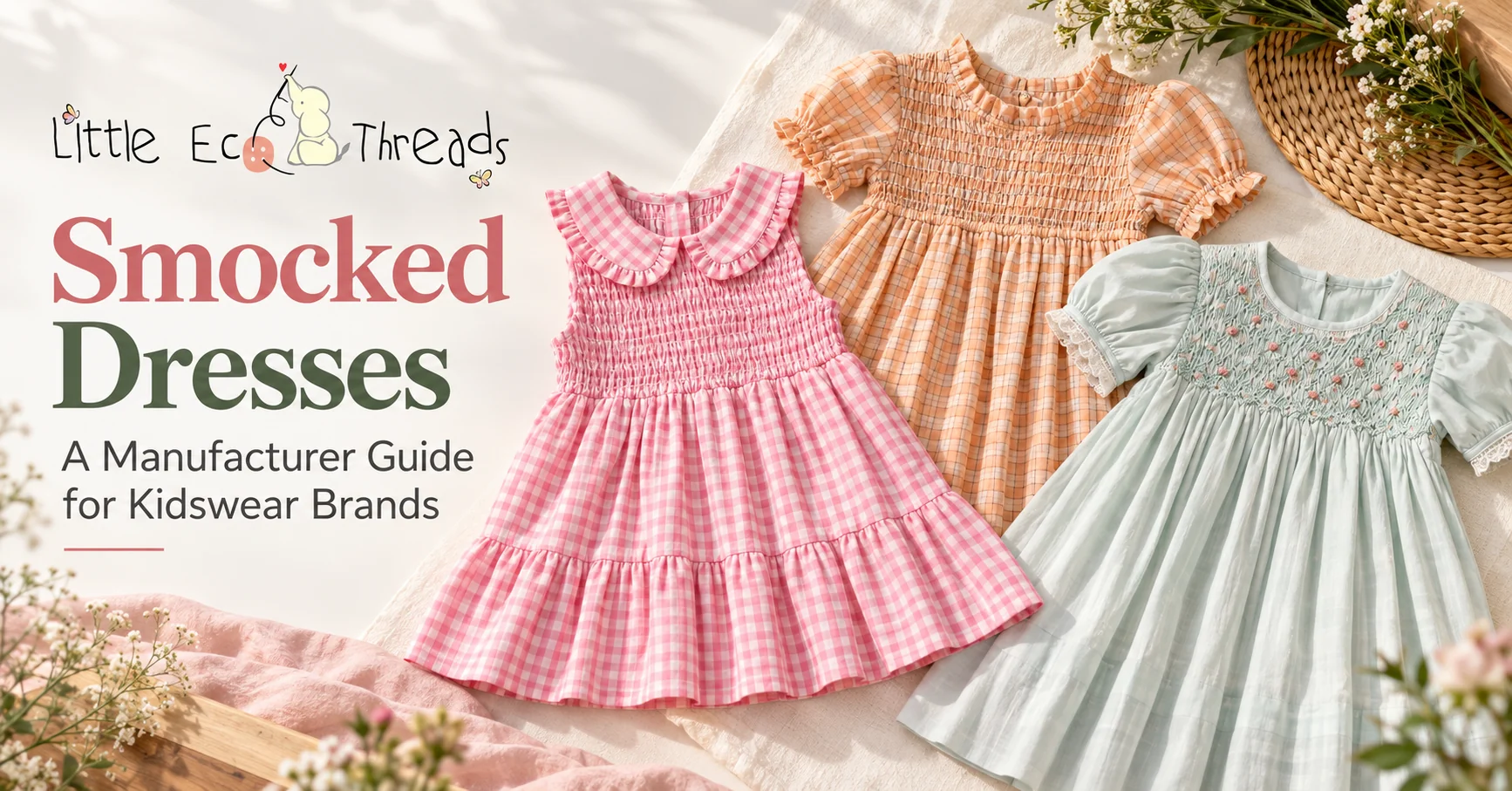
The sample designs feature different patterns, including floral prints, chambray, gingham, checks and dotted fabrics. They also include details such as puff sleeves, Peter Pan collars, flutter sleeves and embroidered rose designs on the yoke. For example, the Dusty Rose Floral Smock Dress is made from 100% cotton woven fabric.
The catalogue also mentions that the designs and materials can be changed to meet a brand's needs. This means brands can use the existing designs as a starting point and discuss changes to suit their collections.
What to discuss with any manufacturer
These are general buyer considerations, not confirmed specifications:
- Fabric weight, softness and drape, and how they affect the smocking definition
- Shrinkage, because uneven shrinkage between fabric and thread can pucker a panel
- Colour consistency between lots, especially for solids and dyed fabrics
- Print scale and direction, and how checks or gingham line up with the smocking grid
- Whether decoration such as embroidery sits comfortably alongside smocked areas
Little Eco Threads lists Pantone colour matching under its customization services and custom dyeing under smocking services. It also offers complimentary fabric swatches, which is a practical way to handle and wash test a fabric before committing to it.
Customization and Private Label Development
For a private label smocked collection, most of the value comes from the decisions made before sampling. Little Eco Threads describes a four step process: design and development, sampling, production and delivery. Brands can start from designs, tech packs or ideas.
Decisions your team will need to make
- Silhouette and overall design, including whether the range stays with dresses or extends to rompers and bubbles
- Smocking placement and pattern, such as a chest panel, yoke or bodice, in geometric or floral styles
- Fabric, colour and print
- Sleeve, neckline and hem details
- Embroidery or other decoration
- Labels, hang tags and packaging
Confirmed services and open questions
The custom manufacturing page confirms custom pattern making and grading, fabric sourcing and development, printing, hand and machine embroidery, hand and machine smocking, appliqué, custom trims, private labels and hang tags, custom packaging, size range customization and Pantone colour matching. The smocking page adds custom smocking pattern design.
Specific sleeve, neckline or hem options are not published as a menu. The catalogue examples show what has been made, but whether a particular combination suits your design is a conversation to have with the team. The same applies to the exact fabric you have in mind.
Sampling, Quality and Bulk Production
The sample stage is where specification becomes a physical product. Approving a sample without a rigorous review simply moves the problem into bulk production, where it is far more expensive.
Little Eco Threads states that multiple sample revisions are included before bulk production begins. Its About page says its sampling team can deliver any sample within a week, and the smocking page mentions rush sampling. Treat these as general statements and confirm timelines for your specific style, especially where hand smocking is involved.
What to review at sample stage
- Measurements against your specification sheet
- Smocking pattern, tension and alignment
- Seams, inside finishing and gathering
- Fabric and colour against the approved swatch
- Labels, trims and packaging
- Wash performance and fit
Protecting consistency in bulk
Once approved, the final sample should become the reference for production, supported by a written specification with tolerances. The company says bulk production starts after sample approval, with quality control at each stage and regular progress updates. Its finishing department references 1.5 AQL standards. Ask how inspection is carried out for smocked areas, and who on the team is your day to day contact.
The homepage quotes production lead times of 45 to 90 days. That range is general, so ask for a timeline for your style and quantity.
Sustainability and Material Claims
Sustainability language on a hang tag needs paperwork behind it. Several terms are easily confused, and buyers carry the responsibility for how they market the finished product.
Cotton versus organic cotton. Cotton describes the fibre. Organic cotton is a verified claim. A listing such as 100% cotton woven, as shown on the Dusty Rose dress page, confirms fibre content only. It does not tell you the cotton is organic.
Product claims versus company credentials. Little Eco Threads states on its sustainability page that its factory holds GOTS, GRS and Sedex approvals. GOTS relates to organic fibre products, GRS to recycled content, and Sedex is an ethical trade membership with audit reports. These cover different things, and none of them automatically applies to every garment in a range.
Scope. Certificates apply to particular facilities, processes or products. Before labelling a smocked dress as organic or recycled, confirm which certificate applies to that order, the fabric supplier, the validity dates and the product scope.
The company states that audit reports and certification documentation are available on request and that materials can be traced to certified organic or recycled sources. Ask for the documents for your specific styles and fabrics, and have your compliance team check the claim wording for your target market.
Why Consider Little Eco Threads for Smocked Dresses?
The case rests on a few confirmed points.
A published smocking range. The smocking collection lists nine designs, each with a stated MOQ of 100 pieces. These include a chambray smocked yoke dress, a gingham style with a ruffled collar, an ivory grid check dress with a geometric bodice, and a mint dress with rose embroidery on the yoke. For a brand building a collection, they show how smocking pairs with different fabrics and silhouettes. The MOQ is shown on illustrative catalogue pieces, so confirm it for your own style, colour and fabric.
Baby and kidswear focus. Little Eco Threads is the dedicated baby and kidswear division of Home Fashions, which the About page describes as a manufacturer with over 30 years of experience. Figures quoted for Little Eco Threads itself vary between pages, so confirm experience directly.
In house departments. The About page lists design and sampling, merchandising, pattern making, cutting, stitching, finishing, embroidery and washing, which means a smocked dress project can be handled under one roof.
Customization support. Hand and machine smocking, custom pattern design, Pantone colour matching, private labels and packaging are listed services. Brands can view the smocked dress catalogue to see styles before approaching the team.
Questions Buyers Should Ask Before Choosing a Manufacturer
Use this checklist in your first conversation with any supplier. The answers should come from the manufacturer, in writing.
- Which smocked dress styles and fabrics are available, and can you share swatches?
- Can you develop a custom smocking pattern, and is it hand or machine smocked?
- What are the minimum order quantities by style, colour and fabric?
- How is sampling handled, how many revisions are included and what are the timelines?
- What size range and grading do you offer, and how are measurement tolerances set?
- What quality checks apply to smocked areas, and how is bulk consistency confirmed?
- What are the production and delivery timelines for my quantity?
- Which certifications apply to my order, and what documentation and traceability can you provide?
Choosing a Partner for Your Smocked Dress Range
A reliable partner is one whose capabilities match your design, quality and commercial plans, and who can document how they will deliver them. Evaluate samples carefully, get specifications and certification scope in writing, and be cautious of general claims that are not tied to your styles.
Little Eco Threads may be a suitable manufacturing partner for brands developing smocked dresses and other kidswear. You can browse the smocking catalogue, review the custom manufacturing process, or contact the team to discuss your requirements.