Sustainable Kidswear Should Last Beyond One Child
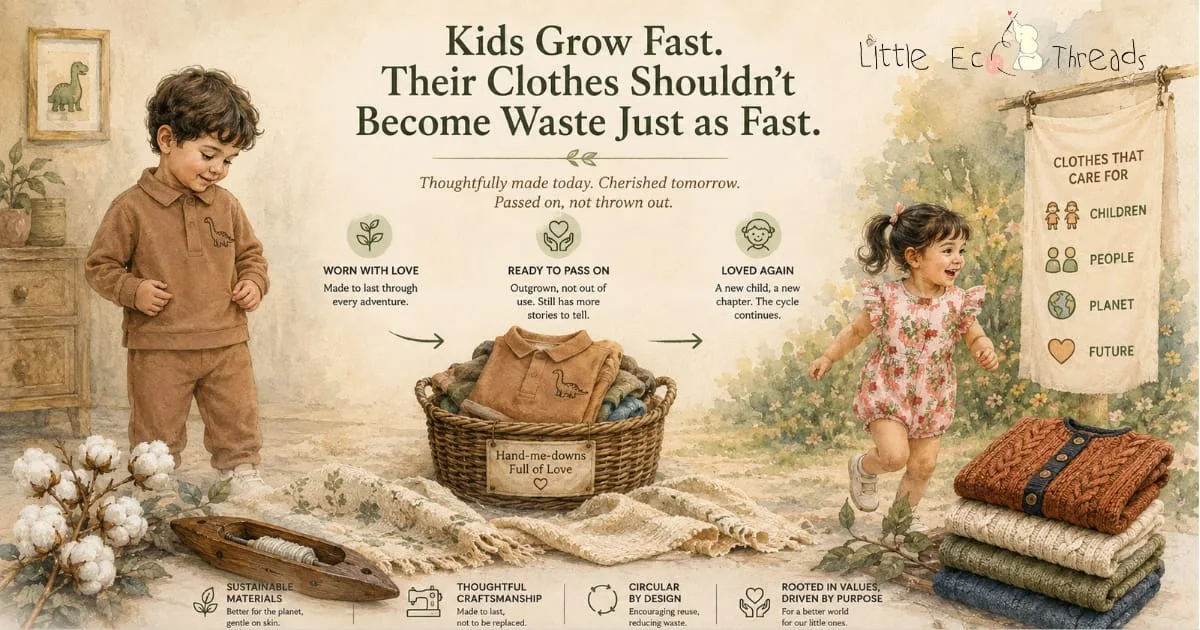
Sustainable kidswear has a problem adult fashion does not face in the same way: children grow quickly. Many children's clothes are not replaced because they are damaged. They are replaced because they no longer fit.
That changes the sustainability question. For adult clothing, brands often ask whether a garment will last for years on one body. For baby and children's clothing, the better question is whether the garment can stay useful after one child has grown out of it.
This is why sustainable kidswear should be designed for more than one wearer, not only one season.
Why Kidswear Plays By Different Rules
Most conversations about sustainable fashion focus on how long a garment lasts before it wears out. How many washes before the fabric thins? How many wears before seams fail? How long before the colour fades?
That is a reasonable way to think about adult clothing because adult sizing is relatively stable. A T-shirt bought at thirty may still fit at thirty-two.
Children are different. A baby can move through several clothing sizes in one year. A primary-school child may need new shoes twice in a school year. For much of early childhood, "how long will this last?" is less precise than "how long will this fit?"
This matters because a garment can be well made, comfortable, and still outgrown within months. In that case, the garment has not failed. It has simply finished its first chapter.
Outgrown Is Not The Same As Worn Out
There are two very different endings for a piece of clothing.
One ending is functional failure. The fabric pills badly, elastic loses stretch, knees wear through, seams open, or the garment no longer performs its job.
The other ending is outgrowing. The garment is still structurally sound, but it no longer fits the child who owns it.
For sustainable kidswear, this distinction matters. A well-made cotton dungaree set might be worn by one toddler through autumn, then passed to a younger cousin the following year. Its useful life is not measured only by the months it belonged to the first child. It is measured by total useful wears across every child who can use it.
That is the core of circular kidswear: the garment's usefulness should not end just because the first wearer has moved on.
Circular Fashion Starts Before The First Wear
The Ellen MacArthur Foundation's report on a new textiles economy argues for a system where clothes, fabric, and fibers re-enter the economy after use instead of becoming waste. Its circular fashion framework is built around eliminating waste, circulating products and materials, and regenerating nature.
For children's clothing, this idea starts at the design and manufacturing stage.
The choice of fabric matters because children's clothes are washed often. Stitching matters because children crawl, climb, pull, run, and fall. Colour quality matters because a faded garment may be rejected even if the fabric is intact. Trims matter because broken poppers, zips, or buttons can make small garments difficult to reuse.
Most parents cannot judge all of this at the point of purchase. The real quality of a garment becomes clear after repeated wearing and washing.
That is why choosing an organic or recycled fabric alone does not automatically make a garment sustainable. If the clothing wears out quickly, its material story is weakened. A durable garment has a better chance of becoming a hand-me-down, resale item, or donation that is still worth wearing.
Built For Childhood, Not Just Product Photos
Children's clothing has a physical job to do.
Children crawl on hard floors. They sit down without checking what is underneath them. They fall on knees and elbows. Favourite pieces may be worn on repeat, which means more washing, drying, stretching, and abrasion than the equivalent adult garment often receives.
Designing for that reality is not only a comfort choice. It is an environmental choice.
Thoughtful kidswear design can include:
- Durable stitching at high-stress points
- Fabric weights that survive frequent washing
- Colourfastness that keeps the garment looking usable
- Secure trims and fastenings
- Comfortable shapes children will actually wear
- Classic styling that does not date too quickly
- Practical construction that makes passing down easier
There is no design trick that lets one garment fit unlimited children through unlimited seasons. But thoughtful design shifts the odds. It increases the chance that a garment survives its first life in good enough condition to have a second one.
Hand-Me-Downs Are Already A Circular System
Long before "circular fashion" became an industry term, families were already running informal circular systems.
An older sibling's coat becomes a younger sibling's coat. Baby clothes move between friends. School uniforms get swapped locally. A box of outgrown garments may pass through several households before anything is donated.
This kind of reuse is especially natural in kidswear because many garments are outgrown before they are worn out.
The Ellen MacArthur Foundation's fashion and circular economy deep dive points to business models that increase clothing use, including resale, rental, sharing, and better care. In kidswear, many of these behaviours already exist informally. The challenge is making garments good enough to move through those systems.
A stained, stretched, or badly made item does not get swapped or resold. It gets thrown away. Durability and circularity are not separate ideas. A garment must survive well to be worth passing on.
Recycling Is Not A Simple Rescue Plan
It would be dishonest to suggest every piece of children's clothing can be passed down forever. Some garments reach the end of their useful life.
Grass stains set permanently. Knees wear thin. Elastic fails. Zips and poppers break. At some point, a T-shirt, romper, or trouser genuinely stops being useful.
The difficult question is what happens then.
The EU Strategy for Sustainable and Circular Textiles notes that less than 1% of textile waste is recycled into new textiles globally. The same strategy highlights design problems such as fiber blends and elastane that can make recycling harder.
The European Environment Agency's 2025 textiles circularity analysis also frames textiles as a value chain where circularity depends on more than collection. Design, use, reuse, repair, sorting, and recycling capacity all matter.
That does not mean recycling is irrelevant. It means brands should not treat recycling as a magical end-of-life solution. For kidswear, extending use through durability, care, resale, donation, and hand-me-downs is often more practical than assuming the garment will become new fabric later.
Durability Can Reduce Clothing Waste
WRAP's work on clothing durability is useful because it treats product life as a measurable design issue, not just a consumer habit. In its case study on extending product lifetimes, WRAP explains that longer garment lifespans can reduce waste, resource use, and carbon impact by reducing the need for replacement production.
For kidswear, durability has two sides.
Physical durability means the garment can survive real use: washing, movement, abrasion, stretching, and repeated wear.
Emotional or practical durability means someone still wants to use it. A garment that is physically intact but uncomfortable, too trend-specific, or visibly tired may not be passed on.
Brands should design for both. A reusable children's garment needs to last physically and still feel worth wearing to the next family.
Everyone Has A Role, Not Just Parents
It is easy to turn clothing waste into a list of things parents should do better: buy less, wash carefully, repair quickly, donate responsibly, and pass clothes on.
Those choices help. But parents are making decisions inside real constraints: budget, time, stains, school needs, fast growth, and children who suddenly refuse everything except one favourite shirt.
Better outcomes need a shared system.
| Who Is Involved | What They Can Influence |
|---|---|
| Designers | Fit, adjustability, construction, repairability, timelessness |
| Manufacturers | Stitch quality, fabric handling, trims, finishing, quality control |
| Brands | Production volume, claims, pricing, resale readiness, customer education |
| Retailers | Merchandising, discounting, take-back, repair and resale access |
| Parents | Care, repair, storage, donation, resale, hand-me-downs |
| Local systems | Swap groups, school uniform exchanges, donation and recycling routes |
No amount of careful laundering fixes a garment that was poorly made. And no strong seam can help if a brand produces far more units than the market needs. The system matters as much as the individual choice.
What If Kidswear Was Designed For The Next Child?
Most children's clothing is designed around one buyer and one child. Will it fit? Will it look good? Will it survive until the child grows out of it?
There is a better question for sustainable kidswear brands: will this still be worth wearing after that child moves on?
That question changes priorities.
It pushes construction quality higher. It makes classic, less trend-dependent design more valuable. It makes resale and donation channels part of the product lifecycle rather than an afterthought. It also makes production planning more important, because overproduction creates waste before a parent even buys the garment.
For a sustainable children's clothing manufacturer, the useful goal is not to claim that every garment is perfectly circular. The useful goal is to design and produce garments with a better chance of staying in use.
Little Eco Threads works with brands building babywear and kidswear collections where fabric choice, quality control, and practical production volumes are part of the sustainability conversation. Founders can also explore organic cotton kidswear or get in touch when planning a collection designed for longer use.
Outgrown Does Not Have To Mean Finished
Think again about the small yellow T-shirt at the bottom of a child's drawer. The child has grown out of it, but the shirt is still in good condition. The stitching is intact. The colour is fine. The fabric still has life in it.
Nothing about that garment says its story has to end.
It could be donated, passed to a younger cousin, sold to another family, or exchanged at a school clothing swap. It could be worn for another season by another child, and then maybe another.
Children will always grow quickly. That is not the problem to solve. The real question is whether their clothes are made well enough, and designed thoughtfully enough, to keep going after the first child has moved on.
Sometimes, outgrown simply means ready for someone else.
FAQ
Why is sustainable kidswear different from adult sustainable fashion?
Children outgrow clothing much faster than adults, so the garment may stop fitting before it wears out. Sustainable kidswear has to account for durability, reuse, hand-me-downs, and resale across multiple children.
What makes children's clothing more circular?
Circular children's clothing is designed to stay useful for longer, move through reuse channels, and avoid becoming waste too quickly. Durable fabrics, strong stitching, timeless design, repairability, and responsible production volumes all help.
Is recycling children's clothing enough?
No. Textile recycling is still limited, especially for blended fabrics and garments with elastane, trims, or complex construction. Reuse, repair, resale, and hand-me-downs are often more practical first steps.
How can brands reduce kidswear waste?
Brands can reduce waste by improving garment durability, designing for reuse, avoiding unnecessary overproduction, choosing appropriate materials, maintaining quality control, and helping customers care for and pass on garments.
What should parents look for in durable kidswear?
Parents can look for strong seams, fabric that feels substantial enough for repeated washing, secure trims, comfortable fit, timeless styling, and garments that still look useful after several wears and washes.