Baby Swimwear Manufacturers in India: The Complete Guide for Brands Who Care About Quality
Every parent knows the moment. You're at the beach or the pool, your baby is absolutely beside themselves with excitement, and you're scrambling for the sunscreen, the hat, the swim nappy. In all that happy chaos, one thing you almost certainly never stop to wonder about is the swimsuit you're pulling over their little arms.
And that's completely fine. That's parenthood.
But here's what parents do notice, sometimes weeks later, sometimes mid-season. They notice when the colour starts fading after a few pool visits. They notice when the elastic loses its shape. They notice a rash on their baby's skin that wasn't there before. They notice when the swimsuit that looked so cute on the hanger looks tired and worn before the summer is even halfway through.
That's the moment a brand either earns loyalty or loses it.
If you're building a children's swimwear brand, finding the right baby swimwear manufacturers in India is the decision that determines which of those moments your customers experience. This guide is here to help you get it right.
Why Baby Swimwear Is Not Like Any Other Garment
Walk into any high street store during summer and you'll find baby swimwear hanging next to sun hats and beach toys, priced cheaply, packaged cheerfully, treated as roughly the same category of purchase as a pair of holiday flip-flops.
That perception is a problem. From a manufacturing standpoint, swimwear for infants and young children is one of the most technically demanding categories in all of children's apparel.
A baby's skin is fundamentally different from adult skin. It's thinner, more absorbent, and far more sensitive to external irritants. Adult swimwear can get away with certain dyes, finishes, and fabric blends that would cause rashes or reactions on a six-month-old. That's not a risk a responsible brand should take.
Then there's the environment the garment lives in. Consider everything a piece of baby swimwear faces in a single afternoon:
- Chlorine from a swimming pool, which breaks down elastic and degrades colour
- Salt water from the ocean, which is harsh on fibres and fading on prints
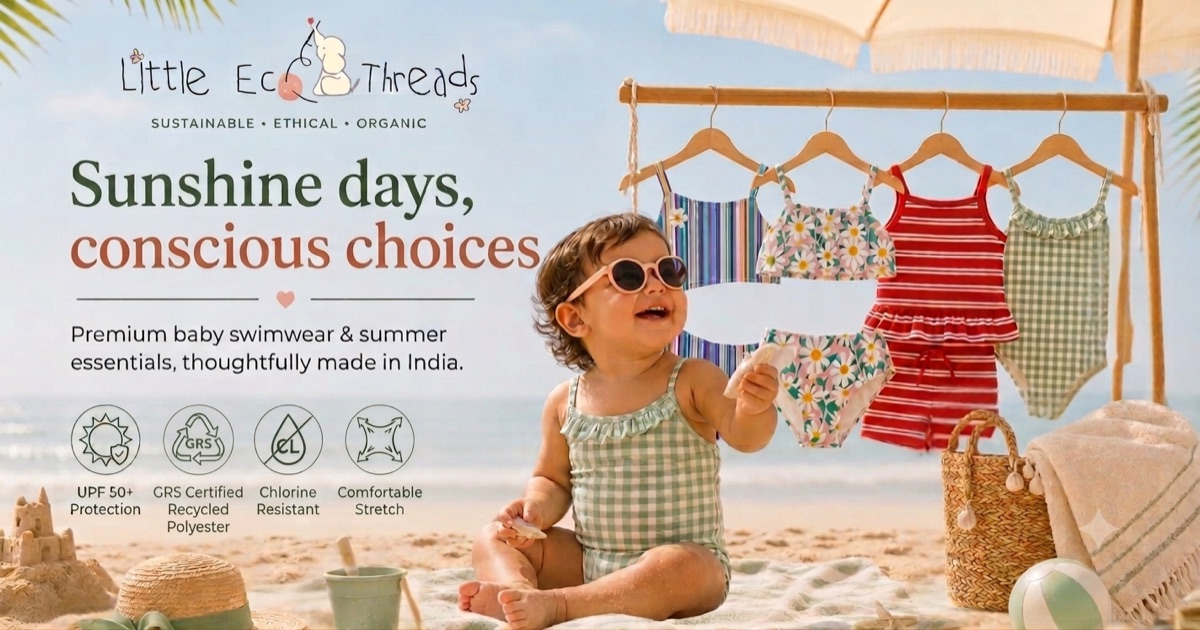
- Direct sunlight for hours at a time, making UPF 50+ sun protection not a bonus feature, but the primary reason many parents buy proper swimwear in the first place
- Repeated stretching as a wriggly baby kicks, rolls, and moves in ways that stress every seam
A garment that isn't manufactured to handle all of that, simultaneously, simply won't last. And for a brand trying to build a reputation for quality, a swimsuit that falls apart after two uses is a disaster.
This is why working with experienced baby swimwear manufacturers in India, ones who understand these specific performance demands, is so different from simply finding a generic childrenswear factory.
Why the World Turns to India for Children's Clothing
India has been a global hub for textile and apparel manufacturing for centuries. That's not marketing language. It's history. The country's garment industry is one of the largest in the world, and its expertise spans everything from luxury handwork to high-performance technical fabrics.
For children's clothing specifically, India offers something genuinely rare: the combination of skilled craftsmanship, competitive manufacturing, and a growing commitment to ethical and sustainable production.
- Deep textile expertise. Indian garment workers are among the most skilled in the world. Attention to detail, clean construction, and the ability to handle complex finishes are built into the manufacturing culture, especially in dedicated children's apparel hubs.
- Export capability. Indian manufacturers export to the United States, United Kingdom, Europe, Australia, and dozens of other markets. They understand international labelling requirements, customs documentation, and the lead times that international buyers depend on.
- Sustainability credentials that are catching up fast. A number of Indian factories now hold GRS (Global Recycled Standard) certification, the credential that matters most for sustainable swimwear. This is the certification that verifies recycled performance fabrics from certified sources, and it's becoming the defining standard for conscious children's brands.
- Flexible partnership models. Unlike some manufacturing regions where minimum order quantities are prohibitively high, many kids' swimwear manufacturers in India are genuinely set up to work with smaller and growing brands, allowing startups to build their range without overcommitting on stock.
- Ethical, audited production. A new generation of Indian manufacturers is operating with genuine transparency around wages, working conditions, and environmental impact. The best of them back those claims with SEDEX membership and third-party ethical audits, not just good intentions. For brands that sell to values-driven consumers, verifiable ethics matter enormously.
What Makes a Great Baby Swimwear Manufacturer
Not every factory that says it can make swimwear should be making swimwear for babies. Here's what to look for when evaluating a manufacturer in India as a potential partner.
Fabric Knowledge and Responsible Sourcing
Baby swimwear typically uses fabrics that combine polyester and elastane because they stretch with the baby, hold their shape wash after wash, dry quickly, and withstand chlorine and salt water. A manufacturer who doesn't know how to source, cut, and stitch these fabrics correctly will produce garments that sag, fade, or lose structure quickly.
But for a sustainable brand, the right fabric question isn't just "what performs well." It's "what performs well and doesn't compromise our values." The answer is GRS-certified recycled polyester and recycled nylon performance swim fabrics made from reclaimed plastic that carry the same functional properties as virgin synthetics, but with a fraction of the environmental footprint. This is what separates a manufacturer with genuine sustainability expertise from one that just uses the word.
UPF 50+ Sun Protection
For baby swimwear, UV protection is often the primary reason parents buy a proper swimsuit rather than a cheap alternative. UPF 50+ fabric blocks over 98% of the sun's UV radiation. A manufacturer who sources performance swim fabric should be able to confirm the UPF rating and provide test data on request. It's one of the most compelling things a children's swim brand can lead with.
Quality Control That Goes Beyond Visual Checks
Great manufacturers check seam strength, elastic recovery, colour fastness, print durability, and size consistency, not just whether the garment looks nice on a hanger. Ask potential partners about their quality control process in detail.
Private Label and Sampling Support
Any serious manufacturer should be willing to produce samples before you commit to a full order. This is non-negotiable. Beyond sampling, look for a private label baby swimwear manufacturer who can work to your labels, your packaging, and your brand identity from day one.
Transparent Communication
Clear, proactive communication about timelines, costs, and challenges makes the difference between a smooth production run and a chaotic one. If a factory is vague or slow in initial conversations, that pattern rarely improves once an order is placed.
The Fabric Story: How GRS Certification Solves the Sustainable Swimwear Problem
For years, sustainable children's brands faced an uncomfortable contradiction when it came to swimwear.
The fabrics at the heart of most conscious kidswear are soft, natural, and gentle on skin. But these are entirely the wrong choice for a swimsuit. Swimwear needs to stretch and recover. It needs to repel water. It needs to hold colour through repeated chlorine and salt exposure. Natural fibres simply can't do that.
For a long time, the only answer was virgin synthetic fabric, which performs perfectly well, but sits badly with brands whose identity is built on sustainability.
GRS-certified recycled polyester and nylon changes that equation entirely. These are performance swim fabrics made from reclaimed plastic (post-consumer bottles, fishing nets, industrial waste) that carry all the functional properties of virgin synthetics: stretch, recovery, chlorine resistance, quick-dry, and UPF 50+ protection. A manufacturer who sources GRS-certified recycled fabric isn't just ticking a sustainability box. They're solving the problem that every other sustainable kidswear brand has quietly struggled with.
And because GRS is an independently verified certification, not a self-declaration, those claims are auditable. That's the difference between a brand that says it's sustainable and one that can prove it.
This is where manufacturer expertise becomes genuinely valuable. The sourcing relationships, the certification knowledge, the supply chain infrastructure: these take years to build and can't be improvised at short notice.
A complete summer collection for a baby might look like this:
- The swimsuit or swim shorts in GRS-certified recycled performance fabric with UPF 50+ protection
- A sun cover-up for protection between swims
- A soft beach robe for after-bath warmth
- Matching summer co-ords and T-shirts
- Wide-brim sun hats for the sand
- Travel sets that make packing easy for families on the go
A manufacturer with genuine GRS expertise can help build that complete, coherent collection with the certifications to back every piece of it. That's a very different offer from a factory that simply makes swimsuits.
Questions Every Brand Should Ask Before Choosing a Manufacturer
Before committing to a manufacturing partner, have these conversations, ideally on a call, not just over email.
- Do they hold GRS certification? For a sustainable swimwear brand, this is the non-negotiable. Ask to see the certificate. If they can't produce it, they can't credibly be your partner for this category.
- Can they scale with your brand? You might start with 300 units. If things go well, you'll want 3,000. Does this manufacturer have the capacity to grow with you, or will you need to start over with a new partner in two years?
- Do they genuinely specialise in children's apparel? A factory that makes adult swimwear and does kids' styles as an afterthought is very different from one dedicated to children. Children's safety requirements (no sharp hardware, no looped cords, no small embellishments) demand genuine specialisation.
- Can they verify their ethical credentials? SEDEX membership and third-party ethical audits are what separate verifiable transparency from good intentions. Ask for the audit reports, not just assurances.
- Can they customise designs for your brand? True creative collaboration, where the manufacturer helps develop original styles, is what separates a genuine partner from a commodity supplier.
Mistakes That Cost Brands Time, Money, and Reputation
Many brands learn these lessons the hard way. You don't have to.
- Choosing on price alone. The cheapest quote almost always comes with the most expensive problems: late deliveries, inconsistent quality, fabrics that don't perform as expected. A slightly higher cost per unit is almost always worth it.
- Accepting sustainability claims without certification. Any factory can call itself eco-friendly. What matters is whether they hold GRS certification for their swim fabrics, independently verified, not self-declared. Ask for the certificate.
- Skipping sampling. It is remarkable how often brands skip the sample stage to save time or money, then receive a full production run that is not what they imagined. Sample. Always.
- Underestimating the communication factor. Clear, proactive communication is what keeps a production run on track. If you find an India-based manufacturer who communicates well and consistently, that quality is genuinely worth paying for.
- Thinking transactionally instead of relationally. The best manufacturing partnerships are long term. Factories that know your brand and your standards will produce better results over time. Jumping to a new supplier every season means you're always starting from scratch.
Why Little Eco Threads Belongs in This Conversation
Everything discussed in this guide points toward a particular kind of manufacturing partner: GRS-certified recycled swim fabrics, UPF 50+ protection, SEDEX-verified ethical production, flexible MOQs, and transparent communication. One that exists not just to fill orders, but to genuinely understand what a children's brand is trying to build.
Little Eco Threads is that kind of partner.
We are an India-based baby clothing manufacturer with a specific focus on sustainable and ethical production. We work with children's brands across the UK, Europe, Australia, and the US, producing everything from everyday babywear to complete seasonal collections.
For brands building a summer or beach collection, we offer:
- GRS-certified recycled performance swimwear: the sustainable fabric answer for swim, with the certification to prove it
- UPF 50+ sun protection built into our swim fabric, with test data available on request
- Complete summer collection capability: cover-ups, robes, co-ords, hats, and travel sets to build a coherent seasonal range
- Private label production with custom labels, swing tags, and packaging to your brand identity
- Flexible MOQs that make it realistic for growing brands to work with us without overcommitting
- SEDEX membership and third-party ethical audits, so our claims about workers' conditions are verifiable, not aspirational
- Export readiness for international markets, with full documentation support
The GRS recycled swim fabric story is what resolves the tension that sustainable kidswear brands have always faced in this category: performance and sustainability in the same garment, with the certification to prove both.
That combination, genuine care paired with genuine craft, is rarer than it should be in this industry. When you find it, it tends to be the beginning of a very good working relationship.
The Factory Behind the Memory
Babies may never remember the first swimsuit they wore. They won't remember the moment they sat in the shallows and felt the water rush over their toes for the first time, but their parents will. They'll remember the colour of the fabric in the afternoon light. They'll remember how comfortable their child looked. They'll remember whether it still looked good at the end of a long summer.
Those memories begin long before the garment reaches the beach. They begin in the factory where someone chose the right fabric, stitched every seam carefully, and checked the finished garment against a standard that puts a child's comfort and safety first.
Choosing from the best baby swimwear manufacturers in India is choosing where those memories start. It's choosing the values, the craft, and the care that go into something a parent will put on their most precious person.
If you're building a children's brand and you're looking for a manufacturing partner who takes that responsibility as seriously as you do, we'd love to hear from you. Reach out to start a conversation, no pressure, just a genuine discussion about what you're building and how we might help.
Little Eco Threads is an ethical children's clothing manufacturer based in India, producing sustainable collections for children's brands worldwide. To get in touch or request a quote, visit our contact page.