Garment Quality Control: Your Brand's Silent Salesperson
She's been waiting for this package all week.
Not because it's expensive or difficult to replace, but because she'd spent an evening looking through dozens of options before choosing this outfit for her child. She wanted something soft enough for everyday wear, sturdy enough to survive countless washes, and well made enough that it wouldn't end up as a floor mop sooner than it should.
When the parcel arrives, she opens it with the quiet excitement every parent knows. The colour is exactly what she expected. The fabric feels reassuringly soft, and for a moment she's pleased she trusted the brand.
Then her eye catches something small.
The brand label is stitched slightly crooked. A loose thread sits near the hem. They're tiny imperfections, nothing that stops the outfit from being worn, but they plant a question she wasn't expecting: if these details were missed, what else might have been?
She doesn't return it. Her child wears it anyway.
But the next time she shops for children's clothing, that brand isn't the first one she thinks of.
How Quality Inspection Protects Your Brand
That decision breaks differently for different customers, but it always starts the same way, with a small story nobody bothers to write down.
Sizing Issues
There's the shopper who ordered her usual size and received a top that pulled strangely across the shoulders, not because she'd changed but because the third production run measured half an inch differently than the first, a gap a simple spec check would have caught. She didn't call to complain. She quietly returned it, mentioned "runs small, inconsistent sizing" in a review, and moved to a competitor. That review will outlive the return by years.
Stitching & Seam Strength
There's the boutique customer who leaned in to hug a friend and felt a stitch give way at the underarm of a jacket he'd worn only twice, a seam an inspector's eye would have caught before it ever left the building. He didn't blame the fabric. He blamed the name on the label.
Colour Consistency
There's the retail buyer who opened a shipment of five hundred units and noticed batch three was a visibly different shade of green than batch one, exactly what a colour-consistency check exists to catch. No shopper will ever see the two batches side by side, but the buyer did, and the next order came in smaller, because consistency, not price, is what a retailer is really buying when they place a wholesale order.
Packaging Inspection
And there's the customer who received the exact right garment inside a box crushed in transit, the shirt creased as though stepped on, a reminder that thoughtful, inspected packaging decides whether a garment survives the trip at all.
None of these customers filed a formal complaint. That's what makes it dangerous. A crooked label, a loose thread, an uneven seam, a zipper that catches, these rarely generate a support ticket. They generate silence, and in retail, that usually means someone chose not to come back. Which is exactly why garment inspection exists: to catch these small stories before they turn into returns and reviews no one can take back.
What a Loose Thread Actually Costs
Multiply any of those moments across a season of garment production, and the math turns uncomfortable fast.
A return isn't only the cost of shipping something back and forth. It's the marketing spend it took to earn that customer, often a founder's single largest expense, quietly erased by one avoidable flaw.
Then there's the review itself. A five-star rating helps a stranger trust a purchase they can't touch or try on. But a single three-star review mentioning "thread coming loose" or "colour different from the photos" does more damage than ten glowing ones do good, because shoppers actively hunt for reasons to say no before they say yes.
Retailers run the same math at a larger scale. A boutique or department store isn't only buying a product, it's buying certainty that unit one and unit one thousand will match. Apparel quality control at scale is what lets a brand say yes to a bigger order, expand into new stores, or raise its wholesale price, because buyers pay more for suppliers they never have to double-check.
This is the quiet economics of garment quality inspection: fewer returns, stronger reviews, more repeat purchases, steadier retailer confidence, and eventually, the pricing power that belongs to a brand whose silent salesperson never has an off day.
The Last Person Between a Mistake and a Customer
None of this happens by accident. At Little Eco Threads, inspection has never been treated as the last box to tick before a shipment leaves the building. It's treated as the last honest chance to catch what a customer would otherwise discover first.
What Gets Checked?
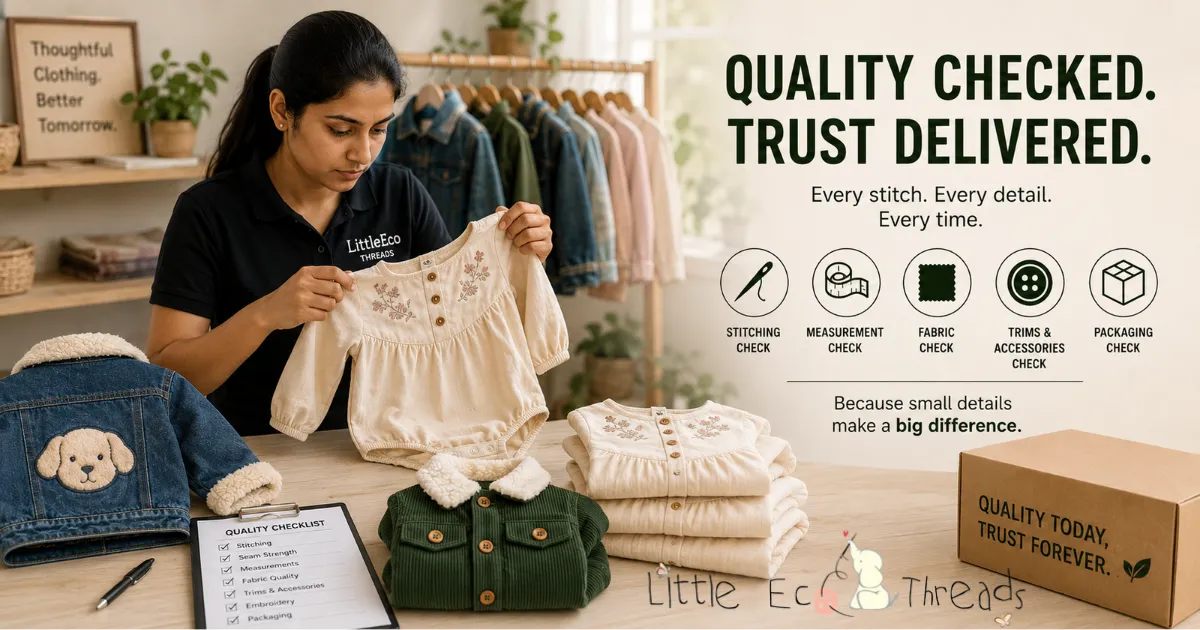
Every garment is checked against stitching integrity, seam strength, measurements against spec, zipper and button function, colour consistency across the full run, and final packaging, not because a contract requires it, but because that single garment is about to become the only representative of the brand a customer will ever meet.
Strip away the technical language, and this is what garment quality inspection, or clothing quality assurance if you prefer the formal term, really is: someone standing between a mistake and a customer, on the customer's behalf, before the customer even knows they need protecting.
It's slower than skipping the check entirely. But quality control in garment manufacturing was never designed for the manufacturer's convenience. It exists for the moment, weeks later, when a stranger opens a package and decides, in about the time it takes to glance at a seam, whether this brand can be trusted with the next order too.
Why Consistency Matters
No retail buyer has ever called a manufacturer to say thank you for a shipment with zero defects. That's the strange bargain of quality: when it's there, it's invisible. When it's missing, it's the only thing anyone remembers.
This is exactly why long-term relationships in apparel manufacturing are built on unremarkable, repeatable consistency rather than any single impressive shipment. A brand that reorders from the same clothing manufacturer season after season isn't chasing excitement, it's chasing the absence of surprises. At Little Eco Threads, that's treated as the actual point of the partnership: not one beautiful sample, but proof, shipment after shipment, that the sample was never a fluke. The silent salesperson doesn't ask for a raise or a day off. It just keeps showing up, whether anyone's watching or not.
For a fashion startup with a tight runway, or a boutique label building its name one small collection at a time, this matters more than almost anything else. It's the difference between a manufacturer used once and forgotten, and a clothing manufacturer for startups that quietly becomes part of how the brand grows.
The Sustainability No One Photographs
Growth built this way carries another quiet advantage. There's a version of sustainability that gets photographed: organic cotton, recycled packaging, low-impact dyes. And there's a version that never makes it onto a swing tag: a garment made well enough that it doesn't get returned, fall apart after a few washes, or end up as landfill.
Garment quality inspection is one of the least glamorous forms of sustainable manufacturing and one of the most effective. A returned package gets shipped twice. A garment that wears out early gets replaced, doubling its footprint for a single body. As a sustainable clothing manufacturer, Little Eco Threads treats durability and construction quality as inseparable from any other environmental claim, because no brand can call itself sustainable while quietly generating avoidable waste.
It's also how Little Eco Threads protects something less visible than fabric: the reputation of every brand it produces for. A defect that reaches a customer rarely stays with just that customer. It becomes a review, a return, a story told to a friend, wearing away, one disappointment at a time, at brand equity built over years.
Why Brands Choose Little Eco Threads
At Little Eco Threads, quality isn't something that's inspected only at the end of production. It's built into the process from the very first sample to the final packed garment. Every collection is produced with the understanding that each piece represents the reputation of the brand that will eventually sell it.
Whether you're a growing fashion startup or an established label looking for a dependable manufacturing partner, Little Eco Threads focuses on delivering consistent craftsmanship, reliable quality control, and the confidence that every shipment reflects the standards your customers expect.
For certified kidswear programs, that same discipline has to extend into documentation too, from GOTS certified organic textiles to an OEKO-TEX standard for harmful-substance testing.
Conclusion
Customers may never notice perfectly straight stitching, consistent sizing, or carefully inspected finishing. That's exactly how quality is supposed to work. It stays invisible until it's missing.
In apparel manufacturing, every garment becomes a brand ambassador the moment it reaches a customer's hands. The brands that grow aren't always the ones with the biggest marketing budgets, they're the ones whose products quietly deliver on every promise.
Because in the end, the first conversation between a customer and a brand isn't started by an advertisement or a website. It's started by the garment itself. If you want a manufacturing partner who treats that conversation as seriously as you do, Little Eco Threads is ready to talk.