GOTS vs Organic Cotton: What's the Difference and What Should Clothing Brands Know?
A practical sourcing guide for sustainable kidswear, babywear and fashion brands
Introduction: The Difference Is More Than a Label
Organic cotton has become an important material choice for brands developing sustainable clothing, especially in babywear and children's apparel. It gives brands a way to talk about the origin of a fibre and the farming practices behind it. But when a supplier describes a fabric or garment as organic cotton, buyers need to ask one more question: what has been checked after the cotton leaves the farm?
This is where the Global Organic Textile Standard, commonly known as GOTS, becomes relevant. Organic cotton describes cotton grown under recognised organic farming rules. GOTS is a textile standard that builds on certified organic fibre and sets further requirements for the processing, manufacturing, handling and labelling of textile products within its certified supply chain.
The two terms are connected, but they do not mean the same thing. A garment can be made with organic cotton without being GOTS certified. In the same way, buying GOTS certified fabric does not automatically give every finished garment the right to carry a GOTS claim. The product, the businesses involved, the records and the label all matter.
The key distinction
Organic cotton tells a buyer about the fibre and its farming origin. GOTS adds a wider set of verified requirements for relevant textile processing and manufacturing, including chemical controls, environmental management, worker related criteria and traceability.
What Is Organic Cotton?
Organic cotton is cotton grown under an organic agricultural standard. The farm must follow defined rules for matters such as soil care, crop rotation, pest management and the use of agricultural inputs. The exact rules depend on the organic standard accepted in the country where the cotton is grown and the market where it will be sold.
In general, organic farming systems avoid the use of prohibited synthetic pesticides and fertilisers and do not allow genetically modified seeds under the relevant organic rules. Farmers may use practices such as crop rotation, composting, natural pest control and other methods that support soil health and biodiversity. These practices are not identical on every farm, so the certification and the standard behind the claim should always be checked.
For a clothing brand, organic cotton is first a material claim. It tells the buyer that the cotton has been grown and certified under an accepted organic farming system. By itself, the phrase does not confirm how the fibre was spun, how the yarn was knitted or woven, which dyes were used, how wastewater was managed or whether the garment factory meets a particular social standard.
This matters during product development. A newborn bodysuit, cotton romper, muslin swaddle or children's T-shirt may use organic cotton as its main fibre. The product still moves through several stages, including ginning, spinning, knitting or weaving, dyeing, finishing, cutting and stitching. Each stage has its own suppliers, processes and records.
What Is GOTS Certification?
GOTS stands for the Global Organic Textile Standard. It is a third party certification standard for textiles made with certified organic fibres. Its purpose is to support clear and verifiable claims while setting requirements for relevant stages of textile processing, manufacturing and trading.
The organic status of the raw fibre must first be established through an organic farming standard accepted by GOTS. GOTS then applies requirements to the textile supply chain after farming. The exact activities covered by a company's certification depend on the scope listed on its certificate.
For clothing brands, the standard brings together several important areas:
- Certified organic fibre inputs. The organic fibres used for a GOTS product must have the required recognised organic certification.
- Chemical input controls. Dyes, processing aids and other relevant chemical inputs must meet the standard's applicable requirements.
- Environmental management. Relevant facilities must follow requirements that address areas such as wastewater, resource use, emissions and waste.
- Worker related criteria. Certified operations must meet social requirements covering areas such as safe working conditions, fair treatment and the prohibition of forced and child labour.
- Traceability and records. Certified businesses keep records that help track materials and products as they move through the supply chain.
- Product claims and labelling. The GOTS name and logo can only be used when the product and the claim meet the applicable rules.
GOTS certification is checked by approved independent certification bodies. The system includes inspections and a review of relevant records. This gives brands more than a supplier's verbal statement, but it is still important to check what the certificate covers and whether it applies to the product being purchased.
A useful reminder
GOTS is a defined textile standard. It does not mean that a garment has no environmental impact or that every possible sustainability issue has been solved. Brands should describe exactly what has been certified.
GOTS vs Organic Cotton: What Is the Actual Difference?
The simplest way to understand the difference is to separate the fibre from the system that covers its processing. Organic cotton describes the material and its farming origin. GOTS sets additional requirements for certified organic fibre inputs and the relevant textile supply chain.
| Comparison point | Organic cotton | GOTS certification |
|---|---|---|
| What it describes | Cotton grown under a recognised organic agricultural standard. | A textile standard and certification system for products made with certified organic fibres. |
| Main focus | The farming system and the organic status of the fibre. | Organic fibre content plus requirements for processing, manufacturing, trading and product claims. |
| Farm stage | The farm and the organic status of the crop are central. | GOTS relies on accepted organic farm certification for the fibre. GOTS certification applies to textile operations after farming. |
| Spinning and fabric making | The organic cotton claim alone does not certify these stages. | Relevant operations must be covered by the certified supply chain and meet applicable requirements. |
| Dyeing and finishing | The phrase organic cotton alone does not set processing chemical rules. | Chemical input and environmental requirements apply to relevant processing stages. |
| Worker related criteria | Not established by the fibre description alone. | Includes social criteria for certified operations. |
| Traceability | Depends on the farm certification and records used for the fibre. | Uses certification and product flow records across the certified textile chain. |
| Finished garment claim | Does not automatically make the garment GOTS certified. | The finished product and relevant supply chain must meet the standard and labelling rules. |
| What a buyer should request | Evidence of the organic fibre claim and relevant supply chain records. | Current scope information and transaction evidence for the specific goods, plus correct product labelling. |
In one sentence
A garment can contain organic cotton without being GOTS certified. A GOTS certified product must meet the standard's organic fibre, processing, traceability and product claim requirements.
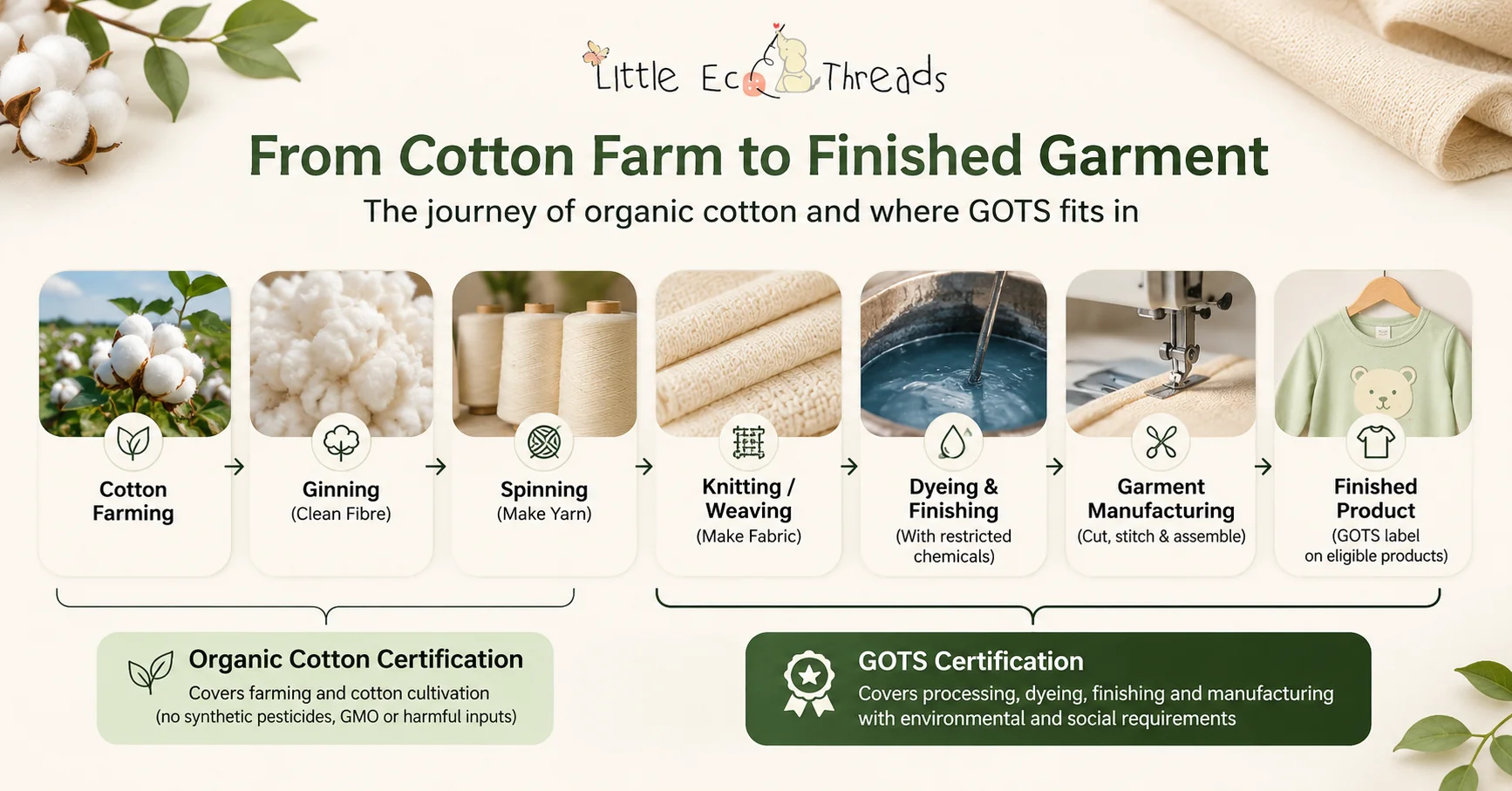
How Does GOTS Fit Into the Journey from Cotton Farm to Finished Garment?
A clothing product does not move directly from a cotton field to a sewing line. It passes through a chain of suppliers and processors. Knowing where farm certification ends and textile certification begins helps brands ask better questions and check the right documents.
| Stage | What happens | What a brand should check |
|---|---|---|
| 1. Cotton cultivation | Cotton is grown and harvested under the applicable organic farming rules. | Which recognised organic standard certifies the farm and how is the fibre status recorded? |
| 2. Ginning | The cotton fibre is separated from the seeds and prepared for textile processing. | Is the relevant operation covered by the certification arrangement and records? |
| 3. Spinning | The fibre is spun into yarn. | Does the supplier have the correct scope and material records? |
| 4. Knitting or weaving | The yarn is made into fabric such as jersey, rib, interlock or woven cotton. | Is the fabric supplier covered for the product and process involved? |
| 5. Dyeing and finishing | The fabric may be treated, dyed, printed, washed or finished. | Are chemical controls, wastewater management and the relevant processing site covered? |
| 6. Garment manufacturing | The fabric is cut, stitched, inspected, labelled and packed. | Is the garment making site included where required, and does the product meet the claim? |
| 7. Trading and sale | The finished product moves to the buyer, brand or retailer. | Are the correct transaction documents and approved product claims available? |
Understanding the 70% and 95% GOTS Label Grades
GOTS uses label grades based on the certified organic fibre content of a textile product. The two main grades are often the first details a buyer notices when reviewing a GOTS claim.
| GOTS label grade | Minimum certified organic fibre content | What it means |
|---|---|---|
| Organic | At least 95% | The product meets the GOTS Organic label grade, subject to all other applicable requirements. |
| Made with Organic Materials | At least 70% | The product meets the Made with Organic Materials grade. The exact certified organic fibre percentage must be stated as required. |
These percentages refer to the fibre content under the standard's calculation rules. They are not simply a calculation of the total garment weight including every trim and accessory. GOTS also sets rules for additional fibre materials and product labelling.
For example, a garment described as 100% cotton is not automatically 100% organic. A garment made from organic cotton fabric is also not automatically entitled to carry a GOTS label. The correct claim depends on the certified inputs, the complete product, the facilities involved, the applicable standard and the approval process.
Avoid this common mistake
Do not use "GOTS certified" as another way of saying "made from organic cotton". They are different claims and require different evidence.
Why Does This Difference Matter for Kidswear and Babywear Brands?
For a kidswear or babywear brand, material selection is only one part of responsible product development. Organic cotton may be suitable for bodysuits, rompers, sleepsuits, T-shirts, leggings, muslin swaddles and lightweight blankets. The product brief should also consider fabric construction, weight, colour, finishing, durability, care performance and the market where the garment will be sold.
Consider a brand developing a newborn bodysuit. The team may choose a soft cotton jersey with suitable stretch and recovery. A swaddle range may need a light woven or muslin fabric. A toddler playwear collection may need stronger seams and fabric that can handle regular washing. In each case, the fibre choice is important, but the rest of the supply chain still needs to be understood.
GOTS can help a brand look beyond the raw material because it includes requirements for relevant processing and manufacturing operations. It can support a more complete sourcing conversation about chemical inputs, environmental management, worker related criteria and traceability. However, it does not replace product specific testing or legal requirements in the destination market.
For this reason, brands should not treat GOTS as a complete product safety certificate. They should check the applicable testing, labelling and legal rules for the countries where the garments will be sold. This is especially important for products intended for babies and young children.
What Should Brands Check Before Choosing an Organic Clothing Manufacturer?
A manufacturer's website may mention organic cotton, GOTS or other sustainability credentials. Those statements are a useful starting point, but a buyer should verify the documents and confirm that they apply to the order in question.
- Ask for the current certificate and check the name of the certified business.
- Review the certificate scope, including the facility, activities and product categories covered.
- Confirm whether the fabric supplier and the relevant processing sites are included in the certified chain.
- Ask for transaction documentation for the specific certified goods being purchased.
- Check whether the finished product qualifies for the exact GOTS label grade and product claim planned by the brand.
- Confirm that the correct label information and logo use have been approved by the responsible certification body.
- Ask which processes are carried out by subcontractors and how those activities are recorded.
- Check product testing, market rules, care labelling and other requirements separately from the GOTS claim.
Two documents are particularly useful in a GOTS sourcing discussion. A Scope Certificate identifies the certified business and the activities and product categories included in its certification. A Transaction Certificate provides evidence for a particular transaction or shipment of certified goods. A Scope Certificate on its own does not prove that every item sold by that business is GOTS certified.
Buyer check
Ask for documents that match the actual product, facility, process and shipment. Do not rely only on a general certificate image or a statement on a supplier website.
Which Should Your Brand Choose?
This is not a choice between two interchangeable certifications. Organic cotton is a material option. GOTS is a broader textile standard. A brand may source organic cotton without making a GOTS claim, or it may plan a GOTS certified product where its supply chain and product requirements support that decision.
| Brand situation | Practical approach |
|---|---|
| A new kidswear startup | Start with the product brief, target price and fibre specification. Decide whether an organic material claim meets the brand's needs or whether a certified finished product claim is required. |
| An established sustainable fashion brand | Map the supply chain and define the exact claim required by retailers and customers. Include certificate and transaction document checks in supplier approval. |
| A private label babywear business | Confirm that the fabric, processing stages, garment manufacturer and finished product documents support the label and website claims planned. |
| A wholesale buyer or sourcing manager | Review certificate scope, product category, facility coverage and transaction evidence before approving a supplier. |
The right decision is the one that matches the product, the evidence available, the brand's sustainability commitments and the requirements of its sales channels. A certification should support a clear sourcing plan. It should not be selected simply because its name sounds more impressive.
How Little Eco Threads Supports Sustainable Kidswear Sourcing
For brands developing babywear and children's apparel, a manufacturing partner should be able to discuss more than fabric availability. Product development also involves matching the material to the garment, planning sampling, reviewing construction and quality, and understanding which certification documents are relevant to the intended product claim.
Little Eco Threads works with brands on baby and children's clothing, including organic cotton garments and custom developed collections. The company's published sustainability information refers to GOTS, GRS and Sedex related credentials. Brands should confirm the current certificate, facility, product category, process scope and transaction documents that apply to their specific order before making a product level claim.
Whether a brand is developing newborn essentials, rompers, sleepwear, swaddles or a wider kidswear collection, the starting point should be a clear product brief. This should cover:
- Fibre composition
- Fabric construction
- Target age group
- Destination market
- Colour and finishing requirements
- Expected performance
- Order quantities
- The certification claim required
These details help align fabric sourcing, sampling and production from the beginning.
Explore Little Eco Threads' sustainability information or discuss a custom manufacturing project with the team.
Conclusion: Know the Fibre, Verify the Process
Organic cotton and GOTS are closely connected, but they answer different questions. Organic cotton describes the farming origin and certified status of the fibre. GOTS builds on certified organic fibre inputs and sets requirements for relevant textile processing, manufacturing, environmental management, worker related criteria, traceability and product labelling.
For clothing brands, the practical lesson is simple: do not stop at the fabric description. Ask which standard certified the cotton, which facilities processed it, what the certificate actually covers and whether the finished product qualifies for the claim you plan to make. This is especially important for brands developing organic baby clothing and sustainable kidswear, where clear product information helps build buyer confidence.
A well planned sourcing decision brings together the right material, suitable construction, reliable manufacturing and evidence that supports every product claim. When these details are considered together, organic cotton can become part of a more transparent and carefully developed clothing collection.
Planning an organic kidswear or babywear collection?
Talk to Little Eco Threads about fabric options, sampling and manufacturing requirements for your next collection.
Frequently Asked Questions
Is organic cotton the same as GOTS certified cotton?
No. Organic cotton describes cotton grown under a recognised organic farming standard. GOTS is a textile standard that also covers relevant processing, manufacturing, traceability and labelling requirements. Organic cotton fabric is not automatically GOTS certified.
Can clothing be made from organic cotton without being GOTS certified?
Yes. A garment may use certified organic cotton even when the downstream processing or finished product is not certified to GOTS. The brand must describe the material accurately and must not suggest that the finished garment is GOTS certified unless it qualifies.
Does GOTS certification mean a garment is 100% organic?
No. The GOTS Organic label grade requires at least 95% certified organic fibre content. The Made with Organic Materials grade requires at least 70%, subject to the standard's rules for fibre content and permitted additional materials.
Does GOTS certify cotton farms?
GOTS relies on organic agricultural certification for the fibre. Farming itself is certified under an accepted organic agriculture standard. GOTS applies requirements to the relevant textile processing and manufacturing stages after farming.
Can a finished garment be GOTS certified?
Yes. GOTS covers applicable processing and manufacturing stages through to finished textile products. The relevant facilities, product category, documentation and label claim must meet the standard.
What is the difference between a Scope Certificate and a Transaction Certificate?
A Scope Certificate identifies a certified business and the activities or product categories covered by its certification. A Transaction Certificate relates to a particular transaction or shipment of certified goods. Buyers should request the documents that match their order.
Why is GOTS relevant to babywear and kidswear brands?
It gives brands a framework for checking organic fibre inputs and relevant processing requirements. It does not replace product specific testing or legal compliance, so brands must also check the requirements of the markets where garments will be sold.
Can a brand use the GOTS logo if its fabric supplier provides a GOTS certificate?
Not automatically. The finished product and relevant supply chain must qualify under GOTS, and the label must follow the current rules. The brand should confirm the product claim and label approval with the responsible certified entity and certification body.
Sources
- Global Standards: GOTS key features: supply chain scope, fibre thresholds, environmental and social criteria, third party certification and traceability.
- Global Standards: GOTS labelling: label grades, label content and approval requirements.
- Global Standards: GOTS frequently asked questions: who can be certified, inspections, environmental management and social criteria.
- Global Standards: GOTS resources and guidance: official standard documents and current implementation guidance.
- Textile Exchange: Organic Cotton: organic cotton farming, farm level certification and the role of downstream textile standards.
- Textile Exchange: Organic Cotton Update (2022), also available as the full Organic Cotton Update report (PDF): organic cotton farming, farm level certification, supply chain traceability and the role of downstream textile standards.
- Textile Exchange: Cotton LCA Technical Report (March 2026), with a summary of the report (PDF): the latest technical reference on cotton production systems. Its scope is cradle to gin gate, covering cotton fibre production up to ginning, so it is not a lifecycle assessment of a finished garment.
- Textile Exchange: Life Cycle Assessment of Organic Cotton Fiber, A Global Average (2014): an earlier research reference, published in 2014, including the definition of organic cotton as cotton certified under organic standards.