Organic Cotton Baby Romper Manufacturer
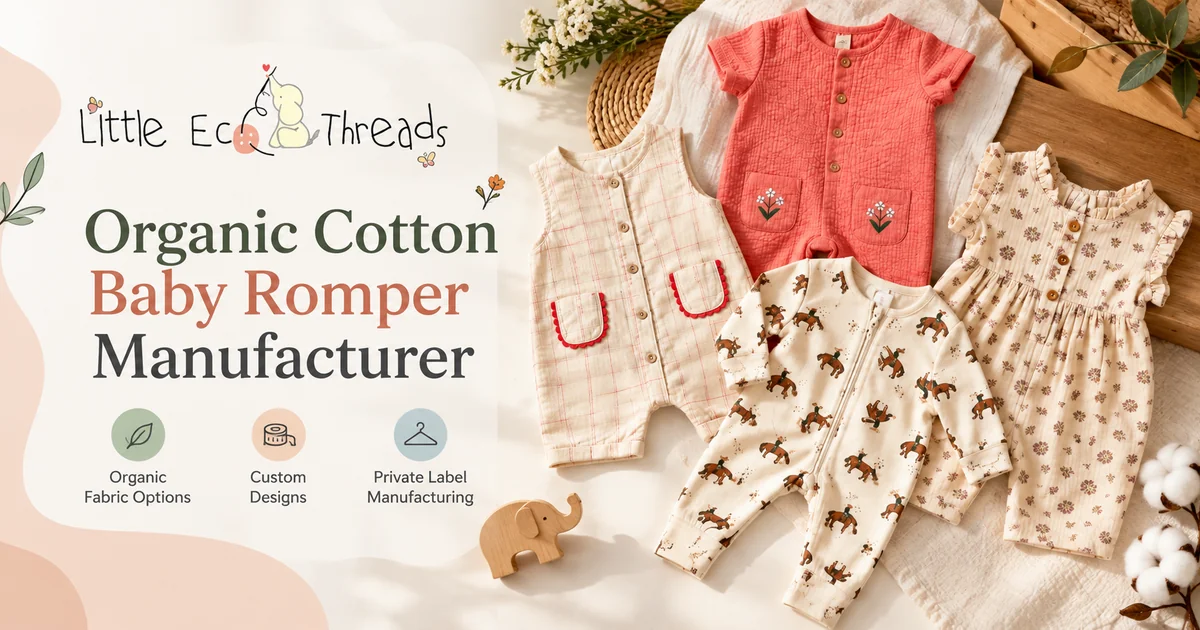
Little Eco Threads is a Noida-based manufacturer of baby and children's clothing that makes baby rompers, including organic cotton options, for brands in Europe, North America and Australia. For buyers comparing an organic cotton baby romper manufacturer, the practical questions are specific: which romper styles are available, which fabrics are certified organic, what can be customised, and how sampling and ordering work.
This guide answers those questions using information published on the company's official website. It also flags where a capability or claim applies to one collection rather than to every product, because that distinction matters when you write specifications and make organic claims of your own.
The article is written for baby clothing brands, private-label businesses, boutique retailers, importers and sourcing teams assessing a production partner. It is not a buying guide for parents choosing a single garment. For fabric, construction and comfort considerations, see the separate guide to organic cotton baby rompers for sensitive skin.
About Little Eco Threads as a manufacturing partner
Little Eco Threads is the baby and kidswear division of Home Fashions, a manufacturer the website says has more than 30 years of experience producing apparel for global brands. Its address is C-51, Sector 63, Noida, Uttar Pradesh, India. The two businesses are related but not the same: Little Eco Threads handles baby and children's clothing, while Home Fashions is the parent group whose heritage underpins it.
The site publishes four headline figures: 100+ brands served, 25+ years of experience, 500+ team members and 20+ product categories. Read the experience figure in context. It appears alongside the parent company's 30+ year history, while the About page also describes the division's own experience as over a decade. Treat 25+ years as reflecting manufacturing heritage within the group, and ask the team to confirm how long the baby and kidswear operation has run. The website does not name the brands it serves, so none are named here.
Operationally, the About page describes in-house design, CAD pattern making, imported cutting machinery, embroidery, washing, finishing and packing. It cites a 30-person sampling team and says samples can reach a buyer within a week. Confirm that timing against your own style and fabric.
Organic cotton baby romper styles in the range
The three collections reviewed here list 19 romper styles between them, each with a stated minimum order quantity (MOQ) of 100 pieces per style. Other catalogue categories, such as Linen and Prints, include further romper designs.
| Collection | Romper styles listed | Fabric per website | Sizes per website |
|---|---|---|---|
| Knits | Six, including ribbed zip (short sleeve), waffle (long sleeve, front pocket) and ribbed knit (centre-front placket) | Cotton rib knit on the product page reviewed; collection page cites organic cotton options | Newborn to 18M on the product page reviewed |
| Summer | Six, including coral embroidery, cream check, pink gingham cap, mint seersucker ruffle, green check tie-strap and pink muslin cat | Seersucker, gingham, windowpane check and double muslin; collection described as GOTS-certified organic cotton | 0–3M to 13 years across the collection |
| Embroidery | Seven: floral collar muslin, ruffle collar, floral bouquet ruffle, sunflower collar, wildflower ruffle, dark floral sleeve and the Floral Yoke Balloon Romper (long sleeve, smocked yoke, floral embroidery) | 100% cotton double gauze or 100% cotton muslin; one style pairs double gauze with a linen collar; no organic claim on these product pages | 0–3M to 18–24M, plus sizes 2 and 3 |
The range runs from newborn essentials, such as ribbed zip rompers sized from newborn, to occasion-led pieces with smocking and embroidery. That breadth suits brands building a core layette line, a seasonal capsule, or both.
Two points matter for specification. First, the site describes its catalogue products as illustrative and made to order, not stocked, and says any design, material or style can be modified. Second, fabric descriptions vary by page. The Summer collection page describes GOTS-certified organic cotton, but the seven Embroidery rompers list 100% cotton double gauze or muslin without an organic claim, and the Knits romper page reviewed lists cotton rib knit. Do not assume every romper is organic. Confirm the fabric and certification status of your exact style in writing before you commit.
What GOTS, GRS and Sedex mean for an organic romper line
The three certifications the website lists cover different things, so they support different claims and are not interchangeable.
| Certification | What it covers | What it supports for your brand |
|---|---|---|
| GOTS (Global Organic Textile Standard) | Textiles made from organic fibres, with ecological and social criteria applied from raw fibre to finished garment | Organic claims on garments made from certified organic fibre |
| GRS (Global Recycled Standard) | Recycled content, plus responsible social, environmental and chemical practices | Recycled-content claims; relevant only to styles that use recycled material |
| Sedex | Ethical trade membership; SMETA audits cover labour rights, health and safety, environment and business ethics | Evidence of social compliance for retailers; says nothing about fibre content |
Sedex is a membership platform and SMETA is an audit method, not a fibre certification, which is why it supports compliance conversations rather than organic labelling.
The sustainability page says the factory holds all three approvals, that they are independently audited and renewed regularly, and that audit reports and certification documentation are available on request. Ask for current certificates, their scope and expiry dates.
A factory certificate does not automatically cover every product. Organic claims depend on the specific fabric and supply chain of your order falling within scope, and brands that label finished goods as GOTS certified may need their own certification or licensing. Confirm the requirements for your market with the manufacturer or your certification body before printing organic claims on labels or packaging.
Private label and customisation options
The Custom Manufacturing page lists services for brands launching new ranges or extending existing ones:
- Custom pattern making and grading
- Fabric sourcing and development
- All-over printing and screen printing
- Hand and machine embroidery
- Hand and machine smocking
- Appliqué and patchwork
- Custom trims, buttons and zippers
- Private labelling and hang tags
- Custom packaging
- Size range customisation
- Pantone colour matching
- Fabric testing and certification
Not every option applies equally to every romper. Smocking and embroidery appear on specific styles, such as the Floral Yoke Balloon Romper, while the ribbed knit rompers are shown as plain, colour-led designs. Treat the list as company-wide capability, and confirm feasibility, cost and MOQ for your own romper design during quoting.
Brands that start from a concept rather than a finished pack can share designs, tech packs or ideas, and the team will work with them to finalise specifications, fabrics and patterns. The Knits and Summer pages also mention exclusive colourways and colour matching, which helps a brand differentiate from catalogue styles. Product pages invite quote requests for a specific style and say enquiries receive a response within 24 hours.
Development, sampling, quality control and lead times
The website describes a four-stage process from concept to delivery:
- Design and development: share designs, tech packs or ideas, and the team finalises specifications, fabrics and patterns.
- Sampling: initial samples are produced for approval, with multiple revisions included before bulk production.
- Production: bulk production begins after sample approval, with quality control at each stage and regular progress updates.
- Delivery: garments are inspected, packed with custom labelling and packaging, and shipped worldwide by sea or air freight.
Quality control is described mainly at the finishing and packing stage, which includes inspection tables, steam pressing, stain removal stations and adherence to 1.5 AQL standards. The homepage states production lead times of 45–90 days. Ask how that range shifts with fabric development, embroidery or smocking, and certified organic fabric availability, and which inspection reports you will receive with each shipment.
Buyers can also order free fabric swatches through the website before committing to a sample.
Verified recognition and media mentions
The homepage "As Featured In" section lists two publications: baby&junior and CWB (Childrenswear Buyer) Magazine. Each logo links to a digital issue. The linked issues could not be opened in full for this article, so it makes no claim about what the coverage said, when it ran or in what context.
No awards are listed on the pages reviewed, and none are claimed here. Brands that want to cite the features in due diligence should ask Little Eco Threads for the specific issues and page references.
What to check before placing a romper order
Confirm six points in writing before you approve a romper order, because the website describes capability at a general level rather than for each style.
- Fabric and certification scope. Ask which exact fabric your romper will use and whether it is certified organic. Request current certificates, their scope and expiry dates, and the audit reports the company says it provides on request.
- Minimum order quantity. Product pages list 100 pieces per style. Confirm whether that applies per colour or per size, and whether custom fabric development or embroidery changes it.
- Specification and sizing. Agree the tech pack, size chart, grading, trims and labelling. The site states sizes from 0–3M to 13 years across its knit and summer pages, but individual styles list narrower ranges.
- Safety and labelling compliance. Children's clothing is regulated differently in the EU, the US and Australia. Confirm which tests, fastener requirements and care labels your destination market needs, and whether the fabric testing service covers them.
- Sampling terms. Clarify the number of revisions, sample cost, courier timing and the approvals required before bulk production starts.
- Pricing, lead time and freight. Catalogue pricing is described as indicative, so request a formal quote with payment terms, the lead time for your style within the stated 45–90 day range, and sea or air freight options.
Brands with retailer compliance requirements should raise them in the first conversation rather than after sampling.
Is Little Eco Threads the right organic cotton baby romper manufacturer for you?
Little Eco Threads is worth shortlisting if you want made-to-order baby rompers with private-label branding, documented certifications and a stated MOQ of 100 pieces per style. The website supports a credible case: a defined process from design to delivery, GOTS, GRS and Sedex credentials, and a catalogue of knit, seersucker, gingham, muslin and embroidered rompers that can be modified.
The likely best-fit buyers are start-ups testing a first organic collection, boutique brands that want exclusive colourways, and established brands adding a made-to-order romper range alongside existing suppliers. Brands that need very high volumes or very short lead times should discuss capacity directly, because the website does not publish production capacity figures or customer references. Ask for both during due diligence.
The case is strongest when you verify the details that vary by style: which fabrics are certified organic, how the certificates apply to your order, and how lead times and costs change with your design. Start with a quote request for a named romper, or order swatches to assess fabric first.
Contact Little Eco Threads at vinall@littleecothreads.com or +91 9650409669, or send an enquiry through the contact page.