Swaddle Manufacturer in India: Custom and Private Label Swaddles for Baby Brands
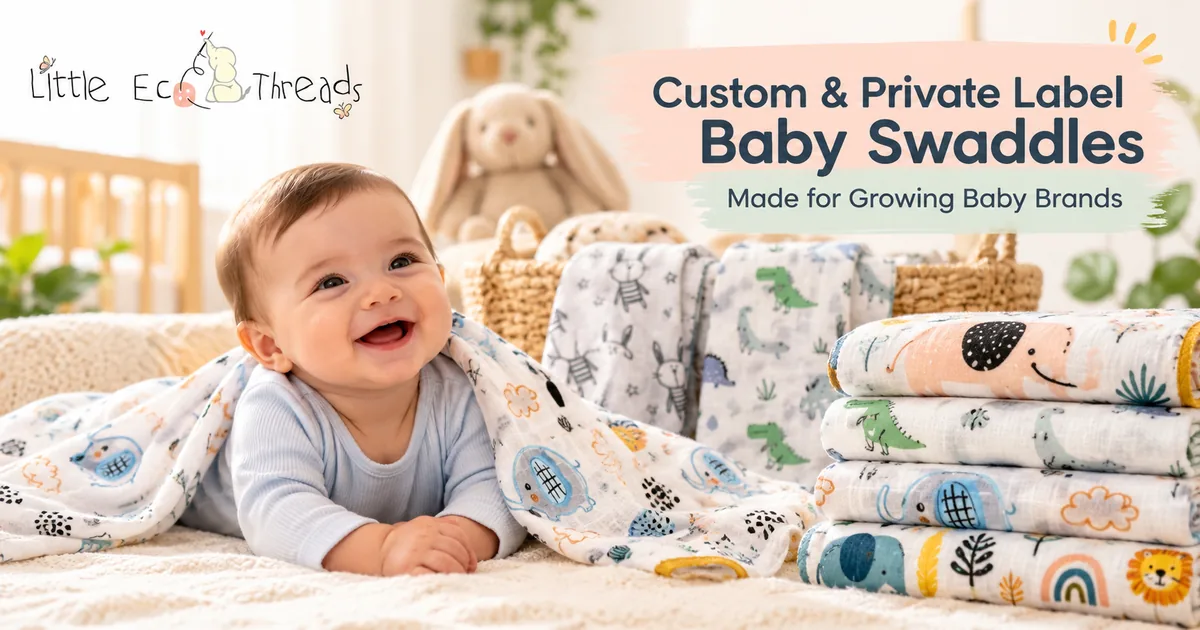
A founder has just finished her first newborn collection. The bodysuits and sleepsuits are approved, the colours are set and the photoshoot is booked. Then a stockist asks a simple question: do you have swaddles to go with it? Suddenly the range feels incomplete, and the search for a swaddle manufacturer in India starts from scratch.
This happens more often than most brands expect. A swaddle looks simple, but a good one depends on many small decisions: fabric and weight, print quality, size, edge finish, and whether the product can be repeated across several orders. The manufacturing partner shapes all of these. A poor match tends to show up later as delayed launches, inconsistent colours or a swaddle that does not quite match the rest of the collection.
This guide is written for brand owners, retailers and ecommerce sellers who want to develop custom or private label baby swaddles. It explains what to look for in a manufacturer, how fabrics differ, what customisation involves and which questions to ask before you place an order. Little Eco Threads, a baby and kidswear manufacturer based in Noida, Uttar Pradesh, is mentioned where it is relevant, but the checklist applies whichever supplier you choose.
Why Baby Swaddles Are Worth Adding to a Baby Brand
Swaddles sit comfortably across several parts of a newborn range. They work as a standalone product, as part of a baby gift set with bodysuits, hats and bibs, and as a companion to nursery items such as baby sleeping bags and muslin burp cloths.
For brands that already sell babywear, a swaddle is a natural way to extend a print story. The same artwork used on a romper can appear on a swaddle, so the collection looks planned rather than assembled. For retailers and boutiques, it is also an easy add-to-basket item.
None of this means every brand should add swaddles. It does mean the category deserves the same care as the rest of your range, starting with the choice of manufacturer.
What to Look for in a Baby Swaddle Manufacturer
A price list alone will not tell you whether a supplier is right for your brand. These are the factors that tend to matter most once production begins.
- Fabric sourcing and selection. Ask where fabrics come from and request swatches. Fabric decides how a swaddle feels and washes.
- Product development support. A capable team can turn artwork or a rough idea into a workable specification.
- Customisation options. Check what can change: prints, colours, sizes, layers, labels and packaging.
- Stitching and finishing. Edges and seams are what customers notice after the first wash.
- Print and colour consistency. The second order should match the first, and both should match your other products.
- Quality control. Ask when inspections happen and what they check.
- Capacity and lead times. Realistic timelines protect your launch dates.
- Minimum order quantities. These decide how much stock risk you take on.
- Packaging and labelling. Presentation matters, especially for gifting.
- Communication and export readiness. Clear updates and correct shipping paperwork save more time than any discount.
Choosing the Right Fabric for Baby Swaddles
No single fabric is best for every baby, climate or brand. The right choice depends on who you are selling to and how the product will be used. For a deeper look at fabric, sizing and safety, see our guide on what makes a good baby swaddle.
Muslin
Muslin is a loosely woven cotton with an airy, slightly crinkled texture that softens with washing. It is light and breathable, and popular for warmer weather, layering and multi-purpose use as a wrap or pram cover. It has little stretch.
Cotton jersey
Cotton jersey is a knit, so it stretches and recovers. Stretch swaddle blankets feel snug and smooth, which suits brands that want a more fitted wrap and a plainer finish. Jersey is usually heavier than muslin.
Organic cotton
Organic cotton describes the fibre rather than the fabric structure, so it can be used for either muslin or jersey. If you plan to market a swaddle as GOTS certified, check the claim carefully. According to the Global Organic Textile Standard, a GOTS claim is not valid until an independent certification body has checked and certified the operation. Ask for the supplier's scope certificate and confirm that the specific fabric and product are covered.
If you are unsure, ask for fabric swatches before you commit. Handling the fabric tells you more than a description will.
Custom Baby Swaddles: Fabrics, Sizes, Prints and Finishing
Custom baby swaddles help a brand stand out on a crowded shelf. Most of the difference comes from a handful of choices, and each one affects cost and lead time.
- Fabric composition and weight. Lighter fabrics feel airy, while heavier ones feel more substantial.
- Dimensions. Size affects how the swaddle is used and how much fabric you pay for.
- Layers. Single layer, or two or more layers where the fabric allows.
- Prints and patterns. These behave differently on muslin and jersey, so ask for a printed sample.
- Colour palette. Share a reference such as a Pantone code to match your wider range.
- Edge finishing and stitching. Plain hems and contrast borders change both the look and the durability.
- Labels and branding. Woven labels, printed labels and hang tags need early planning.
- Packaging. Single swaddles, two-packs and gift sets each need different packaging.
Specifications depend on the design, the fabric and the production method, so treat any measurement as a starting point to confirm in writing. The custom manufacturing process at Little Eco Threads, for example, moves from design and development to sampling, production and delivery, with sample approval before bulk production begins.
Private Label Baby Swaddles for Growing Brands
Private label baby swaddles are made by a manufacturer to your specification and sold under your own brand name. You decide the fabric, print, size, labels and packaging, and the manufacturer handles production.
This is different from buying ready-made wholesale baby swaddles. Wholesale usually means choosing from an existing range, often with the supplier's own design and branding. It is faster and simpler, but your product may look similar to what other retailers sell. Private label takes more planning, yet it gives you control over how the product looks and how it fits with the rest of your newborn essentials.
That control is useful for several types of business:
- Startups can build a consistent first collection around their own artwork.
- Boutiques can offer something customers cannot find elsewhere.
- Established retailers can add a swaddle that matches existing babywear and nursery lines.
- Ecommerce brands can keep photography, packaging and product ranges consistent across channels.
Low MOQ and Product Development for Baby Swaddle Startups
Minimum order quantity, or MOQ, is often the deciding factor for a young brand. Ordering too much ties up cash and creates stock you may struggle to sell. Ordering too little may not be possible, or may push the cost per piece higher than your margins allow.
Think of it as a balance between initial investment, inventory risk, the number of designs you want to test and how easily you can reorder. Many startups prefer a few designs in small quantities over one large run of a single print.
MOQs vary with the fabric, print method, colours and whether the design is custom or from an existing range. Before you commit, confirm these points directly with each manufacturer:
- The MOQ for your specific fabric and design
- Whether sampling is available and how it is charged
- Production lead times for samples and for bulk orders
- Any extra requirements for custom prints, labels or packaging
A supplier who answers these questions clearly at the start is usually easier to work with later.
Quality and Compliance Considerations for Baby Swaddles
Quality starts with traceable materials, stable colours, even stitching and seams that survive repeated washing. Ask how checks are done during production, and whether lab testing such as colourfastness or shrinkage is available for your product.
It also helps to separate three different things that are often mixed up:
- Material certifications relate to the fabric or fibre. GOTS, for example, covers organic fibre textiles through processing and labelling. OEKO-TEX STANDARD 100 tests textiles for harmful substances, with requirements that depend on the intended use of the product.
- Facility audits look at the factory rather than the product. Sedex membership and SMETA audits cover areas such as labour practices, health and safety and business ethics.
- Finished product compliance depends on the destination market. In the United States, for instance, the importer or domestic manufacturer of a children's product must certify it with a Children's Product Certificate, usually supported by testing at a CPSC-accepted laboratory.
No single certificate covers all three. A GOTS certified fabric does not automatically mean a finished swaddle meets every labelling or safety rule in your market. Before you export, confirm the requirements for your destination and design, and ask your supplier which test reports they can provide.
How to Choose a Reliable Swaddle Manufacturer in India
When you compare suppliers, ask each one the same questions and keep the answers in writing. This makes the differences easy to see.
| Area | Questions to ask |
|---|---|
| Samples | Can I see a finished swaddle and a printed sample? How many revisions are included? |
| Fabric specifications | What are the composition, weight and construction? |
| Customisation | Which prints, sizes, layers and labels can you produce? |
| MOQ | What is the minimum for my design? |
| Quality assurance | When do you inspect, and what happens if a batch fails? |
| Timelines | How long do sampling and bulk production take? |
| Packaging | What folding, polybag, gift box and barcode options exist? |
| Export documentation | Which documents and shipping methods do you support? |
| Communication | Who manages my order, and how often will I get updates? |
A manufacturer that is open about its limits is usually more dependable than one that says yes to everything.
Developing a Custom Swaddle Collection with Little Eco Threads
Little Eco Threads works with businesses that want to develop baby swaddles and coordinated newborn essentials under their own brand. The swaddles category lists muslin and gauze wraps and jersey stretch swaddle blankets, with custom prints and colourways, single, double and triple-layer options, and personalised or monogrammed designs. Sampling and bulk production are both offered, and the same team can also produce bib sets, burp cloths and gift sets in matching prints.
On MOQs, the catalogue currently lists 100 pieces for most single swaddle designs and 20 to 30 pieces for coordinated sets. The catalogue notes that its items are illustrative and made to order, so confirm the terms for your own design before planning a launch.
On certifications, the sustainability page lists GOTS, GRS and Sedex membership, with SMETA audits. As with any supplier, ask which documents apply to the specific fabric and product you are developing.
If you are planning a collection, you can browse the swaddles, request fabric swatches and share your artwork or requirements to discuss what is possible.
Frequently Asked Questions
How do I find a reliable swaddle manufacturer in India?
Choose manufacturers that specialise in baby products, request samples, compare specifications and ask for certification documents.
What fabrics are commonly used to manufacture baby swaddles?
Muslin, cotton jersey and organic cotton are the most common. Muslin is light and airy, jersey stretches, and organic cotton can be used for either, subject to certification.
Can baby swaddles be customised for private label brands?
Yes, in most cases. Prints, colours, sizes, labels and packaging can usually be developed to your brief, though options depend on the fabric and the manufacturer.
What is the difference between wholesale and private label swaddles?
Wholesale means buying from an existing range, often with the supplier's design. Private label means the product is made to your specification and sold under your brand.
What should buyers consider when choosing a swaddle manufacturer?
Look at fabric quality, customisation options, stitching, quality control, MOQs, lead times, packaging and how easily the team communicates.
Can startups work with baby swaddle manufacturers?
Yes. Many manufacturers work with new brands, but MOQs and sampling terms vary, so confirm them early and plan a small first order.
What certifications should buyers check when sourcing baby swaddles?
It depends on your market and claims. Common ones include GOTS for organic fibre textiles and OEKO-TEX STANDARD 100 for harmful substance testing, while Sedex and SMETA relate to factory ethics. Check that each certificate covers the product you are buying.
Conclusion
A good swaddle begins with a manufacturer that understands fabric, can customise to your brief, controls quality and is comfortable with private label work. Those four things matter more than any single price quote, because they decide whether your second order matches your first.
If you are building a newborn collection, take your time with samples, ask for documents that match your destination market, and keep every agreement in writing. When you are ready, you can explore the Little Eco Threads swaddle collection and discuss your product requirements with the team.