Sustainable Children's Clothing in the UK: What Brands Need to Know
The market for sustainable children's clothing in the UK brings together parents looking for considered clothing choices and businesses building collections around material quality, product safety and responsible sourcing. For brands, retailers, wholesalers and start-ups, the opportunity is not simply to sell eco-friendly garments. It is to build a kidswear range supported by clear product information, dependable quality and a supply chain that can grow with demand.
For businesses developing sustainable kids clothing, choosing the right production partner is an important part of that plan. Fabric selection, sampling, minimum order quantities, quality control and certification claims all affect how confidently a brand can take products to market.
This guide explains the factors shaping interest in sustainable kidswear, what makes children's clothing manufacturing different from adult apparel, and what UK businesses should evaluate when choosing a manufacturing partner.
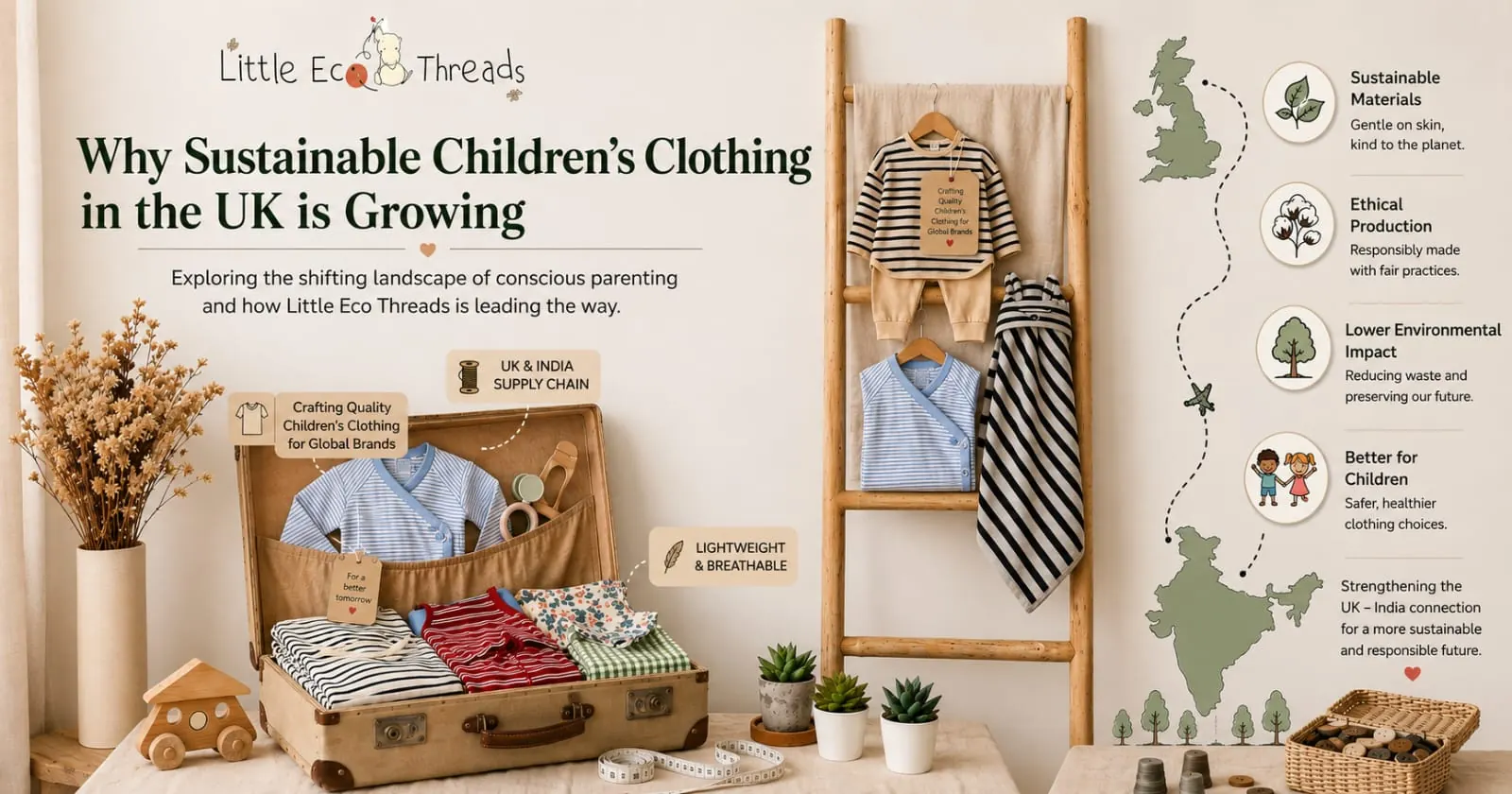
Why Sustainable Children's Clothing Is Growing in the UK
Interest in sustainable kids clothing in the UK is influenced by several practical considerations: parents want comfortable garments, brands need credible product claims, and retailers need suppliers that can meet quality and sourcing expectations. For businesses, these factors make material choice and manufacturing transparency important parts of product development.
Shifting Consumer Values
Many parents pay attention to the materials, comfort and care requirements of clothing they buy for babies and children. Some also look for clear information about how garments are made and whether sustainability claims are supported by credible evidence. For a brand selling sustainable children's clothing or organic baby clothes in the UK, specific product details are more useful than broad claims: identify the fibre content, explain relevant certifications accurately and make care instructions easy to find. Avoid promising environmental benefits that cannot be substantiated.
Regulatory Momentum
Regulatory requirements should be treated separately from voluntary sustainability goals. UK businesses selling children's clothing need to check the product safety and labelling rules that apply to their products, while also monitoring relevant packaging, waste and environmental-claim requirements as these develop. Choosing a manufacturer that can provide clear material specifications, production records and test documentation can make supplier coordination easier. Sustainability certification does not, by itself, replace legal product-safety checks or prove that a finished garment complies with every applicable requirement.
Brand Differentiation and Market Opportunity
The UK kidswear market includes established retailers, independent labels and new brands competing across price, design and product quality. A sustainable range can help a business communicate a clearer product proposition when the claims are specific and supported. Start-ups and private label brands should consider how fabric choice, durability, sourcing information and manufacturing consistency fit together, rather than relying on the word "sustainable" alone. A focused range and a suitable production partner can also help a new brand test demand before expanding its collection.
Market Growth in Children's Apparel
Search interest in terms such as "sustainable kids clothing UK" and "organic baby clothes UK" gives brands a useful starting point for understanding how people describe this category online. However, search volume alone does not establish market size or prove that one segment is growing faster than another. For manufacturers and brands, the practical takeaway is to match content and product development to specific customer needs, then validate demand using sales, enquiries and search performance data.
Why Sustainable Kidswear Is Different from Adult Fashion
Children's apparel is not simply adult clothing scaled down. Designing and manufacturing sustainable garments for babies, toddlers and older children involves a substantially different set of requirements, and businesses that overlook this often encounter costly problems.
Safety and Compliance Standards
Children's clothing needs product-specific safety checks, not just an acceptable appearance and finish. Depending on the garment, businesses may need to assess cords and drawstrings, small detachable components, flammability, chemical restrictions, labelling and the evidence required for their intended market. Requirements vary by product and destination, so brands should confirm the applicable rules and testing with qualified compliance support. A children's clothing manufacturer should be able to discuss specifications, material traceability and quality checks, but the brand remains responsible for ensuring the products it places on the market meet applicable requirements. See our UK children's clothing regulations overview.
Fabric Quality and Skin Sensitivity
Fabric selection is central to developing comfortable children's garments. Organic cotton is commonly considered for babywear and everyday kidswear because of its familiar hand feel and versatility, while muslin, linen and other fibres may suit particular products and climates. The best option depends on the garment's purpose, construction, expected wear and care requirements. Brands should also distinguish fibre claims from chemical-safety claims: a natural or organic fibre does not automatically mean that every dye, finish or finished product is free from substances of concern. Explore our ecofriendly children's fabric guide for more on fabric selection.
Durability Across Growth Stages
Children's garments are washed frequently and used during active play, so durability should be part of product development from the beginning. Stitching, seam construction, fastenings, fabric recovery and colourfastness can all affect how a garment performs over time. For brands building durable kidswear, sampling and wash testing can help identify issues before bulk production. Longer useful life may also reduce premature replacement, although actual performance depends on the garment, its construction and how it is cared for.
The Parent Purchasing Mindset
Purchasing decisions for children's clothing are emotionally driven. Parents are buying for someone they care about more than themselves, which means trust, safety and transparency matter more here than in almost any other category. Brands that can credibly communicate ethical production, safe materials and supply chain integrity hold a powerful advantage in this market.
What UK Businesses Should Look for in a Sustainable Manufacturing Partner
Selecting the right manufacturing partner is one of the most consequential decisions a children's clothing brand makes. The following criteria should inform that decision.
Sustainable Materials and Responsible Sourcing
A sustainable kidswear manufacturer should explain which materials are available, what documentation supports the claims and how material choices affect the finished garment. When assessing a supplier, ask for:
- Fibre composition and available certification or transaction documentation
- Information about fabric mills and relevant raw-material suppliers
- Details of dyeing, printing and finishing processes where these affect your product requirements
- Clear distinctions between certified inputs, verified product claims and general sustainability statements
- Suitable options such as organic cotton, muslin, linen or recycled fibres for the intended garment
Do not assume that every material offered by a supplier is certified. Confirm the documentation for the specific fabric and order you plan to use.
Ethical Production Practices
Sustainability is not only environmental. Ethical production means fair wages, safe working conditions and respect for workers throughout the manufacturing process. UK businesses should ask directly about factory conditions, worker welfare policies and how compliance is monitored. A manufacturer that cannot answer these questions clearly is unlikely to meet growing retailer and investor expectations around social governance.
Quality Control and Consistency
For children's clothing, quality control goes beyond aesthetic finish. Seam strength, colourfastness, label attachment and finishing safety all need to be verified consistently. Inconsistent quality undermines brand trust quickly, particularly in the premium and sustainable segment where customers expect their investment to last.
Certifications as Trust Indicators
Certifications can help brands substantiate particular material or processing claims, but it is important to understand what each one covers and verify that the relevant supplier, facility, material or product is within scope. GOTS certification relates to the Global Organic Textile Standard and covers defined requirements across organic textile processing and supply chains. OEKO-TEX STANDARD 100 tests textile articles for harmful substances against its criteria; it should not be described as proof that a garment is wholly sustainable. The Global Recycled Standard (GRS) addresses recycled content and additional processing and chain-of-custody requirements. Ask for current, applicable documentation and confirm its scope before using a certification claim in product descriptions. See our GOTS certification guide and the OEKO-TEX website.
Scalability and Minimum Order Quantities
For a new kidswear brand, the minimum order quantity (MOQ) can determine how much cash is tied up in the first production run. A low MOQ clothing manufacturer may allow a start-up to test a smaller collection before committing to more sizes, colours or designs. However, MOQ varies by fabric, print method, trims, customisation and production process. Ask the supplier to confirm the MOQ for each style, whether sizes and colours can be combined, what sampling costs apply and how unit pricing may change at higher quantities. Low MOQs are useful only when the product specification and quality expectations remain clear.
Benefits for Brands and Retailers
For businesses ready to commit to sustainable kidswear manufacturing, there can be real commercial benefits, provided the product and its claims hold up.
Stronger Brand Positioning
Sustainable children's brands command attention in a crowded market. Whether selling direct to consumer, through independent retailers or on major platforms, an authentic sustainability story creates a clear and defensible market position. This is not superficial greenwashing. It is a genuine product- and values-led differentiation that resonates with buyers.
Increased Customer Trust and Loyalty
Parents who trust a brand are more likely to return to it. Trust in the children's clothing sector is built through consistent quality, transparent sourcing and reliable ethics. Brands that deliver on these points may see more repeat purchases and word-of-mouth referrals, which matter in a parenting community that shares recommendations both online and offline.
Better Long-Term Profitability
Sustainable products do not automatically deliver higher margins. Costs depend on fabric, certification, sampling, order quantity, shipping, duties, quality requirements and the price customers will accept. Brands should model landed cost and gross margin before setting retail or wholesale prices. A credible sourcing story and consistent product quality may help support positioning, but profitability needs to be validated against the brand's own costs, sales and repeat-purchase data.
Retail and Wholesale Opportunities
Independent boutiques, larger retailers and wholesale accounts are all possible routes to market for a sustainable kidswear brand. Retail buyers are likely to ask about ethical credentials, product quality and supply reliability, so brands that can support these points with documentation may be better placed when approaching new accounts.
Getting Ahead of Compliance Requirements
Keeping supplier records, material specifications and relevant testing documents organised can help a brand respond to buyer questions and applicable regulatory requirements. Businesses should monitor the rules relevant to the markets where they sell and avoid assuming that a sustainability programme alone guarantees compliance. Responsible sourcing is most useful when it is supported by clear documentation and practical production controls.
How Little Eco Threads Supports UK Businesses
Little Eco Threads is a sustainable children's clothing manufacturer based in India, supporting brands that need children's and babywear production, including UK-based clothing brands, retailers, start-ups and private label businesses. Brands looking for a kids clothing manufacturer or baby clothing manufacturer for the UK market often compare UK-based production with overseas suppliers. When evaluating an overseas supplier, UK buyers should consider more than the quoted unit price: sampling, production timelines, shipping method, import costs, product specifications and communication all contribute to the final sourcing decision.
The product range includes smocked occasionwear, embroidered babywear, everyday basics, partywear, swimwear, linen separates, denim and gift sets. Depending on the design and material, brands can discuss a collection that brings several product categories together with one manufacturing partner. Before placing an order, confirm which fabrics, finishes, custom prints, embroidery, smocking and packaging options are available for the specific styles in your range.
A remote development process can use digital briefs, tech packs and video consultations, followed by physical samples for review before bulk production. For UK businesses sourcing from India, shipping by sea or air may be considered according to order size, cost and required delivery date. Buyers should agree in writing on sample approval, production lead time, inspection expectations, shipping terms and responsibility for import charges before confirming an order.
Key areas of support include:
- Sustainable children's clothing manufacturing services for brands developing babywear and kidswear collections
- Fabric and product discussions covering options such as organic cotton and other suitable materials, subject to style requirements and available documentation
- Low-MOQ discussions for early-stage brands, with order minimums confirmed for each product and production method
- Private label children's clothing for businesses creating their own branded range, including private label baby clothing for the UK market
- OEM and ODM support, depending on the design brief and development requirements
- Sample-led development and coordination on production and shipping timelines
- Communication with founders, buyers and brand teams throughout product development
Little Eco Threads works with brands at various stages, from pre-launch start-ups developing their first collection to established retailers looking to expand their sustainable offering. The focus throughout is on producing children's garments to agreed quality and safety specifications, with sustainable material options where the style allows.
Conclusion
Interest in sustainable children's clothing in the UK gives brands an opportunity to build collections around considered material choices, product quality and responsible sourcing. But a credible position depends on more than sustainability messaging. Businesses need clear product specifications, substantiated claims, reliable production and a realistic understanding of costs and compliance responsibilities.
For start-ups and established labels alike, choosing a suitable children's clothing manufacturer means assessing fabric options, sampling, quality control, minimum order quantities, documentation and communication before committing to bulk production. Search visibility can bring the right audience to a brand, but useful content should also answer the practical questions that buyers and founders need to resolve.
Little Eco Threads works with brands exploring children's and babywear manufacturing, including private label collections. If you are planning a new range, review your product requirements, expected order quantities and timeline, then discuss the available manufacturing options at Little Eco Threads.