Sustainable Kidswear Manufacturer MOQ Guide
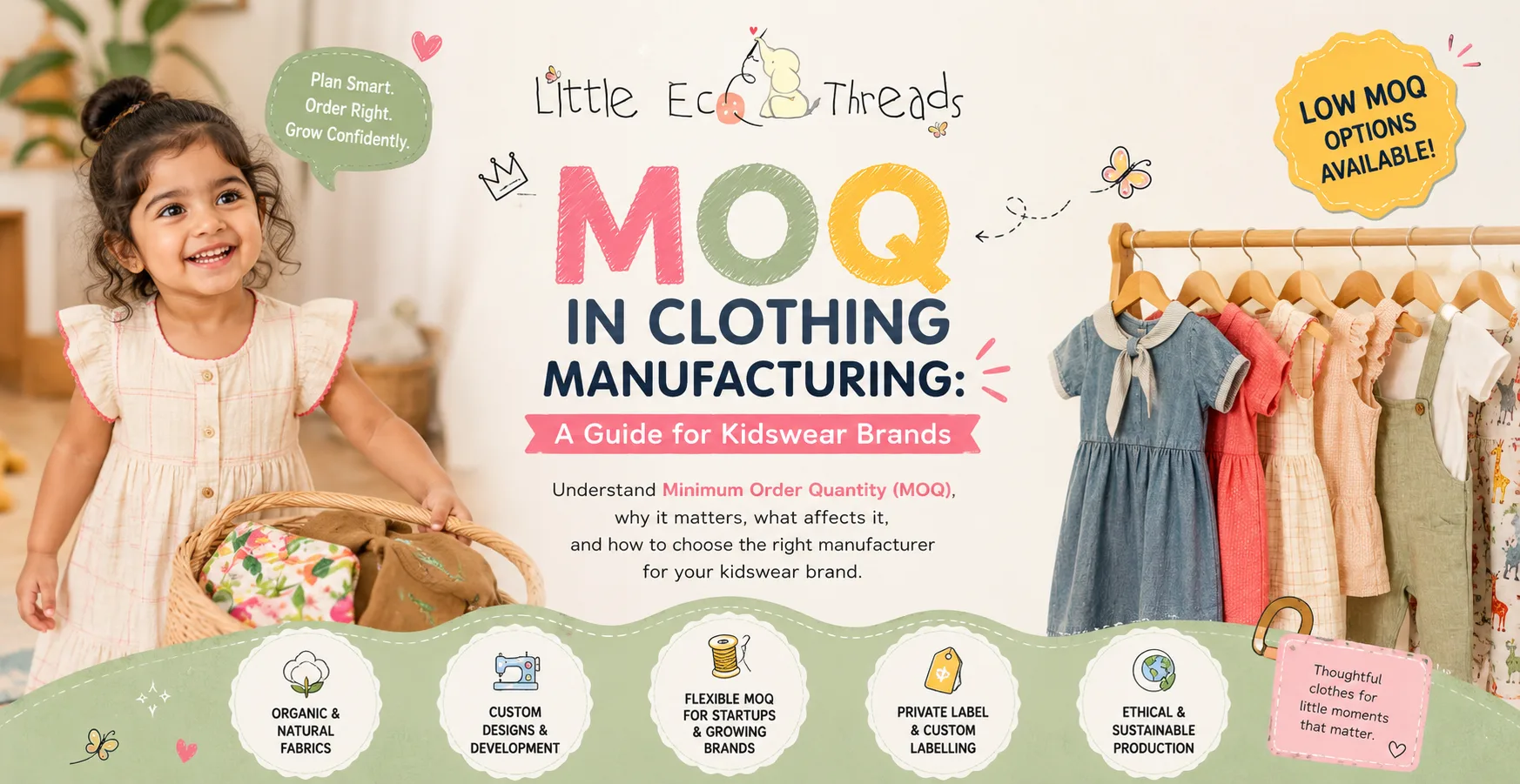
Choosing a sustainable kidswear manufacturer is not only about fabric, pricing, or sampling quality. For new brands, one of the biggest decisions is MOQ, or minimum order quantity. MOQ affects how much stock you commit to, how much cash is tied up before launch, and how quickly you can test new designs without overproducing.
Imagine you have finished three designs for your first kidswear collection. You contact a manufacturer and receive a quote that says, "MOQ: 500 units per design." That means you would need to order 500 pieces of each design. For three designs, your first order would be 1,500 pieces before you know which styles will sell best.
This guide explains how MOQ works in kidswear manufacturing, what low MOQ manufacturing really means, and how startup-friendly kidswear manufacturers can help brands launch with more control.
What A Sustainable Kidswear Manufacturer Means By MOQ
MOQ stands for minimum order quantity. It is the smallest number of pieces a manufacturer will make for you in one order.
For example, if a kidswear manufacturer has an MOQ of 100 pieces per design, you need to order at least 100 pieces of that design. You cannot place a production order for only 50 pieces unless the manufacturer agrees to a smaller run.
MOQ can work differently from one factory to another. It may apply to each design, each colour, each size group, each fabric, or the total order. A 300-piece MOQ could mean 300 pieces of one design and colour, or it could mean 300 pieces divided between sizes and colours within the same style.
Because every manufacturer may calculate MOQ differently, always ask how their MOQ works before placing an order. This helps you understand the true order quantity and avoid unexpected production costs.
Why Kidswear Manufacturers Set Minimum Order Quantities
MOQs exist because of production economics. Buying fabric, setting up cutting and stitching lines, preparing embroidery or print work, arranging trims, and packing garments all take time and labour. These setup costs are often similar whether a factory produces 30 pieces or 300 pieces.
When an order is too small, those fixed costs are spread across fewer garments, so the unit price rises. Below a certain volume, the numbers may stop working for both the manufacturer and the brand.
This is also why MOQs often increase when the product becomes more complex. Custom colours, custom fabric, embroidery, smocking, printed labels, woven labels, hang tags, packaging, and special finishing can all change the minimum quantity needed to produce the order efficiently.
The wider clothing manufacturing sector also depends on careful production planning, skilled labour, and reliable factory scheduling. MOQ is one way manufacturers keep that process commercially workable.
How MOQ Affects Small Kidswear Brands
For an established label, a 500-unit MOQ across several colourways may be routine. For a startup testing its first collection, the same quantity can create real cash and inventory risk.
Say a new brand wants to launch three babywear designs but is not sure which colours will sell best. A high MOQ forces a choice: commit to a large batch before any sales data exists, or delay the launch while searching for a low MOQ clothing manufacturer.
Every extra size, colour, fabric, and seasonal design multiplies that decision. This is why MOQ matters so much early on. It affects:
- Initial production budget
- Inventory risk
- Cash tied up in unsold stock
- Ability to test new designs
- Range size for the first launch
- Speed of repeat orders
The goal is not simply to find the lowest possible MOQ. The better goal is to find a low MOQ sustainable kidswear manufacturer whose order quantities, quality standards, materials, and pricing match your current stage.
What Counts As Low MOQ Manufacturing?
Low MOQ manufacturing generally means a manufacturer is willing to produce smaller batches than the industry norm. In kidswear, that may mean a range somewhere around 30 to 100 pieces per style for simpler products, though there is no universal cutoff.
Low MOQ is especially useful for:
- First collections
- New product testing
- Seasonal capsules
- Boutique wholesale launches
- Slow fashion brands
- Founders who want to avoid overproduction
Lower is not always better. A very small batch can increase the per-piece cost because fabric sourcing, pattern setup, cutting, stitching, and finishing are spread across fewer garments. The right MOQ depends on your budget, launch strategy, product complexity, and how confident you are in demand.
What Can Change A Manufacturer's MOQ?
MOQ is not fixed across every product a factory makes. It often changes based on the product and production method.
Common factors include:
| MOQ Factor | Why It Matters |
|---|---|
| Fabric type | Stock fabrics usually allow lower MOQs than custom-developed fabrics. |
| Colour count | More colours can mean more dyeing, cutting, sorting, and production setup. |
| Custom trims | Labels, buttons, zips, hang tags, and packaging can have their own supplier minimums. |
| Embroidery or printing | Decoration adds setup time and may require separate production minimums. |
| Size range | A wider size range spreads the quantity across more graded patterns. |
| Certifications | Certified materials may require documentation and supply chain control. |
For example, organic cotton can be a strong choice for babywear and children's clothing, but brands should understand whether the fabric is available as stock, whether certification documents are available, and whether the final product claims are supported.
Similarly, GOTS claims need care. The Global Organic Textile Standard (GOTS) is not just a casual fabric description; it is a certification system with rules around organic content, processing, environmental criteria, social criteria, traceability, and labelling.
Questions To Ask Before Agreeing To An MOQ
Before signing off on a production run, ask clear questions:
- Is the MOQ calculated per design, per colour, per size, or per total order?
- Can I mix sizes within the minimum order quantity?
- Can I mix colours within the same MOQ?
- Does custom fabric increase the MOQ?
- Does embroidery, printing, smocking, or applique change the MOQ?
- Are labels, trims, and packaging included in the same MOQ?
- Is the MOQ lower for repeat orders?
- Can the first order be smaller while we test demand?
- What happens if a fabric supplier has a higher minimum than the garment factory?
These questions are especially important for a custom kidswear manufacturer because product details can change the production plan quickly.
How Little Eco Threads Supports Low MOQ Kidswear
For brands building children's clothing, flexible order quantities can make the first collection easier to plan. It gives founders room to test styles, colours, and materials before committing to larger production volumes.
Little Eco Threads is a kidswear manufacturer India-based brands can work with for baby and children's apparel, accessories, and nursery textiles. The team supports both small and large minimum order quantities depending on product type, material choice, and production complexity.
Brands can discuss materials such as GOTS certified organic cotton, bamboo, linen, denim, corduroy, and other natural or blended fabrics. Support can also include pattern making, sampling, embroidery, hand and machine smocking, custom labels, packaging, and private labelling.
If you are comparing startup friendly kidswear manufacturers, the best conversation is not only "what is your lowest MOQ?" It is:
- What can be produced at a manageable quantity?
- Which fabrics suit the first collection?
- Which details increase cost or MOQ?
- How can the range be simplified without weakening the product?
- What can scale later once demand is proven?
That is the practical difference between a generic supplier and a low MOQ sustainable kidswear manufacturer that understands growing brands.
FAQ: MOQ For Kidswear Brands
What is a good MOQ for a small kidswear brand?
There is no universal number, but many small and new brands look for manufacturers offering somewhere between 50 and 300 pieces per style while they test demand. The right MOQ depends on the product, fabric, size range, and amount of customization.
Can a kidswear manufacturer offer low MOQ?
Yes. Many manufacturers working with growing brands offer lower minimums on simpler styles or stock fabrics, even if their standard MOQ is higher for custom work.
Is MOQ calculated per design?
Often, but not always. Some manufacturers calculate MOQ per design, others per colour, fabric, size group, or total order. Always confirm this before ordering.
Can I negotiate MOQ with a manufacturer?
Sometimes. Simplifying your design, choosing stock fabric, reducing the number of colours, or using standard trims can reduce MOQ more effectively than asking for a lower minimum without changing the production requirements.
Is the lowest MOQ always the best choice?
No. A very low MOQ can mean a higher unit cost or fewer customization options. The better choice is an MOQ that allows you to test demand while still achieving the quality, material, and pricing your brand needs.
Plan MOQ Before You Produce
MOQ in clothing manufacturing is not a fixed industry rule. It varies by manufacturer, fabric, design, production process, and factory setup. Some manufacturers may offer low minimum order quantities for simple designs, while more complex garments may require larger orders because of the extra labour, materials, or supplier minimums involved.
Before placing an order, ask how the MOQ is calculated. Find out whether it applies per design, colour, size, fabric, or total order. It is also worth asking whether the manufacturer offers lower MOQs for first orders, samples, or startup brands.
For a new kidswear brand, starting with a manageable quantity can help you test designs, understand customer demand, and learn which products perform best before increasing order quantities.
If you are looking for a low MOQ kidswear manufacturer with sustainable fabric options and private label support, contact Little Eco Threads to discuss your collection, materials, and production requirements.