Kids Swimwear Manufacturer: How Brands Can Build Trend Ready Collections Without High MOQs
Many kidswear brands have a swimwear idea they really believe in, but they keep delaying the launch. Often, the problem starts with the first kids swimwear manufacturer they contact. If the factory asks for a very large order, the brand has to put a lot of money into one collection before knowing whether customers will actually like it.
Swimwear can be especially difficult because it usually sells during a limited season. Brands also need to offer different sizes, colours and prints. What sells well in Australia may not work as well in the UK. Trends can also change quickly, leaving brands with extra stock that is difficult to sell later.
This is where a low MOQ kids swimwear manufacturer can be helpful. But the goal is not simply to order fewer pieces. The real idea is to start small, put the collection in front of real customers, and see what works before spending more money on stock.
A smart first order can help a brand understand which styles, colours and prints customers actually want. Once the best sellers are clear, the brand can place larger orders with more confidence.
This article looks at how brands can plan their first swimwear collection, what they should expect from a low MOQ order, and how to choose a kids swimwear manufacturer that can grow with the brand instead of only handling the first order.
1. Why Low MOQ Matters More for Swimwear Than Brands Think
Swimwear stock can become much bigger than a brand expects. For example, imagine a new collection with 10 styles and 3 colours for each style. That already means 30 different products. Now add 6 different sizes, and you are dealing with 180 different size and style combinations.
This is only an example, but anyone who has planned a clothing collection will understand how quickly the numbers grow. And the main problem is not always the total number of pieces. The bigger problem is deciding how many pieces to make for each size, colour and style.
A brand might correctly guess that a certain style will sell well but still get the size split wrong. There could be too many pieces in size 10 and not enough in size 4. One colour might sell very slowly while another sells out within a few weeks.
With swimwear, there is often only a short selling season. So, if the first order is too large or the stock mix is wrong, there may not be enough time to fix the mistake.
A smaller opening run changes what the launch is for. Instead of trying to be right about everything, you are collecting evidence. Over one season, a lean first order can show you:
- which silhouettes customers actually reach for
- which prints earn back their development cost
- which colours sell through first
- which age groups respond best, and whether your size curve is right
- which styles deserve a larger reorder
That is the shift worth making. Low MOQ is a market-testing strategy, not just a way to reduce spend. You may pay slightly more per piece on a small run. Set that against the markdown cost of a few hundred unsold pieces in the wrong print, and the premium often looks like inexpensive research. It also keeps cash free for the reorder on styles that prove themselves.
2. The Lowest MOQ Is Not Always the Best MOQ
It is tempting to shortlist suppliers by MOQ alone and start with whoever quotes the smallest number. In practice, an extremely low minimum can come with trade-offs, and it is better to find them before sampling than after. The usual ones:
- Higher unit costs, because small runs are less efficient to cut, print and sew
- A narrower fabric range, often limited to stock or in-house materials
- Limits on customisation, such as fixed colour palettes or no custom print development
- Weaker consistency when you later move to larger quantities
- Hidden multipliers, like minimums per colour or per print that quietly raise the real total
None of this makes a very low MOQ a bad choice. For a first capsule or a test in a new market, it can be exactly right. The point is that the headline number says little by itself. As a simple illustration, a 100-piece minimum applied per colour, per style, can commit you to more stock than a 300-piece minimum shared across the whole order.
So change the question. Instead of asking "Who gives me the lowest MOQ?", ask "What is the lowest commercially sensible MOQ for my product?" The answer depends on fabric, print and what you plan to do after the first run. A good manufacturer should be willing to talk through the trade-off between MOQ and quality openly: how unit price moves as quantities rise, what changes if you switch fabric, and what a reorder looks like. If every answer is simply "we can do any quantity", be cautious.
What is a good MOQ for kids swimwear?
There is no universal MOQ for kids swimwear. A workable quantity depends on the style, fabric, colour, print and how the manufacturer sets up production. Rather than chasing the lowest number, look for the lowest quantity that still gives you a fair unit price, your chosen fabric and consistent quality.
3. How Brands Can Build a Low MOQ Swimwear Collection
A low MOQ only helps if the collection is built to use it. These are the decisions that tend to matter most.
Start with a focused collection
Launching fifteen or twenty styles splits a small budget into pieces too small to learn from. A tighter edit, perhaps six to eight silhouettes, usually tells you more and gives each style a more workable quantity. Choose pieces you can describe to a buyer in one sentence.
Limit unnecessary colourways
Colour is the quickest way to multiply stock. Every extra colourway adds sizes and quantity without guaranteeing extra sales. Two or three per style is often enough: one safe option and one that carries the season's mood. If a colour sells out, bring it back next time.
Use prints strategically
A signature print can carry several styles. One well-developed print used on a one-piece, a rash guard and a pair of swim shorts builds recognition and spreads print development and fabric commitment across products. Compare that with five separate prints, each with its own minimum. Pair the print with a plain companion colour in the same fabric so mix-and-match works.
Build around core products
Think about structure rather than product types. One-piece swimsuits and rash guards make sensible anchors, since they are the pieces most likely to be reordered. Two-piece sets add variety. Swim tops and coverups can be lighter-commitment additions, ideally cut from a fabric you are already buying for a core style so the fabric minimum is shared.
Design for reorders
Decide at design stage what a reorder would involve. Is the fabric repeatable? Can the print be matched next season? Is the pattern graded properly across the full size range? A style that sells well but cannot be reproduced consistently is a missed opportunity. Keep fabric codes, colour references and approved samples on file so the second run matches the first.
4. What to Look for in a Low MOQ Kids Swimwear Manufacturer
For a sourcing manager, a kids swimwear sourcing shortlist should go well beyond the quoted minimum. These are the areas worth probing:
- MOQ structure. Whether it applies per style, per colour or per order, and whether it can be shared across styles using the same fabric.
- Sampling. How many rounds are included, how long they take, and how closely samples reflect bulk.
- Fabric sourcing. Access to swimwear fabrics suited to children, such as chlorine resistance, stretch recovery and UPF options, plus clarity on fabric minimums.
- Custom print and colour matching. For custom kids swimwear, whether they develop prints in-house or through partners, and how colour approval is managed between lots.
- Quality control. What is checked during and after production, and how it is documented.
- Reorder capability. Fabric availability for repeats and realistic lead times on second runs.
- Communication. A clear point of contact, quick answers, and honesty about what cannot be done.
- Export experience. Familiarity with the labelling, testing and documentation expected in your destination markets.
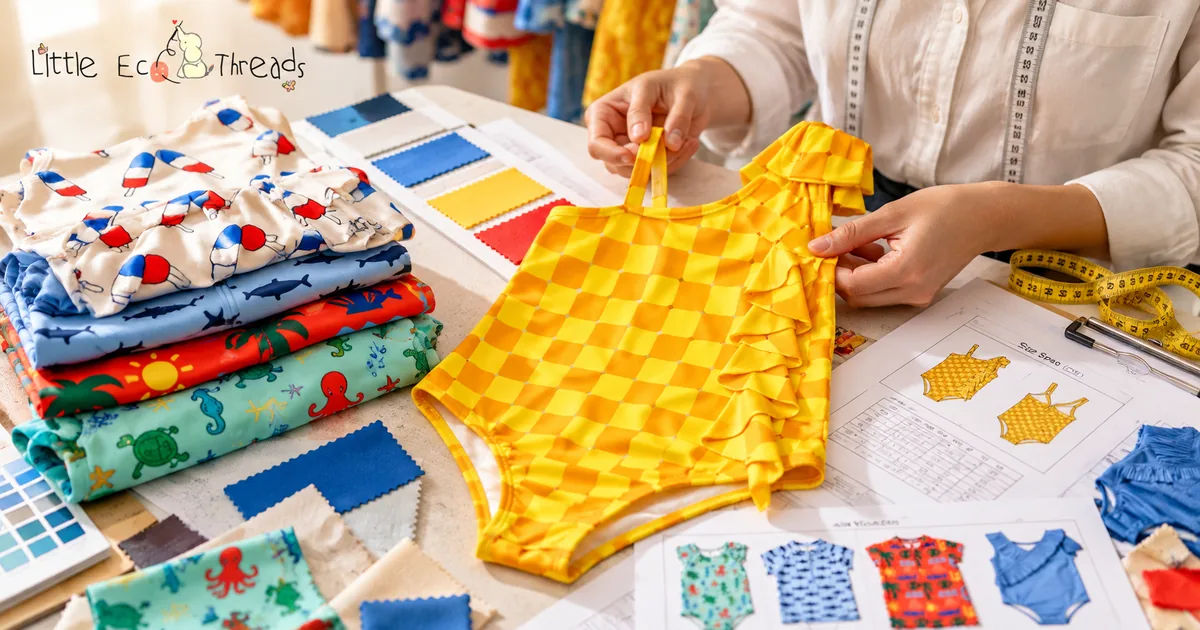
The last item on any such list should be volume range. A supplier with a low opening MOQ that cannot handle larger runs leaves you restarting the search just as a style starts working. A manufacturer that can take you from a small first order to a validated product to a bulk reorder, using the same fabric and pattern, is worth more than one that is simply cheap to begin with.
5. Sustainability Should Not Disappear Just Because the MOQ Is Low
Smaller brands often assume certified materials are out of reach until volumes grow. That can be true of a particular fabric, but it is not a rule, and it is worth asking rather than assuming. Put these questions to any supplier:
- Which certified fabrics are available for swimwear?
- What certification applies to each fabric, and what exactly does it cover?
- What is the minimum quantity for that fabric?
- Can the same material be used across several styles?
- What documentation is available?
- Does the material genuinely support the claims I want to make?
Using one certified material across several styles is often the practical route to a workable minimum. It also keeps your sustainable kids swimwear story simple and easier to verify.
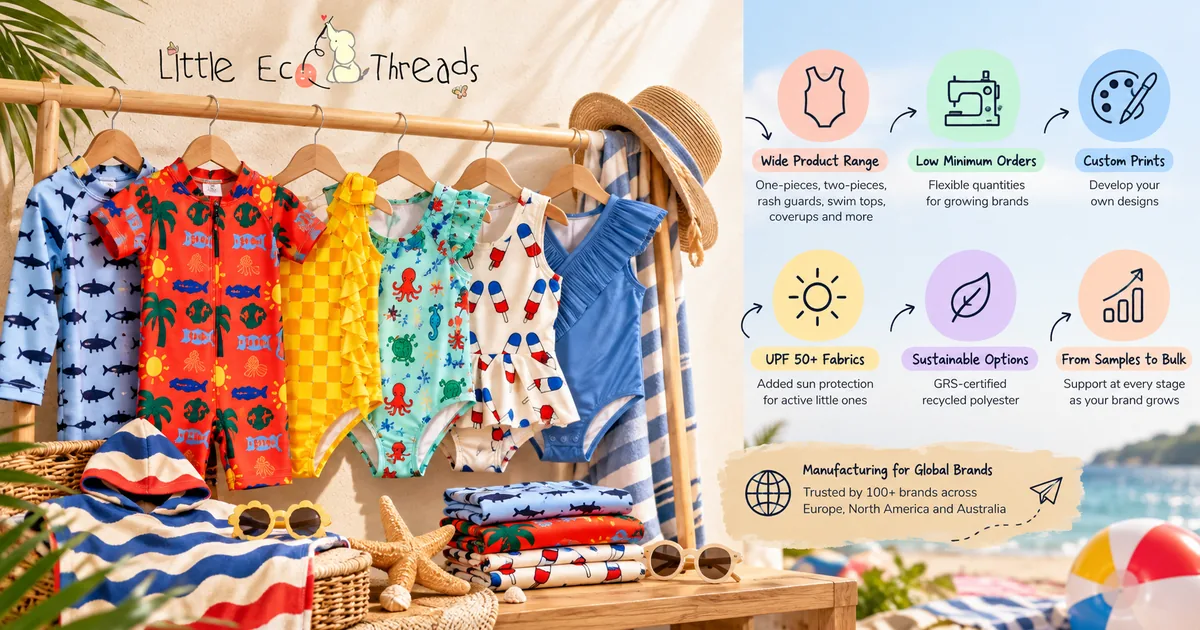
Little Eco Threads is one example of a supplier working this way. It uses GRS-certified recycled polyester for its swimwear and offers low minimum orders. Its website also states that the factory holds GOTS, GRS and Sedex approvals. It helps to be precise about what these relate to. GRS covers recycled content and traceability in the material. GOTS covers organic fibres, so it would not describe a recycled polyester swimsuit (see GOTS vs GRS for the difference). Sedex relates to ethical trade and social auditing rather than the fabric. None of these should be stretched into a blanket claim about a finished product, so ask which certificate covers which material, and keep the paperwork behind any claim you put on a label or website.
6. What Makes a Swimwear Manufacturer Ready for Brand Growth?
Most brands choose a supplier based on their first order. But a better question is: Will this supplier still be a good fit when my brand grows?
For many brands, growth follows a simple path: first comes sampling, then a small production run, testing in the market, reordering the styles that work, and finally moving to larger kids swimwear production. A good manufacturer should be able to support you through all these stages.
In the beginning, you need a manufacturer who is patient with samples and can give honest feedback about the fit, fabric and stitching. When you start selling, the production should look and feel the same as the sample you approved. When you place a repeat order months later, the fabric, colour and print should also stay consistent.
As your orders get bigger, other things become important too. The manufacturer should have enough production capacity, good planning and proper documents so that larger orders can be handled without unnecessary delays.
It is useful to ask about these things during your first conversation itself. Ask how they keep records of fabric and colour choices, how they manage busy swimwear seasons, and what happens if your order suddenly becomes twice as large. Also ask who you can contact if there is a problem during production. These answers can tell you a lot about how prepared a manufacturer really is.
Documentation is another thing that brands often overlook. As your business grows, you may need test reports, certification records and proper product labels, especially when selling to bigger retailers or entering new countries. Working with a manufacturer who already keeps these things properly can save you a lot of time and trouble later.
7. What Brands Should Ask Before Choosing a Low MOQ Swimwear Manufacturer
Ask every shortlisted supplier the same questions and compare the answers side by side.
- Is the MOQ calculated per style, per colour or per total order? This changes the real commitment more than the number itself.
- What happens to the unit price at a larger quantity? Ask for price breaks, not just one quote.
- Can the same fabric be used across multiple styles? Shared fabric often means shared minimums.
- Can you develop custom prints? And is there a minimum per print?
- Which swimwear fabrics are available? Include recycled polyester swimwear fabrics and UPF options.
- What certifications and documentation can you provide? Ask what each one covers.
- What quality checks are performed? At which stages, and how are they recorded?
- What is the sampling process? Rounds, timing and cost.
- What is the typical production lead time? For first orders and for repeats.
- Can you scale production if a style performs well? Ask for an example.
- Do you support private label requirements? Labels, packaging and hangtags for private label kids swimwear.
- Which international markets do you currently manufacture for? This shows how familiar they are with your market's requirements.
A Practical Example: Little Eco Threads
Little Eco Threads is a children's swimwear manufacturer working with brands that need flexible quantities. Its swimwear offer covers rash guards and one-piece and two-piece styles, with UPF 50+ fabrics, custom prints, sampling and bulk manufacturing with quality control, in sizes from 0-3M to size 13. According to its website, it makes for brands across Europe, North America and Australia, and cites 100+ brands served, a team of 500+ and more than 25 years of experience.
As with any supplier, treat that profile as a starting point. Put it through the checklist above and ask for specifics on MOQ structure, fabric minimums and the reorder process.
Final Thoughts
Low MOQ works best when you have a clear plan. Start with a small and focused collection, use one main print or design that makes your brand different, and avoid adding too many colours at once. Use your first small order to see which styles customers actually like and want more of.
When choosing a kids swimwear manufacturer, do not only look for the one offering the lowest MOQ. Look at whether they can support you from making samples and small orders to repeat orders and, later, larger production.
Brands that test their products first usually face fewer problems when they start growing. Once you know which styles are working well, you can order them in bigger quantities from a manufacturer who already understands your products and requirements.