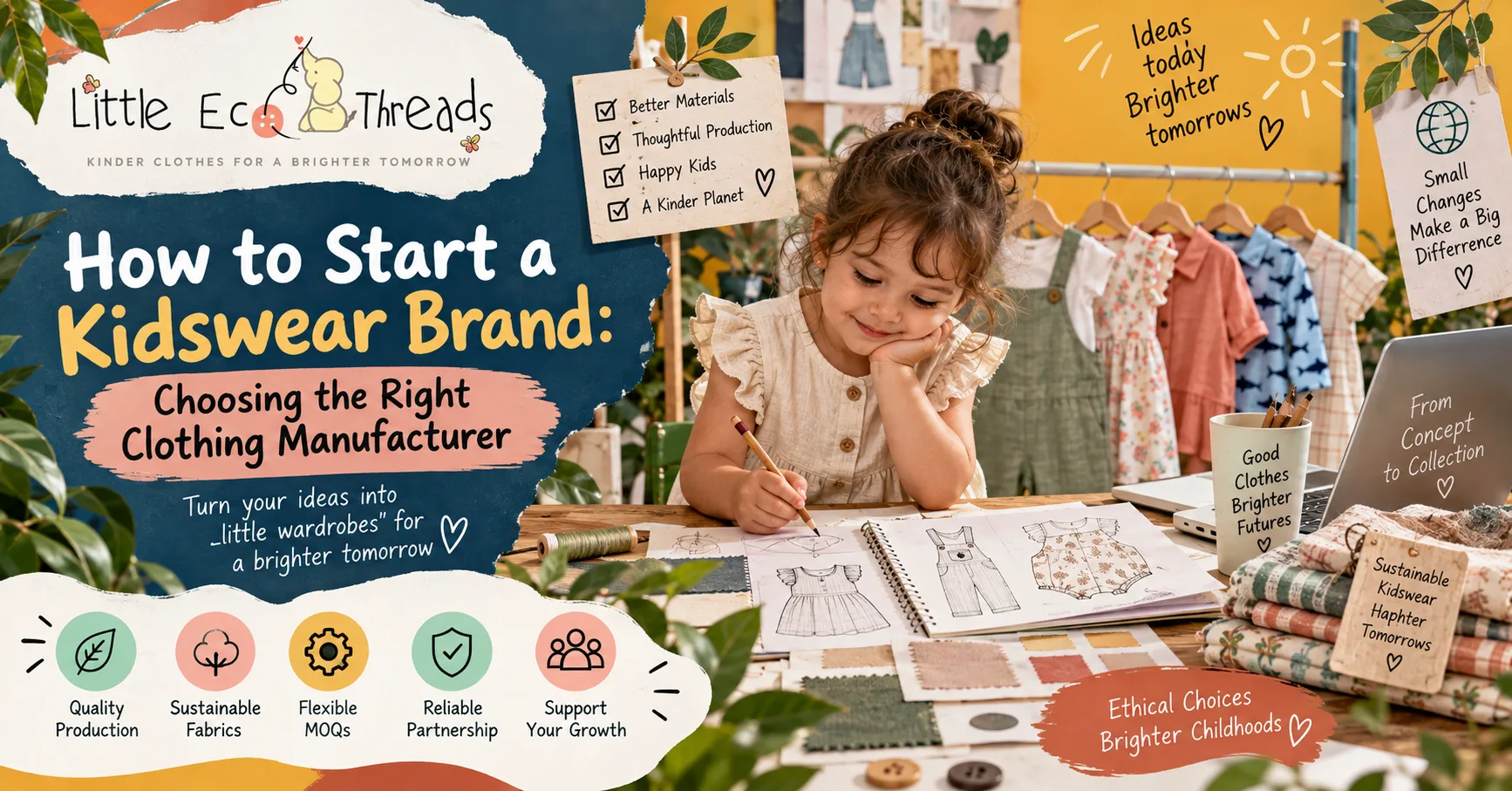
How to Start a Kidswear Brand: Choosing the Right Clothing Manufacturer
Choosing a kidswear manufacturer is one of the first serious production decisions a new children's clothing founder has to make. A logo, brand name, colour palette, and mood board matter, but the manufacturer is what turns the idea into garments that can be sampled, tested, priced, shipped, and reordered.
This decision affects product quality, fabric options, production cost, timelines, order quantities, safety, and how smoothly the brand can grow. For founders building a babywear or kidswear brand, the right manufacturing partner can prevent expensive mistakes before the first bulk order is placed.
This guide explains what to decide before contacting manufacturers, what questions to ask, and how to compare options for private label manufacturing, custom manufacturing, small-batch production, and long-term kidswear manufacturing.
Why Your Kidswear Manufacturer Matters Early
Many founders start with design ideas: a few rompers, dresses, pyjamas, tops, baby basics, or seasonal pieces. Then they reach the harder question: who will actually make the clothes?
A strong kidswear manufacturer does more than sew garments. The right partner helps clarify fabrics, construction, sizing, sampling, timelines, production risks, and whether your launch plan is realistic. The wrong partner can leave you with delayed samples, unclear pricing, weak finishing, inconsistent sizing, or stock you cannot sell confidently.
If sustainability is part of your brand positioning, the choice becomes even more important. A sustainable kidswear manufacturer should be able to discuss materials, documentation, durability, waste reduction, and production practices with more detail than broad marketing language.
Define Your Kidswear Brand Before Contacting Manufacturers
Before messaging a clothing manufacturer, get clear on the business and product direction. Manufacturers can quote more accurately when founders know what they want to build.
At minimum, define:
- Target age group: newborn, baby, toddler, older children, or a mix
- Product categories: bodysuits, rompers, dresses, tops, trousers, sleepwear, outerwear, swaddles, or accessories
- Price positioning: value, mid-market, premium, or boutique
- Fabric preferences: cotton, organic cotton, blends, woven fabrics, knits, muslin, or seasonal fabrics
- Sustainability goals, if any
- Expected first-order volumes
- Target selling market
- Design complexity: basics, prints, embroidery, trims, or fully custom styles
- Quality expectations and packaging needs
Two brands can both call themselves kidswear brands and still need very different partners. A founder launching five organic newborn basics needs a different setup from a founder launching a forty-piece seasonal collection with dresses, tops, bottoms, prints, and trims.
Choose the Right Manufacturing Model
Not all manufacturers work the same way. Understanding the main models helps you ask for the right service.
Private label manufacturing usually means choosing from existing designs or base styles and adding your own branding, labels, colours, trims, or packaging. It can be faster and more affordable for a first launch, but it may offer less product differentiation.
Custom manufacturing means developing original designs, often with pattern development, fabric selection, sampling, fit changes, trims, and brand-specific finishing. It suits founders with a clearer design identity, but it usually takes more time and budget.
Full-package manufacturing covers fabric sourcing, trims, cutting, stitching, finishing, packing, and production management. This can be useful for founders who do not want to coordinate separate suppliers.
Small-batch production allows a brand to test demand at lower volumes before committing to larger runs. It can carry a higher unit cost, but it often reduces inventory risk for an early-stage brand.
The best model depends on your budget, product complexity, design ownership, and how much production responsibility you want to manage yourself.
Look for Experience in Children's Clothing
Children's clothing is not simply smaller adult clothing. Fit, comfort, durability, and age-appropriate construction matter more because children move constantly and parents notice practical problems quickly.
A specialist children's clothing manufacturer should understand:
- Soft seams and comfortable finishing
- Wash durability
- Secure trims and closures
- Age-appropriate sizing
- Fabric behaviour after repeated laundering
- Practical construction for crawling, running, sleeping, and play
- Babywear details such as snaps, labels, neck openings, and skin comfort
A general apparel factory may be able to sew a children's garment, but a specialist babywear manufacturer or kidswear manufacturer is more likely to understand the product risks before sampling begins.
Compare MOQ Before You Commit
The minimum order quantity, usually shortened to MOQ, is the smallest number of units a manufacturer will produce per style, colour, size run, or order. This is often one of the first constraints a new founder faces.
MOQ matters because it affects cash flow and inventory risk. A very high MOQ can force a young brand to buy hundreds of units before it has real customer feedback. A very low MOQ can be useful for testing, but it may come with higher unit costs or limited customization options.
The practical question is not whether the MOQ is low or high in isolation. It is whether it matches your launch stage, pricing, sales forecast, storage capacity, and ability to reorder.
For an early-stage kidswear brand, a smaller first production run can make sense when:
- Demand is unproven
- Designs need market testing
- Size curves are uncertain
- The brand is selling online first
- Cash flow needs to be protected
As demand becomes more predictable, larger production runs can improve unit economics.
Check Sustainability Claims Carefully
If sustainability is part of your positioning, look beyond the word itself. In sustainable fashion, broad claims need to be supported by specific materials, processes, and documentation.
Ask what fibres and fabrics are available, whether organic or recycled materials can be documented, what dyeing and finishing options are used, how waste is managed, and which certifications apply to the material, facility, process, or finished product.
Some standards answer different questions. OEKO-TEX STANDARD 100 focuses on textiles tested for harmful substances. GOTS is relevant for organic textile processing claims when the certified scope supports the claim. These are not interchangeable, so ask your supplier what each document actually covers.
Little Eco Threads works in sustainable babywear and kidswear production, but founders should still ask the same documentation questions they would ask any manufacturer. A credible partner should be comfortable explaining material options, certificates, and production scope clearly.
Review Product Capabilities Against Your Collection
Before choosing a manufacturer, check whether they can make the actual products you plan to sell. A good first call does not guarantee the factory is right for every category.
If your collection includes newborn bodysuits, toddler dresses, kids' tops, pyjamas, swaddles, and accessories, ask for relevant experience across those categories. If the factory specializes in one narrow area, that may be fine, but it may only suit part of your range.
For a founder building a broader collection, one manufacturer with experience across babywear and kidswear can reduce coordination work. It may also help keep fabrics, sizing, trims, finishing, and packaging more consistent across the full line.
Understand the Sampling Process
The sampling process exists because a design that looks finished on paper can behave differently as a physical garment. Fabric weight, stretch, shrinkage, neckline shape, seam placement, snap position, and trim choice all become clearer once a sample is made.
When reviewing samples, check:
- Fit across the intended size range
- Fabric hand feel against skin
- Stitching quality and consistency
- Measurements against the spec
- Colour accuracy
- Print or embroidery placement
- Trims such as buttons, poppers, zippers, or labels
- Wash behaviour
- Overall finishing and presentation
One or two revision rounds are normal. Sampling is not a delay; it is the part of development that protects the bulk order.
Evaluate Quality Control and Reliability
Price matters, but it should not be the only comparison point. Strong quality control, communication, and reliability often decide whether a manufacturer is commercially workable over time.
Pay attention to how the manufacturer communicates before production starts. Do they answer specific questions clearly? Do they ask for missing details? Do they explain risks? Do they confirm what is included in pricing?
A reliable partner should have a defined quality process before production, during production, and before shipment. Ask how they check measurements, stitching, trims, labels, stains, finishing, packaging, and defects. Also ask what happens if goods do not meet the agreed specification.
For brands selling into the US, EU, UK, or Australia, product requirements can vary by market and product type. The CPSC Business Education library includes apparel and textile guidance on safety, including clothing, children's sleepwear, drawstrings, tracking labels, and related product areas. Brands should confirm applicable requirements with qualified compliance support for their exact product and destination market.
Think Beyond the First Order
Choosing a manufacturer is not only about producing one first run. It is also about whether the partner can support the brand after launch.
A useful manufacturer should be able to support:
- Repeat orders
- Size and colour expansion
- New fabric development
- Seasonal collections
- Packaging changes
- Larger order quantities
- More detailed custom work
- Better production planning as demand grows
This is where broader kidswear manufacturing experience matters. A partner that understands growth can help you move from first samples to repeat production without rebuilding your supply chain every season.
Final Checklist Before Choosing a Manufacturer
Before signing off, compare each manufacturer against this checklist:
- Experience in your exact kidswear or babywear categories
- Ability to support private label or custom manufacturing
- Clear MOQ by product, style, colour, and size range
- Suitable fabric and trim options
- Sustainability documentation where relevant
- Realistic sample process and timelines
- Transparent pricing
- Evidence of quality-control checks
- Good communication before and after sampling
- Safety and compliance awareness for your market
- Capacity to scale if your brand grows
- Fit as a long-term production partner, not only a one-time supplier
FAQ
What should I ask a kidswear manufacturer first?
Start with product capability, fabrics, MOQ, sampling process, lead times, quality control, customization options, and whether they have experience with your exact product category.
Is private label manufacturing good for a new kidswear brand?
Private label manufacturing can be useful for testing a first collection because it may reduce development time and cost. It works best when the available styles match your brand positioning and can still be customized enough to feel distinct.
How important is MOQ for a startup kidswear brand?
MOQ is very important because it affects cash flow, inventory risk, and how much product you need to sell before learning what customers actually want. A manageable first MOQ can help a new brand test demand before scaling.
Do children's clothing brands need sustainability certifications?
Not always, but brands making sustainability claims should understand which certifications apply and what they cover. Material, processing, facility, and finished-product claims can mean different things, so documentation should be checked before marketing a product.
Final Thoughts
Choosing the right kidswear manufacturer can shape your product quality, launch budget, production timeline, and ability to grow. The best choice depends on your product categories, design complexity, sustainability goals, MOQ needs, and expectations for quality.
Little Eco Threads works with baby and children's clothing brands on sustainable kidswear, babywear, private label production, and custom manufacturing. If you are planning a first collection or comparing production routes, contact Little Eco Threads with your product idea, target age group, fabric preferences, and expected first order size.