Summer Wear Manufacturing: What Kidswear Brands Should Settle Before Bulk Production
Summer ranges look simple on a line sheet and are often among the harder ones to produce well. Lightweight woven cottons move on the cutting table, checks have to align across plackets and pockets, and a tie strap that charms on a sample can become a compliance question in a regulated market. For brands building organic cotton baby clothes into a summer collection, commercial performance is largely decided before bulk fabric is cut: in fabric choice, construction, sampling discipline and order planning.
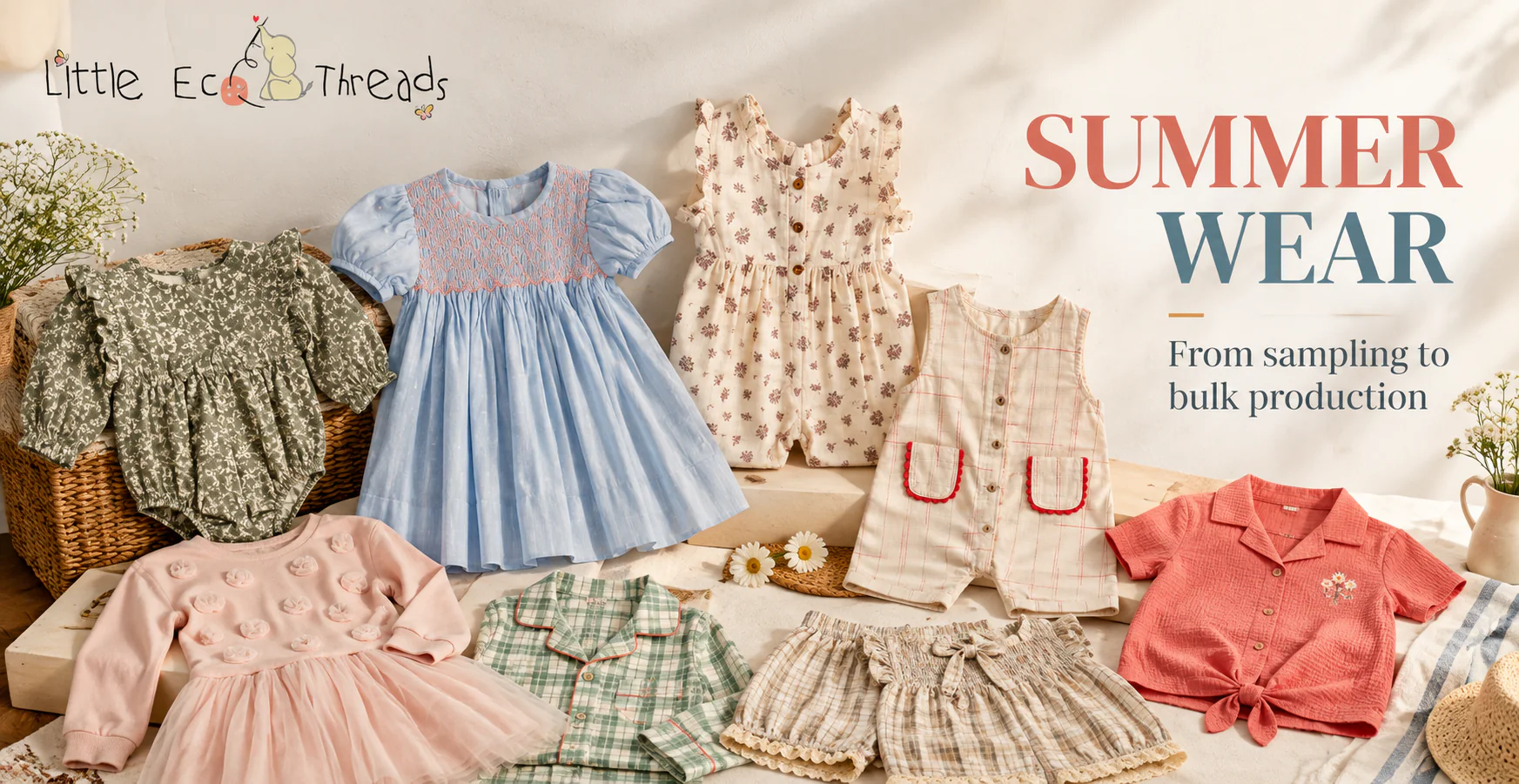
This guide covers those decisions in the order they tend to surface. It uses the range on the Little Eco Threads Summer Wear category page as a reference for what a working catalogue looks like, from seersucker rompers to smocked gingham sets.
Manufacturing decisions that shape a summer collection
Silhouette is a cost decision before it is a design decision. A bubble romper with an elasticated waist and a tiered, ruffled dress sit at opposite ends of fabric consumption and sewing time, even in the same cloth. Tiers, gathers and flutter sleeves use more metres per unit, and every added seam or trim is another operation to time and inspect.
Pattern is the second variable. Windowpane checks and gingham need matching at plackets, pockets and side seams, which raises the cutting allowance and lowers marker efficiency. All over and placed prints add placement rules that belong in the tech pack, not in the cutter's judgement.
Four questions are worth answering before the first sample:
- Which styles share a base fabric? One check or seersucker used across a romper, dress, shorts and top lets fabric commitments be pooled. The cream check styles on the category page follow this logic.
- Which styles need the full size range? The category lists sizes from 0 to 3 months up to 13 years, but a bubble romper graded for infants does not scale unchanged to older children.
- Which trims come from outside the main fabric? Ribbon, ricrac, pom poms and crochet lace each shrink and bleed differently from the body cloth.
- Which market is the range for? The target market decides labelling, testing and how ties and cords can be finished.
Fabric selection and what it means in production
No summer fabric is universally better. Each solves one problem and creates another, so the choice should follow the garment, the child's age and the market. The category page is built mainly on seersucker, gingham and woven checks, with muslin styles at the softer end. Cotton jersey and linen suit other parts of a range.
| Fabric | Where it works | Production watch points |
|---|---|---|
| Gingham and woven check cotton | Pinafores, shorts and collared sets that need to hold shape | Pattern matching, check scale against garment size, shrinkage measured on the finished garment |
| Seersucker | Rompers and sundresses that should sit off the body | Whether the pucker holds after washing; texture can distort embroidery and smocking |
| Muslin or double muslin | Wrap rompers and flowing dresses where softness and airflow lead | Lower dimensional stability, higher shrinkage, seam slippage, opacity in single layers |
| Cotton jersey | Bodysuits, tees and bloomers | Skewing after washing, poor fit for structured ruffles, stretch to allow for in print placement |
| Linen | Textured, breathable dresses and shorts | Creasing, fraying at seams, shade and slub variation between lots |
For infants, softness and washability usually outweigh crispness. For toddlers and older girls, structured wovens hold up better to repeated wear. Print suitability follows structure: tight wovens carry fine detail cleanly, while open muslin weaves and slubbed linen can soften it. For fabric specific detail, see the guides to muslin baby clothes and linen kids clothing.
Sampling, customisation and production planning
The cheapest changes are the ones made at sample stage. Before bulk, the specification pack should fix:
- the fabric specification: composition, weight, construction, finish and shrinkage targets
- an approved pre production sample, signed off against a graded measurement sheet with tolerances
- colour standards approved on physical swatches, not screens
- construction details: seam types, stitch density, closures and trim placement
- test requirements for the destination market, agreed before production starts
Customisation adds loops. Custom prints and colourways need fabric development and approval before garment sampling can begin. Embroidery changes the hand of a lightweight cloth, so density and backing are decided on the actual fabric. Smocking depends on fabric weight and stretch recovery, and a smocked bodice should be measured both relaxed and extended. Little Eco Threads lists custom manufacturing covering custom prints and colourways, embroidery and smocking, with availability depending on the product. Asking for fabric swatches early lets a team judge hand and drape before paying for a development sample.
Plan backwards from the selling window. A range with prints, embroidery and smocking needs to enter sampling earlier than a range of plain checks, and development time should be confirmed style by style, not assumed from a standard schedule.
MOQs, costing and order planning
MOQ is not a single number. Each summer design on the category page shows a minimum of 100 pieces per style, and Little Eco Threads works with MOQs that depend on product, fabric, construction and customisation. Treat any listed figure as a starting point and confirm it per style. Three questions show what a quoted MOQ really means:
- Is it per style, per colour or per fabric? A custom colourway can carry a fabric minimum that exceeds the garment minimum.
- Does it change with embroidery, smocking or print? Added processes can alter the practical minimum.
- What happens on reorder? Fabric availability and shade consistency between lots shape repeat orders.
The trade-offs are real. A low MOQ lets a brand test more styles and limits inventory risk, but development, sampling and fabric costs are spread over fewer units, so unit costs tend to rise. Deeper runs of fewer styles improve unit economics but concentrate risk in a seasonal category. Sharing one base fabric across several silhouettes is often the practical middle path. The MOQ guide for children's clothing covers the planning side in more detail.
Costing is better itemised than averaged. The main drivers in summer wear are fabric consumption (tiers and gathers), pattern matching waste, trim count, embroidery stitch count, smocking labour and testing.
Quality control and responsible material sourcing
Checks that matter for summer garments
These are recommended controls to specify with any manufacturer, not documented procedures of a particular factory:
- Shrinkage and dimensional stability, measured on finished garments as well as fabric, especially for muslin and linen.
- Seam performance at stress points such as shoulder ties, button plackets and smocked bodices, including seam slippage on loose weaves.
- Colourfastness to washing, rubbing and perspiration, with particular attention to contrast trims against pale grounds.
- Print and embroidery durability after repeated washing.
- Measurements and shade checked across sizes and fabric lots against the approved sample.
General inspection practice is covered in the garment quality control guide.
Reading certifications precisely
A general sustainability claim and a product level claim are different things, and each credential answers a different question.
- GOTS is a processing standard for textiles made from certified organic fibres. Its label grades are "organic" (at least 95% certified organic fibres) and "made with organic" (70% to 95%). Certification is held by facilities and covers listed products, so ask for the scope certificate and the transaction certificate for the specific fabric and shipment, not a general statement.
- GRS is a Textile Exchange standard that tracks recycled materials through the supply chain. It is relevant only where a product contains recycled content, so it does not describe an organic cotton fabric.
- Sedex is a membership based data platform, not a certification body. SMETA is its social audit methodology, and it produces an audit report rather than a certificate. Ask for the report date, the audit scope and the corrective actions.
Little Eco Threads lists GOTS, GRS and Sedex credentials on its sustainability page. Brands should still confirm which styles and fabrics fall under each one before using any claim on labels or marketing.
Market specific requirements
Requirements differ by market, so confirm them before development, not after sampling. For the United States, CPSC guidance says children's products need third party testing by a CPSC accepted laboratory, a Children's Product Certificate and tracking labels. That document is a 2016 staff presentation, so check current CPSC guidance. In Europe, EN 14682 sets requirements for cords and drawstrings on children's clothing up to age 14, and its scope includes tied belts. Since tie straps and ribbon trims are central to many summer styles, this affects design decisions, not just testing. The US import compliance guide and the children's clothing safety regulations overview go further.
Where Little Eco Threads fits
Little Eco Threads is a sustainable babywear and kidswear manufacturer based in Noida, India, with more than 20 years of manufacturing experience and more than 100 brands served across Europe, North America and Australia. For summer collections, its relevant strengths are private label production, custom prints and colourways, embroidery and smocking, and work in organic cotton, muslin, cotton jersey, linen and denim. The About page gives the wider company background, and the Summer Wear range shows how these capabilities translate into finished styles.
Choosing the next step
Before committing to any manufacturing partner, test the fit on a small scope. Pick two or three styles that share a base fabric, request swatches, and ask for the scope certificate and transaction certificate behind the fabric. Confirm the MOQ per style and colour, and define the tests your target market requires. The answers will show whether a partner's process matches the way your collection is built. When you are ready to discuss a specific range, contact Little Eco Threads with your target market, fabric preferences and expected quantities.
Building a production-ready tech pack
A clear tech pack turns a design idea into instructions that sampling and production teams can follow consistently. For summer garments, include front and back flats, a bill of materials, fabric composition and weight, colour references, graded measurements, construction details, stitch and seam requirements, artwork placement, label positions, packaging instructions and tolerances. If the style uses checks, stripes or a placed print, mark matching points and acceptable alignment on the technical drawings.
Avoid relying on verbal approvals or screenshots alone. Record the approved fabric, trims, colour standard and sample version, then share the same reference with the people responsible for cutting, sewing, finishing and inspection. When a change is made, identify what changed and which document supersedes the previous version. This reduces the risk of bulk production following an outdated specification.
Planning size sets and fit approval
Summer styles may span different age groups, but grading should reflect how each garment is worn rather than simply scaling every measurement by the same amount. An infant romper, a toddler dress and a pre-teen top have different proportions, movement needs and closure considerations. Establish the size range before sampling, identify the key fit points for each style, and agree measurement tolerances with the manufacturer.
Review fit on the intended size range wherever possible, with attention to armholes, neck openings, rise, elastic tension, ease and garment length. For gathered or smocked styles, record measurements in both relaxed and extended states. Check that trims and embellishments do not create uncomfortable pressure points, and confirm closures are practical for dressing and changing. Document fit approval before releasing the bulk order.
Packaging, labelling and shipment readiness
Packaging should be decided before production is complete. Confirm whether garments will be folded individually, grouped by size, placed in retail packaging or packed for bulk shipment. Provide artwork, barcode details, carton marks, assortment ratios and buyer-specific instructions early enough for approval. Packaging dimensions can affect carton quantities and freight planning, so they should not be left until shipment is ready.
Check labels and care instructions for the destination market and product category. Confirm fibre-content wording, care information, country-of-origin requirements, size presentation and any required safety or traceability information with the responsible compliance team. Requirements vary by market and product, so treat this as a verification step rather than relying on a generic label template.
Pre-production checklist
- Confirm the target customer, destination market, size range and selling window.
- Select base fabrics and trims, and approve physical swatches and colour standards.
- Complete the tech pack, including measurements, construction, artwork and packaging.
- Approve fit, pre-production and any required size-set samples in writing.
- Confirm MOQ by style, colour and fabric, along with costing and payment milestones.
- Agree testing, inspection, labelling and documentation requirements before bulk production.
- Confirm fabric availability, lead time, shipment date and reorder options.
Conclusion: make production decisions before the season starts
A successful summer collection is built by coordinating design, fabric, construction and commercial planning early. A breathable fabric may suit the season, but its shrinkage, opacity and sewing behaviour still need to be checked. A detailed smocked or embroidered design may help a collection stand out, but it also requires more development time and tighter approval controls. Clear specifications, realistic MOQs and market-specific compliance checks make these trade-offs easier to manage.
For brands developing organic cotton baby clothes or a broader kidswear summer range, a useful starting point is a focused group of styles that share fabrics and trims. Request swatches, agree the sample and testing plan, and compare quotations using the same specifications. Little Eco Threads offers private label kidswear manufacturing and customisation options including prints, embroidery and smocking, subject to product suitability and confirmation. When discussing a potential collection, share the target market, preferred fabrics, size range and estimated quantities.