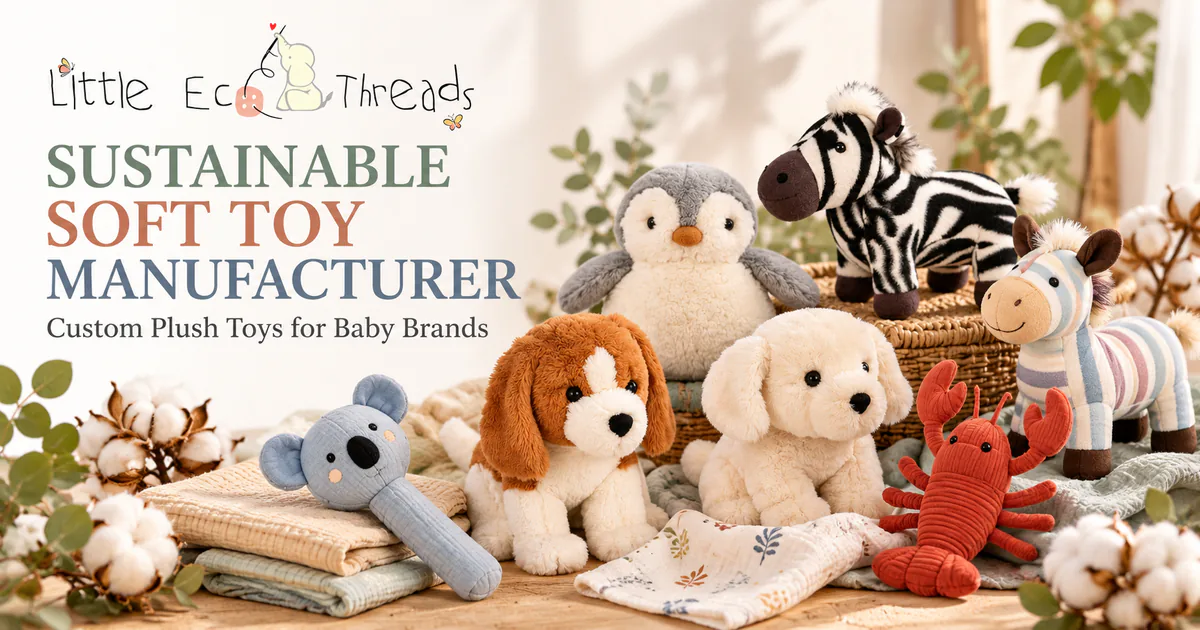
Sustainable Soft Toy Manufacturer: Custom Plush Toys for Baby Brands
Picture a babywear brand that has spent two years building a loyal following with organic cotton bodysuits, muslin swaddles and newborn gift sets. Customers keep asking the same question: do you make a matching soft toy? The founder can see the appeal. A plush toy that shares a colour palette and fabric feel with the clothing would complete a gift set and give the brand another product to place with retailers.
That is where the practical questions begin. Who will make the toy? Which fabrics and fillings suit a product that a baby may hold and mouth? How do sampling, testing and order quantities work for a category the brand has never produced before?
Complementary products can help a brand build a more cohesive collection, offer coordinated gifting options and open conversations with retail buyers who prefer to source a full set from one label. But a toy is not simply a garment with stuffing. It brings different construction methods, different safety rules and different claims to manage.
This guide is written for founders, established babywear brands, retailers with private label ranges and buyers searching for a sustainable soft toy manufacturer. It covers what to consider, what to ask and where to be careful, so that a custom plush toy project starts with clear decisions rather than assumptions.
Understanding Sustainable Soft Toy Manufacturing
Sustainable soft toy manufacturing is less a single feature than a set of choices made across the life of the product. A toy made with a responsible fabric can still fall short if the filling is questionable, the stitching fails after a few washes or the packaging is excessive.
What sustainability can involve
- Material selection: which fibres and trims are used, and where they come from.
- Fabric composition: whether the fabric is a single fibre or a blend, which affects both performance and how the product can be described.
- Filling materials: the type of filling, its source and how it behaves in the wash.
- Durability and product lifespan: a toy that lasts and can be passed on generally spreads its impact over more use.
- Manufacturing waste: how fabric is cut, how offcuts are handled and how much material is lost during sampling.
- Packaging: the amount and type of material used, and whether it suits the brand.
- Supplier traceability: the ability to document where materials came from and how they were processed.
Materials versus the finished product
It helps to separate two ideas. An individual material can carry a sustainability credential, such as organic cotton fabric. The finished toy is a different matter, because its footprint also depends on the filling, thread, dyes, trims, transport, packaging and how long the toy is actually used.
Cotton or recycled content does not make a toy sustainable on its own. Brands are better off describing exactly what they can document, for example a toy made with organic cotton fabric, rather than using broad claims they cannot support.
Choosing Materials for Custom Plush Toys
Material choices shape how a plush toy feels, how it ages and what a brand can honestly say about it. There is rarely one best option. The right choice depends on the product, the customer and the claims the brand wants to make.
Fabric options to evaluate
- Organic cotton fabrics: often considered by baby brands for their natural feel and their fit alongside organic cotton babywear. Brands should ask for documentation that supports the organic claim, and should check how the chosen construction holds its shape and resists wear.
- Conventional cotton fabrics: can offer good softness and breathability, sometimes at a different price point. They do not support organic claims.
- Recycled polyester fabrics: pile fabrics made with recycled polyester can give a plush surface with good durability and colour stability. The recycled content should be verified, and brands should remember that polyester is still a synthetic fibre.
- Other textiles: muslin, cotton jersey, knits, terry and blends may suit particular designs. Whether they work depends on the toy's shape, the stretch of the fabric and the stitching.
Fabric and filling are separate choices
Organic cotton fabric and recycled polyester filling are different material decisions, and they support different claims. A toy can have an organic cotton cover and a recycled polyester filling, and the brand should describe each part accurately rather than letting one claim stand in for the other.
Other filling options exist, and each involves trade-offs in softness, washability, resilience and cost. No material is universally superior. What matters is how well it suits the design, the age group and the standards of the market.
Practical points to test
- Softness: judge it against the feel the brand wants, and check it again after washing.
- Durability: look at seam performance, pilling and how the fabric handles repeated handling.
- Construction: stretchy fabrics may need stabilising, while thick piles can hide fine detail.
- Washing: base care instructions on wash testing of the actual sample.
- Colour consistency: dyes and prints can vary between lots, so agree acceptable tolerances early.
- Intended use: a keepsake in a newborn gift set has different needs from a toy meant for a toddler.
Custom Plush Toys for Baby Brands
Custom development lets a brand create a toy that belongs to its own world instead of choosing from a catalogue. For brands working on custom baby soft toys, the creative options are wide, but each one needs to be confirmed with the manufacturer.
Customisation options to explore
- Custom shapes and characters, such as an animal, a mascot or a simple comforter design.
- Brand colours and prints that echo an existing babywear range.
- Embroidered details such as faces or small motifs, which are often considered for young babies because they avoid separate attached parts. The design still needs to be checked for safety.
- Coordinated pieces for newborn gift sets.
- Packaging that reflects the brand's identity.
- Designs made to sit alongside current clothing and blanket collections.
These are possibilities, not a fixed menu. Manufacturers differ in what they can produce, so a brand should ask each prospective partner which of these options are realistic for its project.
How design choices affect cost and timelines
- Complexity: more panels, seams and details mean more labour and often more rounds of sampling.
- Materials: specialised or imported fabrics can raise cost and lengthen lead times.
- Sampling: every revision takes time, and changing the brief midway usually moves the schedule.
- Construction: embroidery, appliqué, printing and finishing steps each add a stage.
A simple, well defined design generally moves faster than a character with many parts. If a quote seems high or a timeline seems long, ask the manufacturer to explain what is driving it.
Private Label Plush Toys: From Concept to Production
A private label plush toy project usually moves through a recognisable sequence. The exact steps and timing differ between manufacturers, so treat this as a framework for planning conversations rather than a fixed schedule.
A typical development process
- Define the target customer and the product concept, including age group and price position.
- Prepare a design brief and specifications, with sketches, dimensions and reference images.
- Select fabrics and filling that fit the concept and the claims the brand intends to make.
- Develop and evaluate samples, checking shape, feel and finish.
- Confirm construction, dimensions, colours and finishing details.
- Verify the safety requirements that apply to the product and the destination market.
- Approve production specifications and quality standards in writing.
- Plan packaging and delivery.
Why samples and specifications matter
Sampling is where most misunderstandings surface. A face that looks charming in a sketch may sit awkwardly on a stuffed head. A fabric that feels right in a swatch may behave differently once cut and sewn. It is far cheaper to find these issues on a sample than in a full production run.
Clear specifications protect both sides. A written approval covering fabric, filling, dimensions, colour references, stitching and finishing gives the brand something to check bulk production against, and gives the manufacturer a clear target.
Order quantities, pricing and turnaround times depend on the design, materials and supplier. Brands should request these details directly and in writing rather than relying on general estimates.
Safety and Compliance in Baby and Children's Plush Toys
Safety deserves the most attention in any plush toy project. Babies explore with their hands and mouths, so a toy that looks harmless can still carry risk if it is poorly designed or built.
Design and construction considerations
- Small parts and detachable components: anything that could come loose and be swallowed needs careful design.
- Eyes, buttons and other attachments: these are common risk points, which is why some brands choose embroidered features for the youngest age groups.
- Seam strength and filling containment: seams should withstand pulling, and the filling should stay inside the toy.
- Fabric and filling composition: materials should suit the age group and be documented.
- Flammability: some markets set flammability requirements, depending on the product and where it is sold.
- Chemical safety: relevant testing may cover restricted substances in fabrics, dyes, trims and fillings.
- Age grading: a toy intended for children under three is assessed differently from one for older children.
Requirements vary by market
Applicable requirements depend on the destination market, the product design, the age group and the intended use. A toy sold in the European Union, the United Kingdom, the United States or another market may face different standards and testing routes.
This article cannot offer a definitive legal view. Brands should confirm what applies to their product with a qualified testing laboratory or compliance specialist before production begins.
Textile certifications are not toy-safety compliance
OEKO-TEX STANDARD 100 and GOTS both relate to textiles, but they address different things. OEKO-TEX STANDARD 100 is concerned with testing textiles for harmful substances. GOTS covers the organic status of fibres and criteria for processing textile products.
Neither one automatically shows that a finished toy meets every applicable toy-safety requirement, such as mechanical and physical tests, small parts rules or flammability. A certified fabric is a useful input. The finished toy still needs to be assessed for its market and age grade.
When reviewing a supplier's documents, ask whether a test report covers the finished product or only the fabric. The two are not interchangeable.
What to Look for in a Plush Toy Manufacturing Partner
Whether a brand is approaching a custom soft toy manufacturer, a sustainable plush toy manufacturer or a plush toy manufacturer in India, the evaluation questions are much the same. The aim is to understand what the supplier can actually deliver, not what a brochure suggests.
- Material transparency and documentation: can the supplier show where fabrics and fillings come from, and provide paperwork that supports any sustainability claim?
- Sampling and product development: how are samples made, how many revision rounds are normal, and who handles pattern making?
- Quality control: what checks happen during and after production, and how are defects handled?
- Category experience: has the supplier made plush toys before, or would this be a first project in the category?
- Clear communication of specifications: can the supplier work from a written brief and return a confirmed specification for sign-off?
- Testing and compliance documentation: which tests have been done on comparable products, and can the supplier support testing for the brand's target market?
- Customisation options: which shapes, prints, embroidery and finishing options are available?
- Packaging: can the supplier produce or source packaging that suits the brand?
- Order quantities, pricing and timelines: what are the minimums, the price drivers and the realistic lead times?
Brands should verify every one of these points directly with the supplier before placing an order. A confident answer in conversation is useful, but written confirmation and documents are what a brand can rely on later.
A short, practical test is to ask for a sample project plan. A supplier with real experience in plush toy manufacturing for brands will usually be able to explain the steps, the approvals needed and the risks to watch.
How Sustainable Plush Toys Can Complement a Babywear Collection
For a brand that already sells baby clothing, a plush toy can work as the piece that ties a collection together. The commercial logic is simple: a coordinated range is easier to present, easier to gift and easier for a retail buyer to merchandise.
Some ways brands approach this:
- Newborn gift sets: a bodysuit, a muslin cloth and a small soft toy in matching colours, packed together.
- Matching colour palettes: a toy that picks up the tones and prints of a seasonal babywear range.
- Character-based collections: a recurring animal or figure that appears on clothing, blankets and a companion toy.
- Complementary gifting products: a toy added to a basket or box for baby showers and birth gifts.
For retailers developing private label collections, the same idea applies. A plush toy that matches the look and material story of the clothing range can make the whole assortment feel intentional.
It is wise to stay realistic about demand. Rather than relying on broad market claims, brands can test interest with a small first range, gather feedback from existing customers and retail buyers, and expand once the numbers support it.
It also makes sense to talk to manufacturers who understand baby textiles. A company such as Little Eco Threads, which works with sustainable fabrics for babywear and children's apparel, may be a natural place to start a conversation. Whether a particular soft toy project can be supported is something to confirm directly with the team.
Building a Thoughtful Plush Toy Collection
A good plush toy project rests on a handful of decisions made early: which materials to use and what can honestly be said about them, how the design will be built, what safety requirements apply to the target market, and how samples will be approved before bulk production. Brands that document their claims and test their assumptions tend to avoid the expensive surprises.
Supplier choice matters just as much. The right partner explains trade-offs clearly, shares documentation openly and welcomes questions about testing and quality control.
Little Eco Threads is a babywear and children's apparel manufacturer based in Noida, India, focused on sustainable textiles such as organic cotton and muslin. Brands thinking about adding soft toys to a baby or children's collection are welcome to share their requirements with the team and discuss what a manufacturing partnership could look like, including which parts of a plush toy project can be supported.