Sustainable Kids Knitwear Manufacturer for Wholesale & Private Label
Finding a kids knitwear manufacturer is rarely just about locating a factory that knows how to knit fabric into garments. A brand also has to think about fabric quality, minimum order quantity, customization options, certifications, labeling, packaging, and whether the factory can repeat the same quality from sample to bulk production. Get any one of these wrong and a good design idea turns into a difficult production run.
Little Eco Threads works with kidswear brands, retailers, startups, and private label businesses on exactly this kind of sourcing decision. Based in India, the company manufactures sustainable kids knitwear and related children's apparel for brands that want organic materials, certified production, and flexible order quantities without giving up on quality or consistency.
This article looks at what such a manufacturer actually produces, which materials matter for sustainable kidswear, how MOQ and private label production work in practice, and what a buyer should check before placing an order.
What Products Can a Kids Knitwear Manufacturer Produce?
Kids knitwear is often assumed to mean sweaters or winter jumpers. In manufacturing terms, it covers a much wider range of knitted and jersey garments worn all year round.
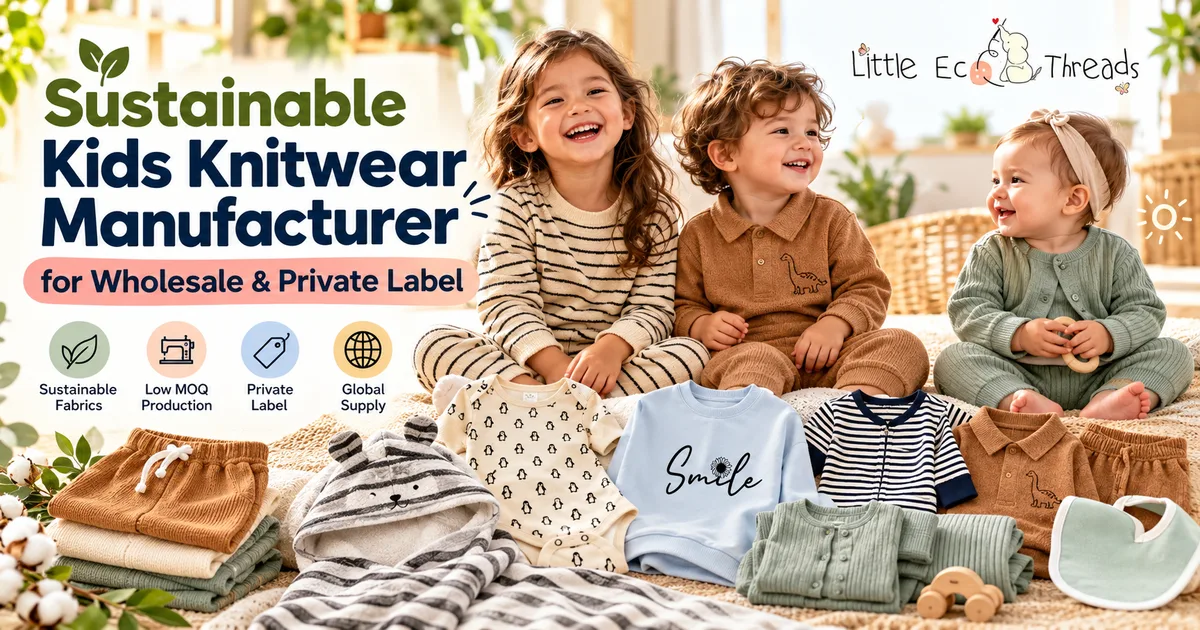
A kids knitwear supplier working across this category typically produces leggings, shorts, joggers, and sweatshirts for everyday wear, along with knit sets and polo sets that brands sell as coordinated outfits. Oatmeal stripe knit sets are a good example of how a simple knit construction and a natural, undyed looking colorway can be styled into a product that reads as premium rather than basic. For babies, the same knitting and fabric knowledge extends to rompers and bodysuits, which need softer, more flexible ribbed or jersey fabric and different seam finishing than older children's clothing.
Little Eco Threads produces across this range as part of its knitwear collection, and some buyers also source adjacent knitted or textile items, such as hooded towels, from the same manufacturer to consolidate their supply chain.
The exact fabric, weight, and construction used for any of these products depends on the design brief, the season the collection is aimed at, and the specifications a brand provides. A joggers style meant for cooler weather uses a heavier, brushed fabric than a legging meant for summer, even though both are technically knitwear.
This is also why grouping products by construction rather than by season makes more sense for sourcing. A ribbed knit set and a jersey knit set might be worn in different weather, but they come from the same production line and the same base skill set: cutting and stitching stretch fabric to a consistent fit across a size range. A buyer building out a full kidswear collection benefits from working with a manufacturer that already handles this range, rather than splitting an order across separate suppliers for leggings, sweatshirts, and rompers.
Sustainable Materials for Kids Knitwear
Material choice is where a lot of sourcing decisions get made, especially for children's clothing, where parents and retailers alike are paying closer attention to what a garment is made of and how it was produced.
Organic cotton is the starting point for most sustainable kidswear ranges. Little Eco Threads works with GOTS certified organic cotton, which covers not only the fiber itself but also restrictions on the chemicals and processes used to turn it into finished fabric. Where relevant, GRS certified materials are also used, which is a certification that applies to products made with recycled content. On the finishing side, OEKO-TEX STANDARD 100 certification confirms that a fabric has been tested for harmful substances, which matters for products worn close to a baby's or young child's skin.
Beyond fiber and certification, the knit construction itself affects how a garment performs:
- Jersey is the most common base fabric for t-shirts, bodysuits, and lightweight sets because it is soft and stretches in one direction.
- Ribbed fabric is used where a snugger fit is needed, such as cuffs, necklines, or fitted leggings.
- Interlock and similar double knit constructions are chosen when a brand wants a slightly heavier, more stable fabric that holds its shape better through repeated washing, which is a real consideration for children's clothing.
An organic cotton kidswear manufacturer should be able to explain which of these fabric types suits a specific product, rather than offering one default option for everything a brand wants to make.
Certifications also matter for reasons beyond the fabric itself. A brand selling into markets with strict labeling or import requirements often needs GOTS or OEKO-TEX documentation to clear customs or satisfy a retailer's own compliance checks. An eco-friendly kidswear manufacturer that can provide this paperwork alongside the physical product saves a buyer from sorting out certification gaps after an order has already shipped.
Low MOQ Kids Knitwear Manufacturing
Minimum order quantity is one of the first practical questions a growing brand runs into. A factory that only accepts large bulk orders is not useful to a startup that is still testing which designs will sell, or to a retailer adding a private label range alongside existing stock.
A low MOQ kidswear manufacturer allows a brand to sample a design, produce a smaller first run, and see how the market responds before committing to a large order. This matters for a few reasons:
- Sampling confirms fit, fabric feel, and finishing before any money is spent on bulk production.
- Small production runs reduce the financial risk of testing a new design, colorway, or print.
- They also help a brand avoid the excess inventory that comes from over ordering a style that does not sell as expected.
Once a design proves itself, scaling up production with the same manufacturer keeps specifications, fabric sourcing, and quality consistent, which is harder to guarantee when a brand has to move factories to get a larger order fulfilled.
Little Eco Threads structures its production around this kind of low MOQ approach, which is why it works with brands ranging from early stage startups to established retailers adding a new kidswear line. A low MOQ clothing manufacturer that can also handle larger repeat orders gives a brand room to grow without switching suppliers at every stage.
Private Label Kids Knitwear Manufacturing
Private label kidswear means a brand sells a product under its own name, even though the manufacturing is handled by a specialist supplier. For a knitwear range, this usually includes more than just sewing a different label into an existing style.
A private label kids knitwear order typically starts with the brand's own design or a design developed together with the manufacturer, followed by fabric and color selection, and sampling to confirm fit and construction. From there, customization options come into play, including custom prints and patterns, embroidery, and brand specific labels.
Packaging is often part of the same conversation, since many brands want polybags, tags, and cartons that match their own branding rather than generic manufacturer packaging. Product specifications, such as sizing charts, fabric weight, and wash care instructions, are agreed before bulk production begins, and a final sample is usually approved before the full order goes into production.
Little Eco Threads handles private label manufacturing along these lines, working from a brand's specifications through sampling and into bulk production, with customization and packaging built into the process rather than treated as an afterthought.
What to Check Before Choosing a Kids Knitwear Manufacturer
Beyond price, a few practical points tend to separate a good manufacturing relationship from a difficult one.
- Fabric options matter because a manufacturer limited to one or two base fabrics cannot support a full range of products.
- Certifications, such as GOTS and OEKO-TEX, should be verifiable rather than just claimed.
- MOQ and sampling: Ask how MOQ is structured, whether it changes by product type, fabric, or print complexity, and whether sampling is available before committing to a bulk order.
- Quality control should happen at multiple stages of production, not only as a final check before shipping.
- Customization capability is worth confirming in detail, including which print methods, embroidery, and label formats are supported.
- Production capacity affects lead times, particularly around seasonal demand, so it helps to ask what a realistic timeline looks like for your order size.
- Clear communication through sampling, approvals, and production updates avoids surprises later.
- Labels and packaging requirements should be discussed early, since custom packaging sometimes needs its own lead time.
- Export experience: If the brand plans to sell internationally, it is worth asking about the manufacturer's export experience and documentation process.
Finally, ask how the manufacturer keeps bulk production consistent with the approved sample, since this consistency is often what separates a reliable kids knitwear wholesale partner from one that only performs well on the first order.
It also helps to ask how a manufacturer handles size grading and fit consistency across a size range, since a children's clothing manufacturer working across newborn through older kids' sizing needs a reliable grading process, not a single pattern scaled up or down. And where a brand plans to reorder a style once it sells well, it is worth confirming that fabric and dye lots can be matched closely enough that a repeat order does not stand out next to the original batch on a shelf.
None of this replaces a direct conversation with a potential manufacturer, but going in with these questions makes that conversation far more useful.
Why Brands Work With Little Eco Threads
Little Eco Threads brings together the points covered above into a single, sustainable kidswear manufacturer setup. The company manufactures using GOTS certified organic cotton and, where applicable, GRS certified materials, with OEKO-TEX STANDARD 100 tested fabric for products that need to meet that standard.
Its low MOQ production model gives smaller brands and startups a realistic way to sample and launch a range without committing to large volumes upfront, while still supporting larger repeat orders as a brand grows.
On the private label side, the company works with custom designs, prints, and embroidery, along with custom labels and packaging, so a finished order arrives ready to sell under the buyer's own brand. Quality control runs through sampling and production rather than being limited to a final inspection, and the team has experience manufacturing for international brands, which matters for buyers who need export documentation handled correctly.
As a kidswear manufacturer in India, Little Eco Threads combines access to organic cotton supply chains with the certifications and production discipline that overseas buyers typically require.
None of this makes Little Eco Threads the only option available, but it does explain why brands sourcing sustainable kids knitwear, wholesale kidswear, or a private label range choose to work with the company rather than a generic garment factory.
FAQ: Kids Knitwear Manufacturing
What products does a kids knitwear manufacturer produce?
Kids knitwear covers far more than sweaters. It includes leggings, shorts, joggers, sweatshirts, knit sets, and polo sets, as well as baby rompers and bodysuits made from softer ribbed or jersey fabric. Some manufacturers, including Little Eco Threads, also produce related textile items such as hooded towels.
Which certifications matter for sustainable kids knitwear?
GOTS certification covers organic cotton, including restrictions on the chemicals and processes used to make the finished fabric. GRS applies to products made with recycled content. OEKO-TEX STANDARD 100 confirms that a fabric has been tested for harmful substances. Whichever certifications a manufacturer claims, they should be verifiable, with documentation available for customs and retailer compliance checks.
Can I order kids knitwear in low quantities?
Yes. A low MOQ kidswear manufacturer lets a brand sample a design, produce a smaller first run, and test the market before committing to a larger order. Ask how MOQ is structured and whether it changes by product type, fabric, or print complexity.
What does private label kids knitwear production include?
It usually covers design development, fabric and color selection, and sampling, along with custom prints and patterns, embroidery, brand specific labels, and custom packaging. Sizing charts, fabric weight, and wash care instructions are agreed before bulk production, and a final sample is usually approved before the full order goes into production.
Where is Little Eco Threads based?
Little Eco Threads is a kidswear manufacturer based in India. It has experience manufacturing for international brands and handling the export documentation that overseas buyers need.
Choosing the Right Kids Knitwear Manufacturer
Choosing a kids knitwear manufacturer comes down to a handful of practical questions: what materials and certifications are available, how MOQ is structured, whether private label and customization are genuinely supported, and whether quality stays consistent from sample to bulk order. A brand that gets clear answers to these questions before placing an order tends to have a much smoother production experience than one that only compares price.
If you are a brand, retailer, startup, or sourcing manager looking for a sustainable kids knitwear manufacturer for wholesale or private label production, Little Eco Threads is happy to discuss your requirements, share fabric options, and talk through MOQ and customization for your specific range.