Sustainable Soft Toys: Why Baby Brands Are Diversifying
Ten years ago, most baby brands focused on growing by offering more clothes. They introduced new prints, added more sizes, and launched fresh collections every season. Today, the approach has changed. Many successful baby brands are no longer selling just clothing. They are also offering soft toys, nursery essentials, and everyday baby accessories, creating a complete collection that parents can trust and enjoy.
This change is not simply about adding more products. It reflects the way parents shop today, the way retailers choose what to stock, and the growing importance of sustainability. Families increasingly prefer brands that can meet several of their baby's needs in one place, while retailers look for brands that offer a wider range of products under a single name. For businesses involved in sourcing, product development, or private label manufacturing, understanding this shift and responding to it has become an important way to stay competitive.
Sustainability Has Moved From Marketing Claim to Purchasing Criteria
For many years, sustainability in the baby industry was mostly associated with clothing. Brands highlighted features such as organic cotton, GOTS certified fabrics, OEKO-TEX Standard 100 certification, and low impact dyes because baby apparel was the category where parents paid the most attention. But over time, it has become clear that parents do not think about sustainability only when buying clothes. They want every product their child uses, whether it is a soft toy, a blanket, or a nursery accessory, to meet the same standards of safety, quality, and environmental responsibility.
Recent research shows that these expectations are becoming even stronger. GlobeScan's 2025 study found that around half of American consumers had purchased an environmentally friendly product within the previous month. Research by Simon Kucher also found that sustainability is now one of the top factors influencing buying decisions, with many shoppers considering it alongside price and brand reputation.
This shift is also creating real business opportunities. Research from McKinsey and Company found that products backed by credible environmental and social responsibility claims have consistently achieved stronger sales growth than conventional alternatives. For baby brands, this means the trust they build through certified and responsibly made clothing does not have to stop at apparel. Parents increasingly expect the same commitment to extend across the entire product range. This is the philosophy embraced by Little Eco Threads, which focuses on extending the same sustainability values beyond baby clothing into thoughtfully designed products that parents can trust throughout a child's early years.
That is why many baby brands are expanding beyond clothing into soft toys, nursery essentials, blankets, bibs, and other baby accessories. A parent who trusts a brand because its clothing is made with GOTS certified organic cotton and tested under OEKO-TEX Standard 100 naturally expects the same level of care when choosing a plush toy or another baby product from the same brand. When companies maintain consistent sourcing standards and certifications across different product categories, they strengthen customer confidence. When they do not, they risk weakening the trust they worked so hard to build.
Why Baby Brands Are Treating Portfolio Diversification as a Growth Strategy
Expanding beyond apparel is rarely about chasing a trend. For the brands doing it well, it is a deliberate response to several converging business pressures.
Building a Complete Brand Ecosystem
A single category brand is inherently more fragile than a multi category one. Apparel only baby brands compete on seasonal drops, sizing cycles, and fast-moving trend calendars, all of which compress margins and shorten product lifecycles. Soft toys, nursery textiles, and accessories do not follow the same seasonal churn. They allow a brand to build a more complete baby collection: a going home outfit paired with a coordinated blanket, a nursery mobile that matches a crib sheet, a soft toy that echoes the same print family as a swaddle. This kind of cohesive ecosystem is what separates a brand from a manufacturer of individual SKUs.
Stronger Retailer Relationships and Shelf Presence
Retail buyers increasingly prefer working with brands that can fill more of a category set rather than a single niche. A brand that can supply apparel, soft toys, and nursery accessories under one label reduces the number of vendor relationships a retailer has to manage, simplifies planograms, and creates opportunities for coordinated in store or online merchandising. For wholesalers and distributors, this also means fewer minimum order quantity conflicts and more efficient logistics when a single supplier or a single OEM partner can produce across categories.
Cross-Selling and Customer Lifetime Value
From a commercial standpoint, portfolio diversification changes the customer relationship from a single transaction into an ongoing one. A parent who buys a newborn layette is a highly qualified lead for a matching soft toy, a nursery textile set, or a gift occasion purchase months later. Brands with a broader product ecosystem have more natural touchpoints to bring that same customer back, which directly supports customer lifetime value, a metric that matters more to sustainable growth than any single seasonal collection.
Why Soft Toys, Specifically, Are the Natural Next Category
Not every adjacent category makes sense for every apparel brand. Soft toys are a particularly strong fit for baby brands for reasons that are more structural than sentimental.
An Emotional Category With a Premium Perception Ceiling
Soft toys occupy a different psychological space than most baby products. They are rarely purchased purely on utility; they carry emotional weight as keepsakes, comfort objects, and milestones. That emotional dimension supports a materially different pricing ceiling than functional categories like feeding accessories or basic apparel. A well designed, sustainably manufactured plush piece can command a premium price point that a comparable utilitarian product cannot, simply because the purchase decision is driven by sentiment as much as specification.
A Gifting Category With Built-In, Year-Round Demand
Unlike apparel, which is sized and often outgrown within months, soft toys are largely gift-driven and size-agnostic. Baby showers, birthdays, hospital visits, and holidays all generate consistent demand independent of a child's growth curve. Industry data from Grand View Research places the global stuffed animal and plush toy market at roughly USD 13.7 billion in 2025, with a projected climb to nearly USD 26 billion by 2033, a growth rate that outpaces many broader baby product segments. That gifting-driven demand pattern gives brands a category that performs consistently across the calendar year, smoothing out some of the seasonality inherent in apparel sales.
A Category Where Sustainability Credentials Travel Well
The Toy Association's research on parental attitudes found that a substantial share of parents under 40 now factor a toy's environmental footprint into their purchasing decision, a shift that mirrors what has already happened in apparel. Because soft toys are held, chewed, and slept with far more intimately than most nursery products, safety conscious and eco conscious buyers are unusually receptive to messaging around organic textiles, non toxic dyes, and responsibly sourced fill. This is a category where a brand's existing sustainability story does not need to be reinvented; it needs to be extended.
This is where manufacturing partners with dedicated soft toy capability become valuable. Little Eco Threads, for example, works with apparel first baby brands specifically at this inflection point, offering OEM and private label plush manufacturing built on the same sustainable material standards (organic cotton, recycled fill, non-toxic dyes) that the brand may already use in its clothing lines. The goal for a manufacturing partner in this context is not to sell a generic plush catalog, but to help a brand extend its existing material story into a new category without compromising it.
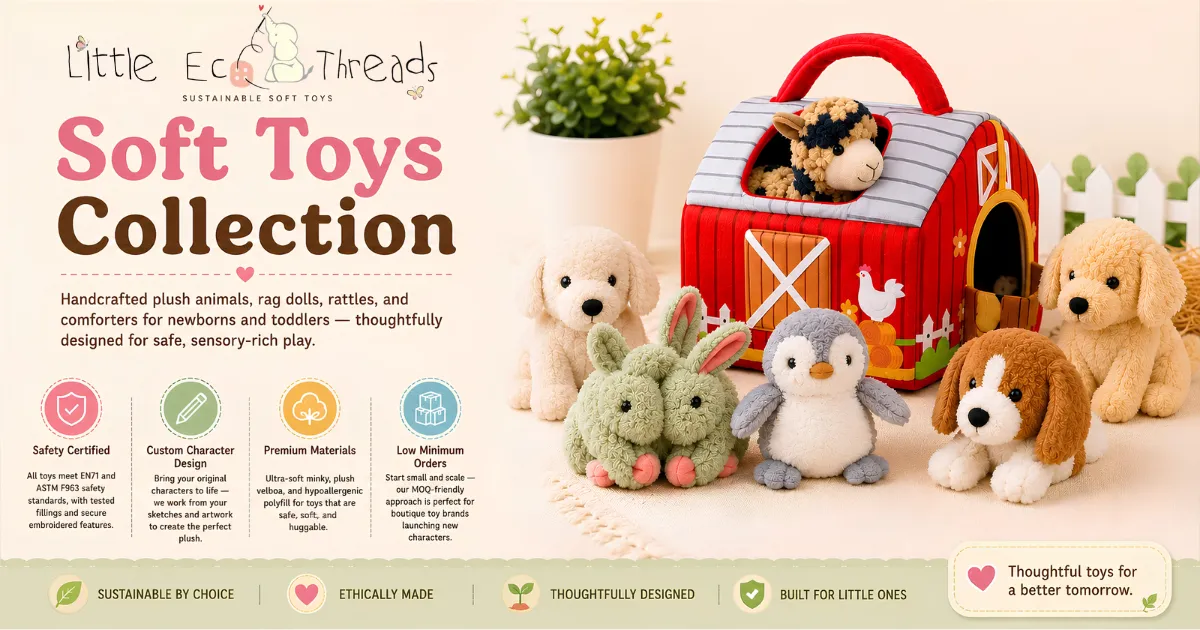
Little Eco Threads' Soft Toys Collection reflects this same discipline in practice. The range spans handcrafted plush animals, rag dolls, rattles, and comforters for newborns and toddlers, each thoughtfully designed for safe, sensory-rich play. Every toy is safety certified, meeting EN71 and ASTM F963 standards, with tested fillings and securely embroidered features built to withstand a child's daily handling. For brands with an original character or mascot, the manufacturer can also work directly from sketches and artwork to bring that design to life as a custom plush piece, rather than adapting it from an existing template. Materials follow the same premium standard used across categories (ultra soft minky, plush velboa, and hypoallergenic polyfill), so the finished toy is as safe and huggable as it is soft. And because the approach is MOQ friendly, boutique and emerging baby brands can start small and scale, launching a new character or collection without committing to the volumes larger toy manufacturers typically require.
The Profitability Case for Sustainable Soft Toys
Category expansion only makes sense if it strengthens the underlying business, and the profitability logic behind sustainable plush is worth examining on its own terms without inflating the numbers.
First, soft toys tend to support healthier margins than commodity nursery basics because their value is perceived rather than purely functional. A blanket and a plush toy may use comparable materials and labor, but the toy's emotional positioning as a keepsake or gift generally supports a higher price point relative to production cost.
Second, sustainably manufactured plush can support premium pricing more credibly than most other baby categories, because the certifications and sourcing standards that matter to eco-conscious buyers (organic fiber content, recycled or biodegradable fill, verified non-toxic dyes) are easy to communicate and increasingly expected by retailers as a baseline for shelf placement, not just a differentiator.
Third, soft toys increase average order value when merchandised alongside apparel or nursery products, since they are frequently added as a complementary gift item rather than purchased alone. And because plush purchases are so often gift-driven, they introduce a brand to a wider circle of buyers, grandparents, friends, colleagues, many of whom become repeat customers for future occasions.
None of this guarantees profitability on its own. It requires manufacturing discipline: consistent quality control, safety compliance across markets, and a supply chain that can scale without compromising on materials. This is precisely the operational layer where OEM soft toy manufacturers add value; brands get the category expansion without having to build plush-specific manufacturing expertise from scratch.
Sustainability as a Manufacturing Discipline, Not a Marketing Layer
It is worth being direct about something many brands get wrong: sustainability that lives only in marketing copy does not survive contact with informed retail buyers or increasingly literate consumers. Real sustainability in soft toy manufacturing is a set of manufacturing decisions, the fiber sourcing, the dye process, the fill material, the factory's labor and environmental practices, long before it becomes a product description.
This is where responsible sourcing and ethical manufacturing become inseparable from brand credibility. A brand that markets an eco friendly plush toy manufactured through an opaque, unverified supply chain is exposed to reputational risk the moment a retailer or journalist asks basic sourcing questions. Brands that work with manufacturing partners who can document their material sourcing, factory practices, and compliance certifications are, in effect, buying insurance against that exposure.
Little Eco Threads positions its manufacturing approach around this principle: sustainable materials and ethical production practices applied consistently across apparel, soft toys, and nursery textiles, rather than treated as a premium add-on for a single collection. For a private-label business or importer evaluating OEM partners, this consistency matters more than any individual product spec sheet, because it is what allows a sustainability claim to hold up across an entire portfolio rather than one hero product.
The broader benefit of this discipline extends past any single brand. When more manufacturers adopt responsible sourcing as standard practice rather than a marketing feature, the entire supply chain, from raw material suppliers to converters to finished-goods factories, has more incentive to invest in genuinely lower impact processes. Retailers benefit from a more credible category to merchandise. Consumers benefit from products that meet the claims made about them. And the industry as a whole benefits from raising the baseline expectation for what a baby product portfolio should look like.
What This Means for Sourcing and Product Decisions
For brands, retailers, and private-label businesses evaluating whether and how to diversify beyond apparel, a few practical considerations follow from everything above:
- Treat category expansion as a portfolio decision, not a single product launch. A one off plush SKU rarely moves the needle; a coordinated collection does.
- Choose manufacturing partners who can carry the same sustainability standards across categories, rather than sourcing apparel and soft toys from separate, inconsistently vetted suppliers.
- Prioritize custom plush toy manufacturers and OEM partners who can document material sourcing and compliance, since retail buyers are increasingly asking for this evidence before granting shelf space.
- Recognize that soft toys are a gifting and brand-building category as much as a retail one; merchandising and positioning matter as much as the product itself.
- View diversification as a long-term brand investment rather than a short term sales lift; the portfolio effects on retailer relationships and customer lifetime value compound over multiple seasons.
Conclusion: Diversification with a Purpose
Expanding from baby clothing into soft toys, nursery essentials, and other baby accessories is much more than following a market trend. It reflects a real change in what parents expect, how retailers choose the brands they work with, and how successful businesses build long term customer trust.
The brands that are growing the fastest are not simply adding new products to their catalog. They are creating a complete ecosystem where every product follows the same standards for quality, safety, and sustainability. Whether it is a piece of clothing, a plush toy, or a nursery essential, parents want the same level of care and responsibility throughout the collection.
For companies, this approach creates stronger customer loyalty, opens new opportunities with retailers, and reduces the risk of relying on a single product category. As the sustainable baby products market continues to evolve, the brands that expand thoughtfully with trusted manufacturing partners, responsible sourcing, and consistent certifications such as GOTS and OEKO-TEX Standard 100 will be the ones that build lasting relationships with families and achieve sustainable long term growth.
If you're planning to extend your range beyond apparel, Little Eco Threads is an OEM and private label manufacturer supporting baby brands, retailers, and importers with sustainable apparel, soft toys, nursery essentials, and textile accessories, built on consistent ethical and environmental manufacturing standards.