
How Global Tariffs Are Reshaping Apparel Manufacturing
Introduction
Global apparel manufacturing is being shaped by more than labour costs, fabric prices and delivery times. Trade policy now has a direct influence on where brands place orders, how they calculate landed costs and how they manage supplier relationships. Changes in import duties, new trade agreements and geopolitical tensions have made apparel sourcing a strategic decision rather than a simple price comparison.
For fashion businesses, the effect is practical. A garment that appears less expensive at the factory gate may become more costly after customs duties, freight, compliance and currency movements are included. This is why apparel import tariffs, import duties and supply chain planning have become important subjects for sourcing teams.
The impact is especially relevant to brands buying from several manufacturing countries. India, China, Bangladesh and Vietnam each offer different strengths. The right choice depends on the product, destination market, tariff classification, production capability and the reliability of the supplier. This article explains the main changes and what international brands should consider when planning their apparel manufacturing strategy.
Why Tariffs Matter to Apparel Manufacturing
A tariff is a tax applied to goods when they enter a country. In apparel, the rate can differ according to the product type, fibre content, construction, gender or age category, country of origin and the importing market. A knitted cotton top and a woven jacket may fall under different tariff classifications even when they are sold as part of the same collection.
Tariffs affect the landed cost of a product. Landed cost is the total cost of getting goods to the buyer, including the factory price, freight, insurance, customs duties, brokerage and other import charges. If duties rise, the importer may have to accept a lower margin, increase the wholesale price, negotiate with the manufacturer or reconsider the sourcing country.
Geopolitical Tensions and Changing Sourcing Decisions
Trade policy has become more closely connected with geopolitical relationships. Governments may use tariffs to respond to trade disputes, protect domestic industries, address national security concerns or influence the behaviour of trading partners. These measures can change quickly, making long term sourcing decisions harder.
The United States is an important example. In July 2026, a United States action following Section 301 investigations introduced additional duties for goods from a number of economies, including India. The Federal Register notice set an additional rate of 10 percent for products of India, subject to stated exceptions and product specific provisions. This is not the complete duty on every garment. Importers still need to identify the correct tariff classification and check the applicable base rate, additional measures and exemptions before calculating the final amount. [1]
The development matters because the United States is a major destination for apparel exports. Reuters reported in November 2026 that Indian garment exporters were reviewing their reliance on the US market after earlier tariff increases affected orders and margins. Some companies were looking more closely at the United Kingdom, Europe, the United Arab Emirates and domestic demand. This shows how trade uncertainty can influence market diversification as well as factory selection. [2]
China remains a central part of global apparel supply chains, supported by a broad supplier base, textile capacity, manufacturing scale and established logistics. At the same time, brands have been exploring other production locations to reduce concentration risk. This approach is often called China plus One. It does not necessarily mean leaving China. It means building additional sourcing options so a business is not dependent on one country or one production network.
India, China and the Changing Manufacturing Landscape
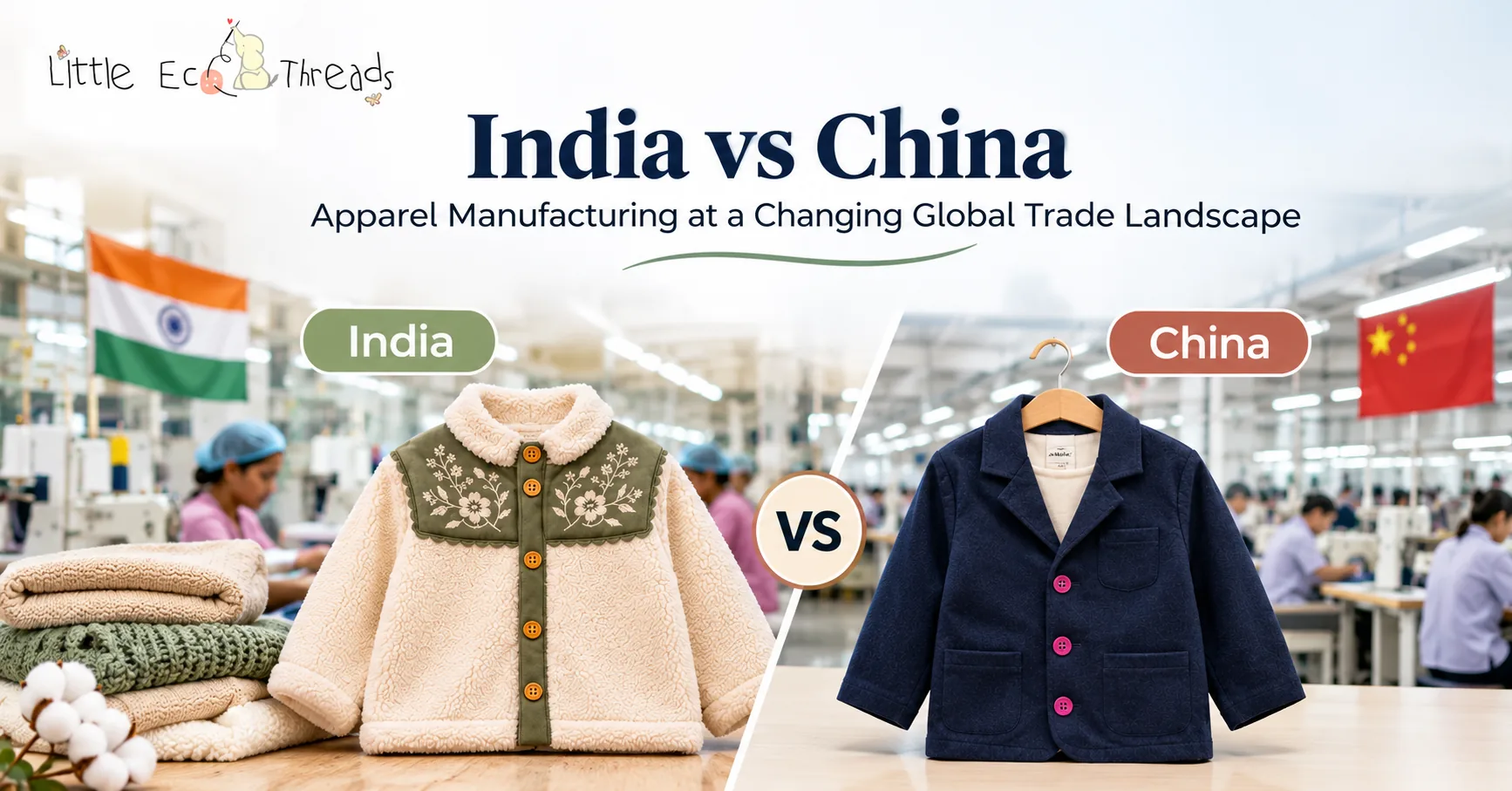
China offers scale, an extensive materials ecosystem and experience across many product categories. Its strengths can be important for brands that need large volumes, complex supply chains or access to specialised components. However, buyers may also need to consider geopolitical exposure, changing duties, lead times, minimum order quantities and the cost of managing a concentrated supply base.
India has a substantial textile and apparel industry, a large workforce, established cotton production and a range of manufacturing clusters. Its strengths can be relevant to brands sourcing cotton clothing, knitted products, woven apparel, babywear and value added garments. Indian suppliers also serve different order sizes and product types, although capability and minimums vary from factory to factory.
The choice between India and China should not be reduced to a claim that one country is always cheaper. A fair comparison should include the full landed cost, quality consistency, sampling speed, fabric availability, compliance records, production capacity and communication. A lower factory price can lose its advantage if a supplier cannot meet the required specification or delivery date.
India's trade agreements can also influence sourcing decisions. The India United Kingdom Comprehensive Economic and Trade Agreement entered into force on 15 July 2026. The Indian government says the agreement provides preferential access for a large share of Indian exports to the UK. [3] India and the European Union announced the conclusion of negotiations on an FTA in January 2026, but buyers should check its signing, ratification and implementation status before assuming a preference applies to a shipment. An announced or concluded agreement does not automatically mean that a new tariff rate is already available at customs. [4]
How Apparel Import Duties Affect the Final Cost
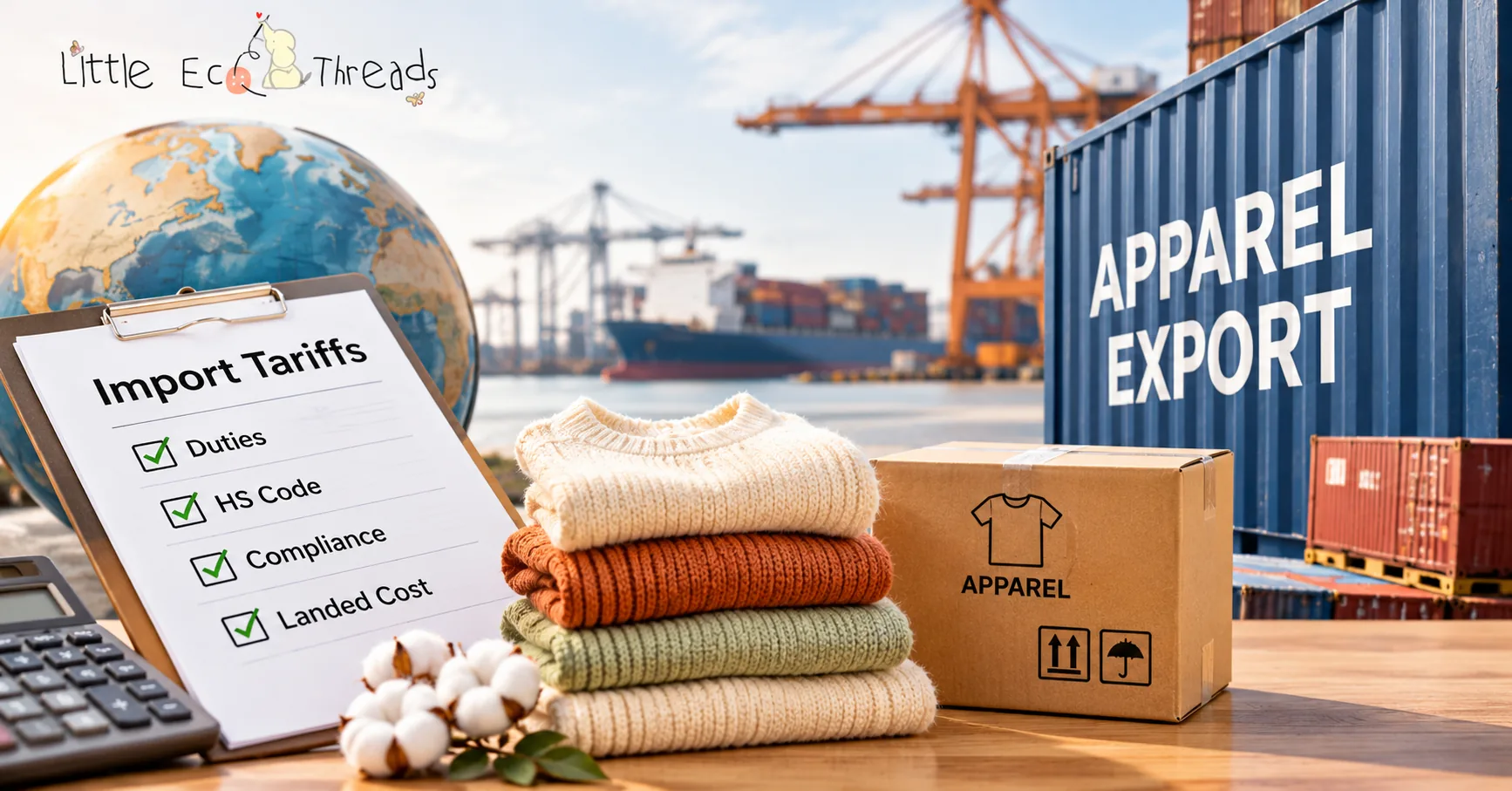
Tariffs are one part of a broader cost calculation. A sourcing team should assess at least five areas before confirming an order.
First, confirm the Harmonized System code. The code describes the product for customs purposes. Fibre composition, knitted or woven construction, garment type and intended wearer can affect classification. The United States uses its Harmonized Tariff Schedule, while other markets apply their own tariff schedules.
Second, establish the country of origin. The country from which goods are dispatched is not always the country of origin. Rules of origin determine whether a product qualifies for a preferential rate under a trade agreement.
Third, calculate the applicable duty. Check the ordinary rate, any additional tariff, trade agreement preference, product exclusion and relevant date. Do not rely on a general rate quoted for a country or for the apparel sector as a whole.
Fourth, include freight, insurance, customs brokerage, port charges and other costs. These can change the total landed cost even when the tariff rate remains the same.
Finally, test the effect on pricing and margin. A brand should model more than one scenario. For example, it can compare the current duty, a possible increase and a lower rate available under a verified trade preference. This makes it easier to decide whether to adjust retail pricing, negotiate a new order or diversify suppliers.
Supply Chain Diversification Is Becoming a Business Priority
A diversified supply chain gives a brand more options when trade conditions, shipping routes or production capacity change. It can also reduce the risk of depending on a single factory for a seasonal collection.
The process takes time. Buyers need to compare samples, test quality, review factory capability, agree specifications and confirm production schedules. They should also check labour practices, product safety requirements, chemical restrictions and traceability expectations in the destination market.
What International Brands Should Look for in an Indian Manufacturer
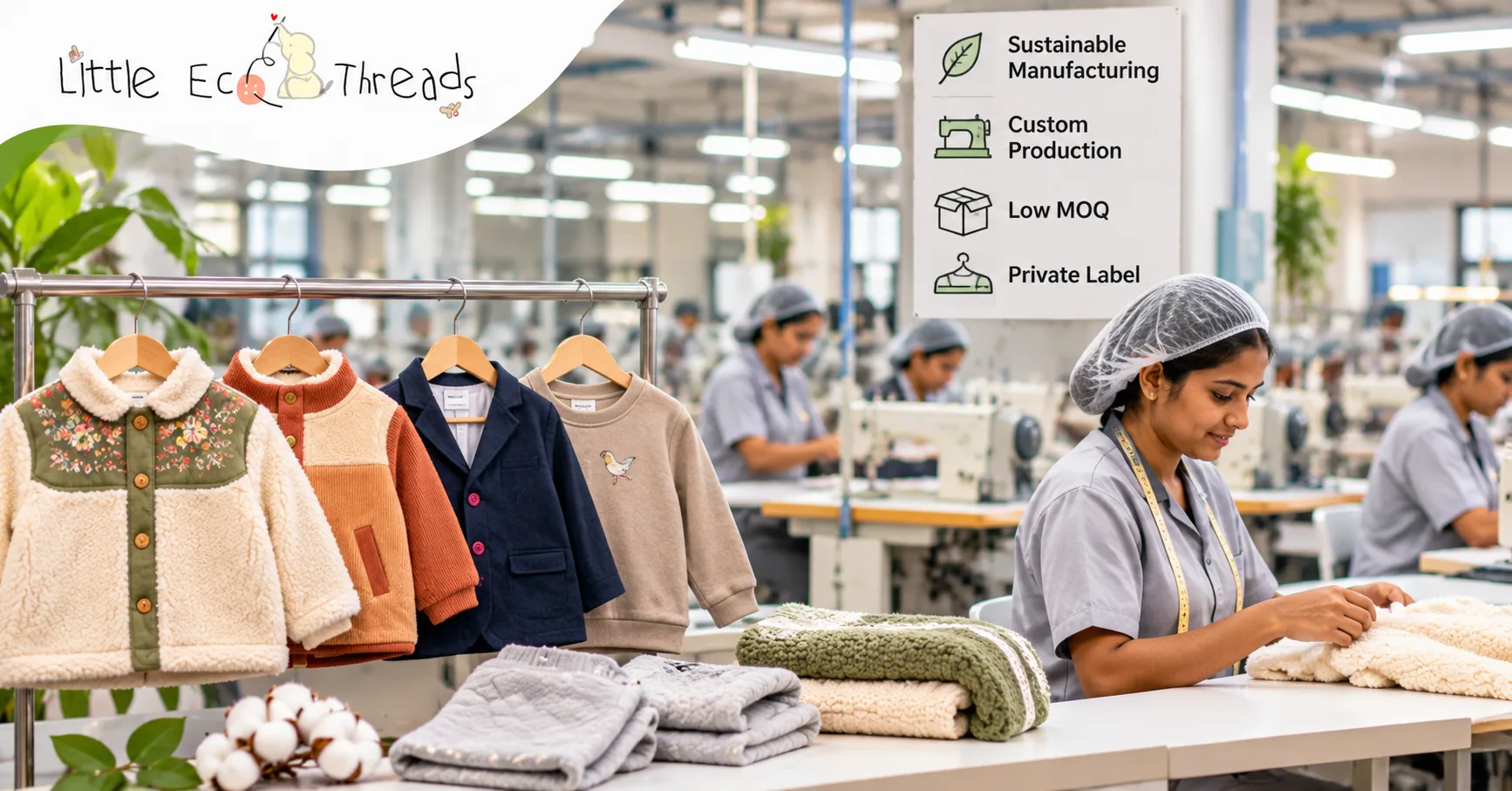
When considering apparel sourcing in India, international brands should look beyond a factory quotation. They should ask whether the manufacturer can develop the product, source the required fabric, produce consistent samples, manage customisation and provide clear production updates.
For babywear and kidswear, product safety and material claims need particular attention. Buyers should confirm the applicable rules in the destination market and request evidence for any certification or sustainability claim. GOTS, GRS and OEKO TEX refer to different standards and scopes. A certificate held by a company does not automatically mean every product or material is covered. Buyers should review the current certificate, its scope and the documentation for the actual order.
Customisation is another important consideration. Brands may need specific colours, prints, embroidery, labels, trims, packaging or sizing. A manufacturer should explain what can be customised, what affects the minimum order quantity and how changes influence sampling time and cost.
Flexible production quantities can help a new label test a collection before committing to larger volumes. However, minimum order quantities depend on fabric availability, dyeing requirements, construction, machinery and the number of colours or sizes. Buyers should ask for the minimums by style and material rather than assuming one figure applies to every product.
How Little Eco Threads Fits into the Changing Sourcing Landscape
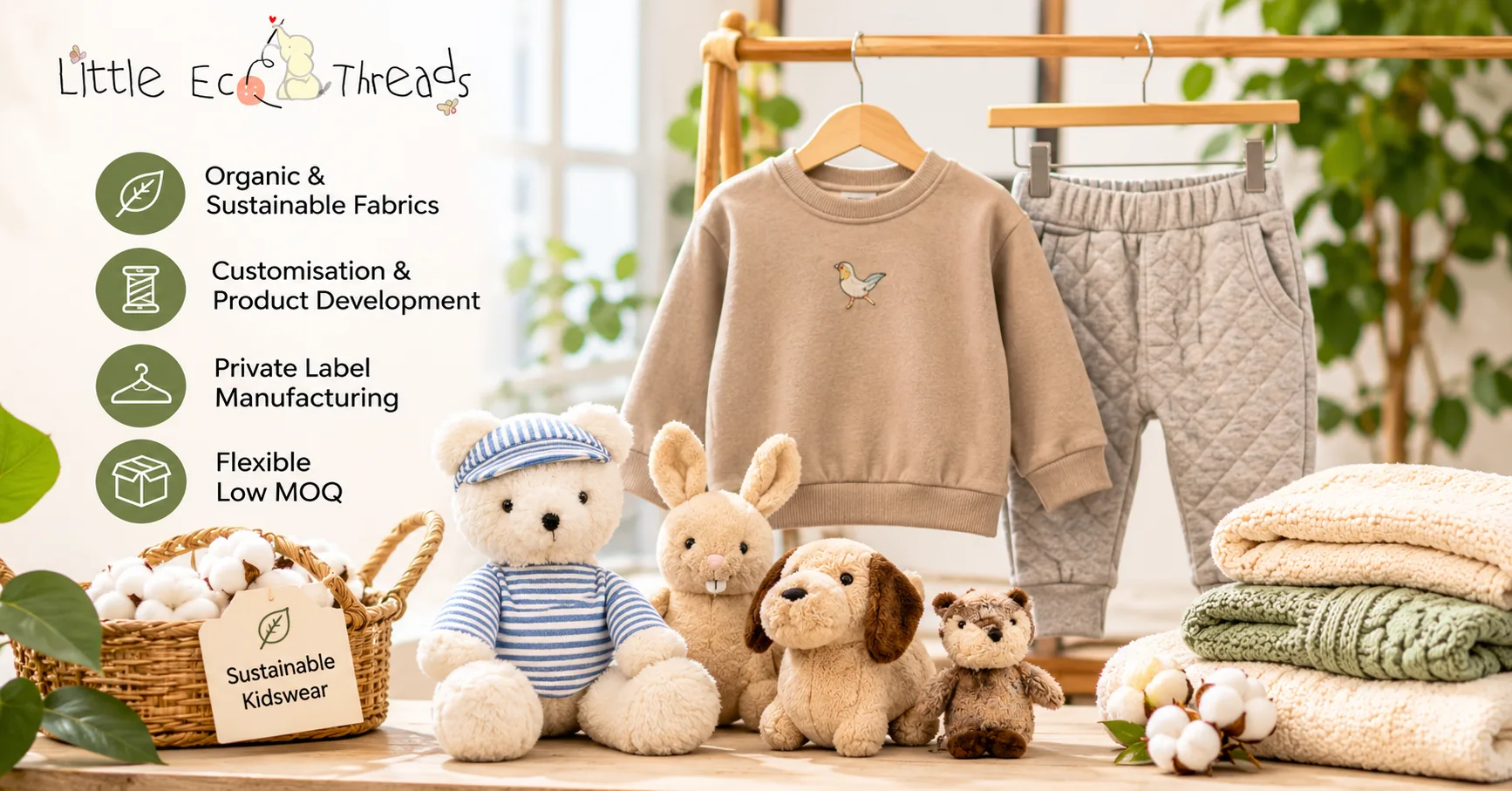
For brands developing babywear and kidswear collections, India can offer access to a broad textile base and manufacturing partners with different product specialisations. Little Eco Threads is an India based B2B manufacturer focused on sustainable babywear and kidswear for international brands, wholesalers and growing labels.
Its services include customisation, private label development and OEM and ODM manufacturing. Brands can discuss design details, fabrics, colours, prints, embroidery, labels and packaging as part of product development. This is relevant for buyers who want a collection that reflects their own brand identity rather than selecting only ready made products.
The product range includes baby and kids clothing, knitwear, sleepwear, newborn essentials, swaddles, blankets, quilts and soft toys. The company also works with material options such as organic cotton and recycled materials where suitable for the product and order requirements. Its website identifies GOTS, GRS and Sedex related credentials. Buyers should confirm the current certificate and scope that apply to the specific material, process and product they plan to order.
Low minimum order options may be useful for brands testing new designs or building a first collection. The actual minimum depends on the style, fabric, colour and production requirements, so it should be confirmed during enquiry and sampling. For a buyer comparing manufacturers, the value is not simply a low starting quantity. It is the ability to discuss custom development, product range, quality expectations and production planning with one manufacturing partner.
Building a More Resilient Apparel Sourcing Strategy
Global tariffs are changing the economics of apparel manufacturing, but they are not the only factor shaping sourcing decisions. Brands need to consider product classification, origin rules, trade agreements, freight, quality, compliance and supplier reliability together.
India can be part of a diversified sourcing strategy, particularly for brands looking at cotton apparel, babywear, kidswear and customised collections. China and other manufacturing countries may remain important depending on the product and business requirements. The strongest approach is to compare suppliers using verified landed costs and production capability rather than assumptions about national cost advantages.
For international brands, the next step is practical: review the tariff classification of key products, confirm the rules for each destination market, qualify more than one suitable supplier and build realistic production plans. With better information and a broader supplier base, businesses can respond to trade changes without compromising product quality or customer commitments.
Frequently Asked Questions
How do tariffs affect apparel manufacturing?
Tariffs increase the cost of importing products into a market. They can affect landed cost, wholesale prices, profit margins and sourcing decisions. The impact depends on the product classification, country of origin and importing market.
Are apparel import tariffs the same for every garment?
No. Rates can vary according to fibre content, garment construction, product type, country of origin and the destination country's tariff schedule. Importers should confirm the correct HS code before calculating duty.
Is India becoming an alternative to China for apparel sourcing?
India is one option for brands diversifying their supplier base. It offers textile and garment manufacturing capabilities across several product categories. The suitability of a supplier depends on quality, price, capacity, compliance and delivery requirements.
Do free trade agreements remove all apparel import duties?
Not necessarily. An agreement may reduce or remove duties for eligible products, but the benefit depends on the product schedule, rules of origin, implementation date and required documentation.
What should brands check before choosing an apparel manufacturer in India?
Brands should review product experience, fabric sourcing, sampling, customisation, minimum order quantities, quality control, compliance documentation, production capacity and communication. They should also calculate the final landed cost for the destination market.
References and Further Reading
- United States Federal Register, July 2026, Section 301 determinations and additional duties
- Reuters, 11 November 2026, India garment makers rethink reliance on US after tariff shock
- Press Information Bureau, Government of India, India UK CETA enters into force, 15 July 2026
- European Commission, EU India Free Trade Agreement chapter by chapter summary