Sustainable Kidswear: Organic Cotton vs Recycled Materials
Sustainable kidswear is not created by choosing one good-sounding fabric label. Organic cotton and recycled materials can both belong in a responsible children's clothing collection, but they solve different problems and perform differently depending on the product.
If you have ever bought clothing for a baby or young child, the first test is usually not the label. You touch the fabric. You ask whether it feels soft enough, whether it will hold its shape, whether the colour will stay, and whether it will still feel good after repeated washing.
For brands sourcing sustainable kids clothing, the questions become more practical: will this fabric work for a ribbed romper, muslin swaddle, sleeping bag, baby quilt, or newborn gift set? Can the material claim be documented? Does the manufacturing process support the sustainability story?
This guide compares organic cotton vs recycled materials for sustainable kidswear, including recycled polyester, recycled cotton, sustainable clothing materials, GOTS, GRS, OEKO-TEX STANDARD 100, ethical manufacturing, responsible sourcing, and greenwashing risks.
What Makes Sustainable Kidswear Actually Sustainable?
It is tempting to treat sustainability as a simple equation: organic is good, recycled is good, conventional is bad. Real children's clothing manufacturing is more complicated.
A baby romper may look simple, but it needs fabric that feels comfortable, seams that hold, trims that do not irritate, sizing that works, and wash performance that keeps the garment useful. If a garment becomes unusable quickly, another garment has to be produced, packed, shipped, sold, washed, and eventually disposed of.
When comparing sustainable clothing materials, brands should ask:
- Where did the raw material come from?
- How was the fibre processed?
- What dyes, finishes, or chemicals were used?
- How durable is the fabric after washing?
- Does the material suit the garment's real use?
- Can the product be reused, repaired, or recycled?
- What certifications support the claim?
- How transparent is the supply chain?
- How are the workers and production facilities managed?
At Little Eco Threads, material selection is treated as part of product development. The fabric has to be appropriate for what the finished garment is expected to do.
Organic Cotton In Sustainable Kidswear
Organic cotton is popular in baby and children's clothing because cotton can be soft, breathable, absorbent, and familiar to parents. It often works well for garments worn close to the skin, including bodysuits, baby basics, T-shirts, rompers, sleepwear, and lightweight everyday styles.
Organic cotton is cotton grown under recognised organic farming requirements, but the finished fabric still has to be spun, knitted or woven, dyed, finished, cut, sewn, packed, and transported. That means "organic" should not be treated as a complete sustainability answer on its own.
It is also inaccurate to describe organic cotton as "chemical free." Textile manufacturing involves chemistry. The better question is which inputs are allowed, how they are managed, and whether a credible standard supports the claim.
That is where GOTS certification becomes useful. The Global Organic Textile Standard supports organic textile claims across certified processing and supply-chain stages. If a supplier says it can provide GOTS certified organic cotton, brands should still ask what exactly is certified and whether the finished product claim is covered.
Organic cotton can be a strong choice, but it still needs good yarn, fabric construction, finishing, pattern development, and quality control.
Recycled Materials In Children's Clothing
Recycled materials are not one single category. Recycled polyester and recycled cotton behave differently, come from different sources, and suit different products.
Recycled polyester is often made from recovered polyester material, including PET plastic or polyester textile waste. It can be useful where durability, shape retention, stretch, or moisture behaviour matter. Swimwear, outerwear, accessories, and some performance-led kidswear can be better candidates than newborn garments worn directly against sensitive skin.
Recycled cotton usually starts with cotton textile waste. It can help give existing material another use, but fibre length and strength can be affected during recycling. That is why recycled cotton is often blended with other fibres to reach the hand feel, strength, and consistency needed for a finished fabric.
The Global Recycled Standard and GRS-related documentation can help support recycled-content claims. Textile Exchange also explains its recycled standards and chain-of-custody system through official resources for the Global Recycled Standard.
Recycled does not mean impact-free. Recycling still requires collection, sorting, processing, energy, transport, dyeing, finishing, and quality control. The end-of-life path for the finished garment also matters.
Organic Cotton vs Recycled Materials: Key Differences
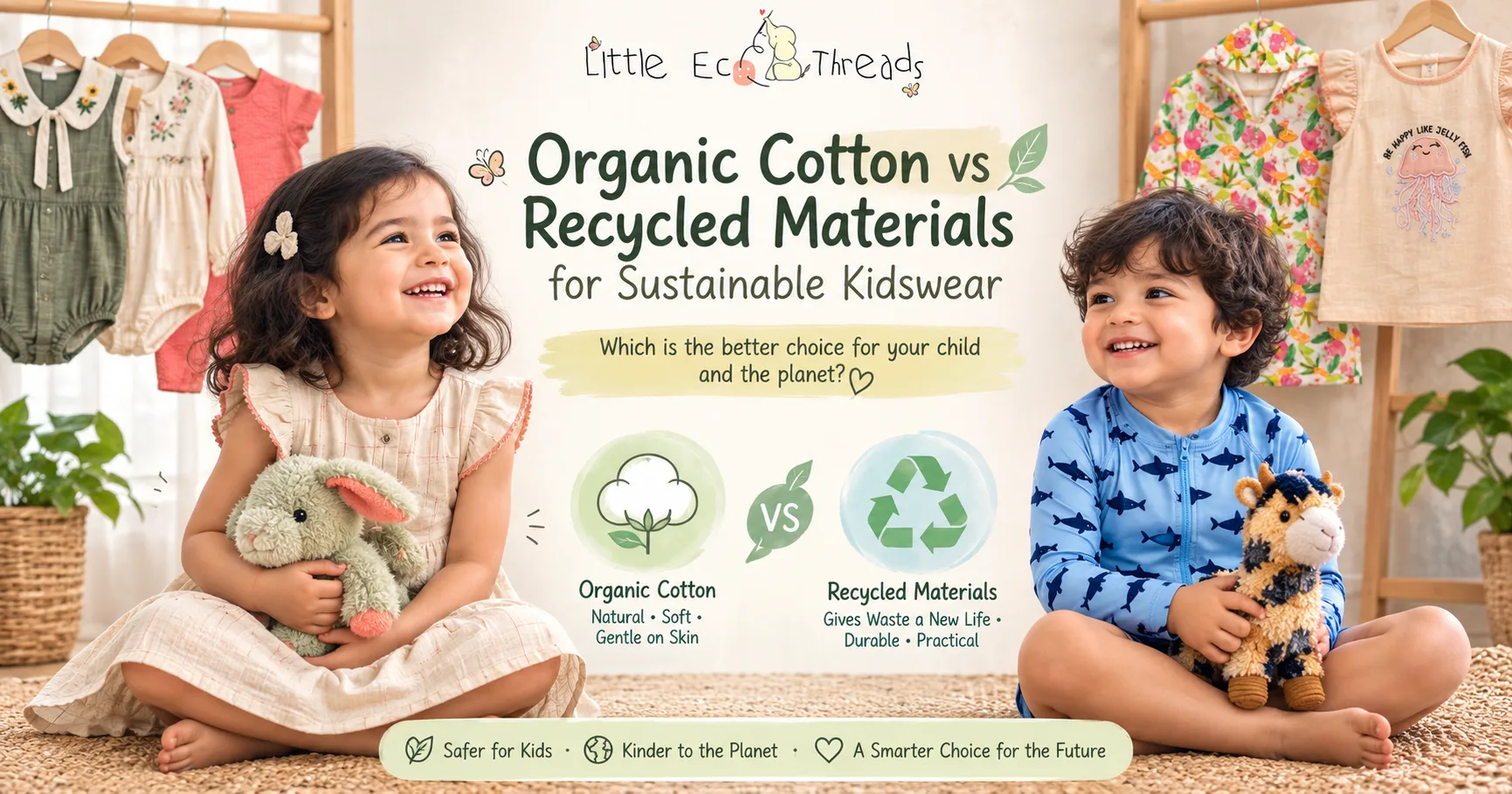
Organic cotton and recycled materials answer different questions. Organic cotton asks how the cotton was grown and processed. Recycled materials ask whether existing material can be recovered and used again instead of relying entirely on virgin resources.
| Factor | Organic Cotton | Recycled Materials |
|---|---|---|
| Source | Cotton grown under organic requirements | Existing material recovered and processed into new fibre |
| Fibre type | Natural cellulosic fibre | Natural or synthetic, depending on the source |
| Comfort | Often strong for skin-contact garments | Depends heavily on fibre and fabric construction |
| Breathability | Often useful for breathable everyday garments | Varies significantly between fibres |
| Durability | Depends on yarn, GSM, knit/weave, and finishing | Recycled polyester can perform well in durable uses |
| Waste reduction | Not primarily a waste-recovery strategy | Can give existing materials another use |
| Certification fit | GOTS may support organic textile claims | GRS may support recycled-content claims |
| Kidswear uses | Basics, rompers, tees, sleepwear, swaddles | Swimwear, outerwear, blends, accessories, performance uses |
| Main caution | Organic does not mean zero impact | Recycled does not mean zero impact |
The better choice depends on product type, age group, skin contact, climate, washing frequency, durability expectations, and the claim your brand wants to make.
Which Material Is Better For Children's Products?
Neither material is automatically better for every children's product.
A ribbed romper worn close to the skin may benefit from soft organic cotton jersey or ribbed knit because breathability, stretch, and comfort matter. A muslin swaddle needs lightness, softness, and airflow. A sleeping bag has its own warmth, construction, and wash-performance requirements. A baby quilt may need durability, loft, stitching quality, and fabric stability. newborn gift sets need consistency across several products that may touch the baby's skin in different ways.
That is why experienced manufacturers start with the product, not the label.
Useful questions include:
- What is the product for?
- How directly will it touch the skin?
- How often will it be washed?
- How long should it last?
- Does the fabric keep its shape and hand feel?
- Can the sustainability claim be verified?
- Does the supplier understand the manufacturing requirements?
The strongest sustainable kidswear decisions are product-specific.
Why Fabric Quality Matters As Much As Fibre Choice
A good fibre cannot rescue a poorly made garment. If a garment shrinks heavily, twists at the seams, pills quickly, loses colour, or stretches out of shape, the sustainability claim loses practical value.
For children's clothing, fabric quality means:
- Consistent hand feel
- Shrinkage control
- Colourfastness
- Stable GSM and construction
- Wash performance
- Seam durability
- Reliable trims and finishing
- Consistency between production batches
This is why material selection should happen alongside sampling, quality control, and manufacturing planning. A durable garment that remains useful through repeated wear can be a more meaningful sustainability choice than a garment with a strong fibre claim but weak construction.
Certifications Help Buyers Avoid Greenwashing
Greenwashing happens when sustainability claims sound better than the product evidence behind them. Claims such as "eco-friendly," "natural," "clean," or "conscious" should be supported with specifics.
Important certifications and standards answer different questions:
- GOTS and the Global Organic Textile Standard support organic textile claims.
- GRS and Global Recycled Standard documentation support recycled-content claims.
- OEKO-TEX STANDARD 100 focuses on harmful-substance testing for textiles and components.
The official OEKO-TEX STANDARD 100 guidance states that textiles are tested against a large list of harmful substances, with stricter requirements where skin contact is more intensive and for products for babies and young children.
No single certification proves everything. A GOTS claim does not automatically prove recycled content. A GRS claim does not prove organic origin. OEKO-TEX STANDARD 100 does not prove that a fibre is organic or recycled. The certification needs to match the claim.
Ethical Manufacturing And Responsible Sourcing
Sustainable kidswear is also shaped by how the product is made. Fibre choice is important, but it is only one part of a wider sustainable fashion supply chain.
Brands should evaluate:
- ethical manufacturing
- responsible sourcing
- Traceability
- Worker and social compliance
- Environmental management
- Quality control
- Material documentation
- Clear communication during sampling and production
For brands planning a sustainable fashion supply chain, the question is not simply whether a material sounds sustainable. The question is whether the supplier can explain where it came from, how it was processed, how the finished product performs, and what documentation supports the claim.
How Little Eco Threads Approaches Sustainable Kidswear
Little Eco Threads does not treat sustainable kidswear as a single-fabric decision. Different products need different material, construction, and quality decisions.
Organic cotton may be right for soft baby basics, rompers, swaddles, and everyday garments. Recycled polyester may be more suitable for swimwear, outerwear, or products where performance and durability are the priority. Recycled cotton can make sense in blends or products where the yarn and fabric quality meet the intended use.
The goal is to match fabric, certification, product category, sampling, and quality control before bulk production. That helps brands make clearer product claims and avoid building a collection around vague sustainability language.
FAQ
Is organic cotton better than recycled polyester for kidswear?
Not automatically. Organic cotton can be a strong choice for soft, breathable garments worn close to the skin. Recycled polyester can be useful where durability, stretch, or performance matter. The better option depends on the product and the documentation behind the material.
Is recycled cotton sustainable?
Recycled cotton can be part of a sustainable kidswear strategy because it gives existing cotton material another use. Its performance depends on fibre length, yarn quality, blends, processing, and the final fabric construction.
Is organic cotton safer for children's clothing?
Organic cotton and textile safety are related but not identical. Organic standards focus on organic fibre and processing requirements, while OEKO-TEX STANDARD 100 focuses on harmful-substance testing. Brands should match the certification to the claim being made.
What is the difference between GOTS and GRS?
GOTS focuses on certified organic textiles and related processing criteria. GRS focuses on recycled content, traceability, and related social, environmental, and chemical requirements. They verify different parts of a textile supply chain.
Can recycled materials be used for baby clothing?
Yes, when the specific fibre, fabric construction, chemical-safety expectations, comfort, and durability are appropriate for the product. The word "recycled" alone does not prove that a fabric is suitable for a baby garment.
What should brands look for when choosing sustainable kidswear materials?
Brands should check fibre composition, product suitability, certification documentation, supplier transparency, wash performance, durability, finishing, and whether the material claim can be clearly explained to buyers.
Choose The Right Material For The Product
Organic cotton vs recycled materials should not be treated as a competition with one permanent winner. Organic cotton has real strengths in soft, breathable children's clothing. Recycled materials can help reduce reliance on virgin inputs and provide useful performance in the right product.
The better question is: which material is right for this product, this customer, this supply chain, and this claim?
If you are developing sustainable kidswear and need help choosing between organic cotton, recycled cotton, recycled polyester, or other fabric options, contact Little Eco Threads. We can help you evaluate materials, sampling, documentation, and production planning before you commit to a collection.