Denmark's Sustainable Baby Clothing Market in 2026
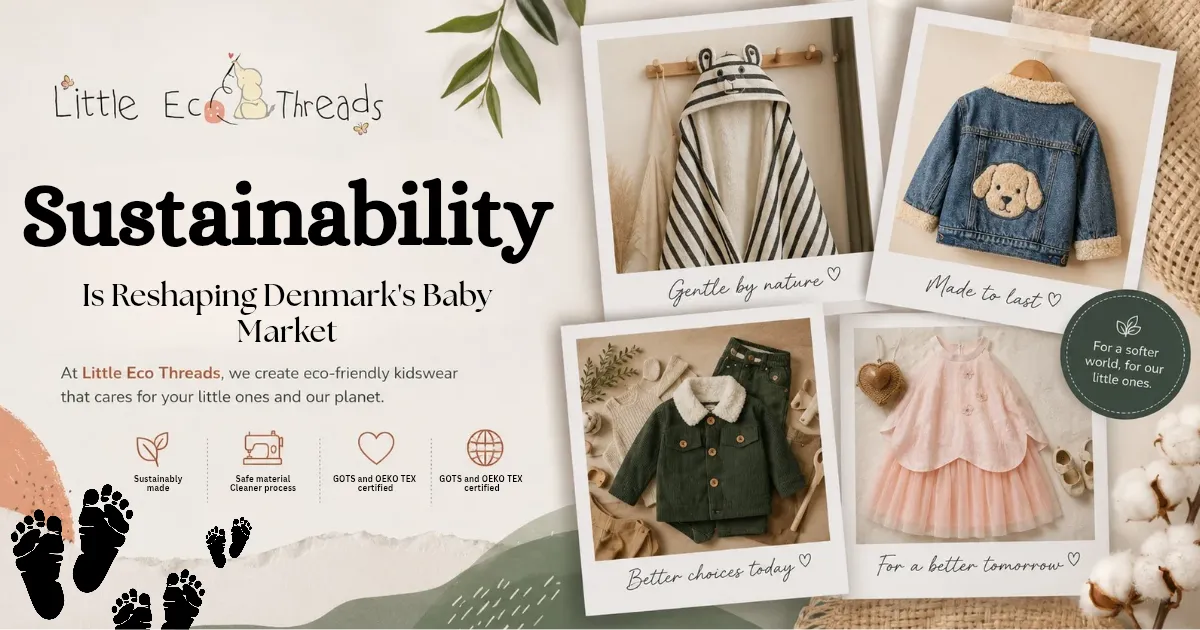
Not long ago, many children's clothing brands viewed sustainability as a marketing feature. A recycled paper tag, a mention of organic cotton, or a few eco friendly claims on the label were often enough to position a collection as sustainable. Today, that approach is no longer sufficient. In Denmark's children's products market, sustainability has become a core business consideration that influences manufacturing decisions, retail partnerships, and long-term brand growth.
For businesses selling into Denmark, whether established baby brands, importers, distributors, or entrepreneurs preparing to launch their first collection, this shift has changed the way sourcing decisions are made. Danish retailers and consumers increasingly expect sustainability to be reflected throughout the entire supply chain, not just in the finished product. As a result, choosing the right manufacturing partner has become an important part of building credibility and earning the trust of both retailers and customers.
In this article, we'll explore why sustainable baby clothing is becoming a major driver of growth in Denmark's children's products industry, what businesses should look for when selecting a children's apparel manufacturer, and how brands can expand into complementary product categories while keeping clothing at the heart of their business.
Denmark's Sustainability-Driven Children's Products Market
Denmark has one of the more mature sustainability cultures in Europe, and it didn't arrive overnight. Environmental responsibility runs through Danish design education, retail policy, and everyday consumer habits in a way that's difficult to fake with a marketing campaign. For children's products specifically, that creates a market where buyers, both retailers and parents, tend to ask sharper questions before committing to a brand.
Danish consumers are known for favoring goods that last. A baby grow that survives repeated washing, gets passed down to a younger sibling, or gets resold second-hand tends to be viewed more favorably than one built for a single season. That's not just a preference for durability. It reflects a circular economy mindset that treats reuse and resale as normal, not as an afterthought.
Retailers operating in this environment have adjusted their buying criteria accordingly. Many now ask suppliers directly about fabric origins, dyeing processes, and certifications before agreeing to stock a line, and demand for eco-friendly baby clothing has moved from a niche request to a standard line item in supplier negotiations. This scrutiny isn't unique to Denmark, but it tends to run deeper here than in markets where sustainability is still a bonus feature rather than a baseline expectation.
For brands and manufacturers alike, the practical takeaway is that sustainability credentials for sustainable children's clothing can't be bolted on after the fact. They need to be part of the product from the sourcing stage onward, which is exactly where a manufacturing partnership starts to matter.
Why Sustainable Baby Clothing Is Becoming a Competitive Advantage
Sustainability has become one of the few factors that genuinely helps children's clothing brands stand out. The market is more competitive than ever, with new collections launching constantly, pricing pressure increasing, and trends changing quickly. In this environment, a well-supported sustainability story is much harder for competitors to replicate than a new print or a temporary discount, making it a true business advantage rather than simply another marketing claim.
Brands that are transparent about where their fabrics come from, how their garments are manufactured, and the standards they follow often build stronger relationships with retailers. Buyers are more likely to invest in brands they trust, leading to longer-term partnerships instead of one-time orders. The same principle applies to parents, who are increasingly thoughtful about the products their children wear. Knowing that a garment has been responsibly made gives them greater confidence in their purchasing decisions.
A strong sustainability strategy also creates opportunities beyond the domestic market. As brands grow, expanding into other Nordic and European countries becomes much easier because many of these markets already value ethical manufacturing and responsible sourcing. The same pattern is visible in the UK and Germany, where certified, verifiable sourcing has become the price of entry. When sustainability is built into the supply chain from the beginning, businesses can enter new markets without having to redefine their brand story.
There is also a clear commercial benefit. Sustainable manufacturing often comes with higher production costs than conventional alternatives, but customers are generally willing to pay more when they understand the value behind the product. Brands that communicate this value clearly tend to build stronger customer loyalty and enjoy higher repeat purchase rates. In the children's clothing industry, where families buy new sizes regularly as children grow, that long-term loyalty is often far more valuable than winning a single sale through lower prices.
What Modern Buyers Expect from Baby Clothing Manufacturers
The short version: serious buyers now expect verified quality, transparent sourcing, and manufacturing flexibility, backed by documentation and samples rather than promises alone.
Consistency and Verified Quality
A single strong sample doesn't guarantee that an entire production run will match it. Buyers increasingly test a manufacturer across several orders before committing to anything long-term, checking whether fabric weight, colorfastness, and stitching hold steady at scale rather than just on the sample table. Certifications matter here too, GOTS for organic cotton baby clothing and OEKO-TEX for chemical safety, but what matters more is whether a manufacturer can produce documentation on request instead of simply claiming a fabric meets those standards. That distinction alone removes a meaningful amount of due diligence risk for a buyer.
Transparent Sourcing and Communication
Sourcing teams typically manage several suppliers across different time zones, so a manufacturer's communication style ends up mattering almost as much as their product quality. The ones who answer questions clearly, flag problems before they escalate, and give realistic timelines tend to earn repeat business even when a competitor quotes a slightly lower price. Transparency about where fabric actually comes from, not just a general claim of responsible sourcing, has become a baseline expectation rather than a nice-to-have.
Scalability, Customization, and Room to Grow
A brand's first order might be a few hundred units. Its fifth might be tens of thousands. Manufacturers who can scale without letting quality slip, and who are honest about capacity limits rather than overpromising, become long-term partners rather than one-time vendors. The best ones also leave room for customization, adjusting trims, packaging, and labeling for private label baby clothing and OEM or ODM programs, without treating every request as a disruption to their standard process.
Why Manufacturing Partnerships Matter More Than Ever
Choosing a children's apparel manufacturer ranks among the most consequential decisions a baby clothing brand makes, shaping far more of the outcome than most founders expect when they first start sourcing. Brand reputation, launch timelines, and how a brand is able to grow all trace back to that relationship.
Consider what happens when a manufacturer misses a delivery window ahead of a key retail season. That's not just a logistics problem, it's a missed opportunity with a buyer who may not offer shelf space again for months. Or consider a fabric quality issue that surfaces after a product has already reached customers: the brand absorbs the reputational damage, not the factory.
This is why sourcing teams increasingly evaluate manufacturers as partners rather than vendors. A partner brings supply chain stability that holds up during raw material shortages or shipping disruptions. A partner offers honest inventory planning guidance instead of accepting every order blindly. And a partner who understands a brand's growth trajectory, rather than treating each order as an isolated transaction, can help plan production around seasonal launches, new market entries, and retail negotiations.
Manufacturers who work this way, including groups like Little Eco Threads, which structure their operations around long-term client relationships rather than one-off runs, tend to become an extension of a brand's own team. That shift, from supplier to partner, is often what separates brands that scale smoothly from those that stall out after their first few seasons.
Product Diversification Beyond Clothing
Clothing will always be the core of a baby apparel brand, but it doesn't have to be the only thing on the shelf. Once a brand has established its fabric standards and design language, expanding into complementary categories can be a natural next step rather than a distraction.
Soft toys and plush pieces made from the same organic or recycled materials as a clothing line are a common starting point, since they reinforce the same sustainability story a brand has already built with customers. A textile toy manufacturer already working with children's fabrics can extend that story consistently. Nursery accessories, muslin blankets, swaddle sets, and textile-based gifts follow similar logic. None of these categories compete with clothing for attention; they extend the same values into new touchpoints, including eco-friendly baby toys with matching certifications.
Matching collections, where a soft toy or blanket coordinates with a clothing line's print or color palette, tend to perform particularly well at retail. They lift average order value without asking for a separate purchase decision, and they give retailers a reason to expand shelf space rather than simply restocking the same items.
Manufacturers who can support both clothing and textile-based accessories under one roof, Little Eco Threads among them, remove a meaningful amount of friction from this kind of expansion. A brand doesn't need to manage a second sourcing relationship or reconcile two different quality standards. That said, diversification only works when it's deliberate. Expanding into unrelated categories purely to chase trend cycles tends to dilute a brand's identity rather than strengthen it. The categories that work best feel like a natural extension of the clothing line's values, not an afterthought bolted onto the catalog.
Sustainability Throughout the Supply Chain
Sustainability claims fall apart the moment someone asks where a fabric actually came from. That's why the supply chain, not just the finished garment, is where a brand's environmental story is either proven or exposed.
Responsible sourcing starts with knowing exactly which farms, mills, and processing facilities touch a fabric before it reaches a cutting table. Traceability isn't only useful for marketing claims; it's practical risk management too, since a brand needs to answer a retailer's or regulator's questions quickly if a compliance issue ever comes up.
Waste reduction matters at every stage, from cutting patterns efficiently to reduce fabric offcuts, to designing packaging that minimizes unnecessary plastic without compromising protection during shipping. Quality inspections, done consistently rather than only at final shipment, catch problems early enough to fix before they become returns or, worse, safety concerns in products meant for infants.
None of this happens by accident. It requires a manufacturing partner willing to be transparent about where materials come from and how production actually runs, not just what a compliance certificate says. Brands that ask pointed questions about a factory's waste management, energy use, and supplier relationships tend to get a much clearer picture of whether a manufacturer's approach to sustainable textile manufacturing is operational or purely aspirational. The answer usually separates serious manufacturing partners from ones simply repeating buzzwords about a sustainable supply chain.
Innovation Driving the Future of Children's Apparel
Innovation in baby clothing rarely looks like a dramatic breakthrough. More often, it's steady improvement in materials and design choices that add up to a meaningfully better product.
Organic cotton remains the foundation for most sustainable baby clothing lines, but the fabric landscape has broadened. Recycled fibres, often blended with organic cotton for softness and durability, are increasingly viable for infant wear, provided the recycling process meets the same safety standards expected of anything touching a baby's skin. Low-impact dyeing techniques, which use less water and fewer harsh chemicals than conventional dyeing, are also becoming more accessible to mid-sized brands, not just the largest players in the children's fashion industry.
Design innovation matters just as much as material innovation. Durability-focused construction (reinforced seams, snap closures built to withstand repeated use, fabrics chosen for how they hold up after dozens of washes) extends a garment's usable life, which supports both sustainability goals and the resale or hand-me-down culture common in markets like Denmark.
There's also a quieter shift toward minimalist, timeless design in children's collections. Rather than chasing seasonal trends that fade quickly, more brands favor neutral palettes and simple silhouettes that stay relevant across siblings, seasons, and resale cycles. That's not purely an aesthetic choice, it's a sustainability decision dressed up as a design one, and it's proving to have real staying power in a market that increasingly values products built to last rather than to be replaced.
Conclusion: A Long-Term Strategy, Not a Passing Trend
Sustainable baby clothing is no longer just a trend in Denmark's children's products market. It has become an important factor in how retailers choose suppliers and how parents decide which brands to trust. Businesses that build sustainability into their products and supply chains are better positioned to create lasting retail relationships, expand into new markets, and earn long-term customer loyalty.
A strong manufacturing partner plays a key role in that success. From product quality and reliable production to responsible sourcing and future product expansion, the right partner helps brands grow with confidence.
Little Eco Threads supports baby clothing and children's apparel brands with sustainable manufacturing solutions, including organic cotton baby clothing as well as complementary textile toys and nursery accessories. For businesses looking to grow in Denmark and beyond, choosing the right manufacturing partner from the beginning can make a meaningful difference.