Sustainable Children's Clothing in Germany: A Market Built on Certification, Not Hype
Germany has become one of the leading markets in Europe for sustainable children's clothing. It may not be the biggest or the fastest growing market, but it is known for its high standards. German parents do not buy organic cotton just because it sounds good. They want to know who certified the product, where it was made, and whether a brand is truly following sustainable practices or simply using the word for marketing.
Because of this, sustainable children's clothing has a stronger meaning in Germany than in many other countries. Parents expect brands to be honest, share clear information, and follow trusted standards. This has created a market where sustainability is based on real actions instead of just attractive claims.
This article looks at why that is, what the data says about where the German children's apparel market is heading, and what it means in practice for the parents shopping in it, and for the brands and manufacturers trying to serve it well.
Why Germany's Market Is Becoming Ideal for Sustainable Clothing
Think about the last time you bought something as simple as bread or jam. Before buying it, you probably checked the manufacturing date, expiry date, ingredients, packaging, and price. Today, this has become a normal habit for most people. But if we go back 10 or 20 years, many shoppers did not pay much attention to these details. People are now more aware of what they buy and why they buy it.
A similar change is happening in the clothing industry. In many countries, people still focus only on how a piece of clothing looks or feels. In Germany, consumers have started looking beyond the product itself. They want to know how the clothes were made, whether the materials are sustainable, and if the brand is truly following eco friendly practices. This growing awareness is one of the biggest reasons why the demand for sustainable clothing continues to rise in Germany.
Let's look at the main reasons behind this growing demand.
-
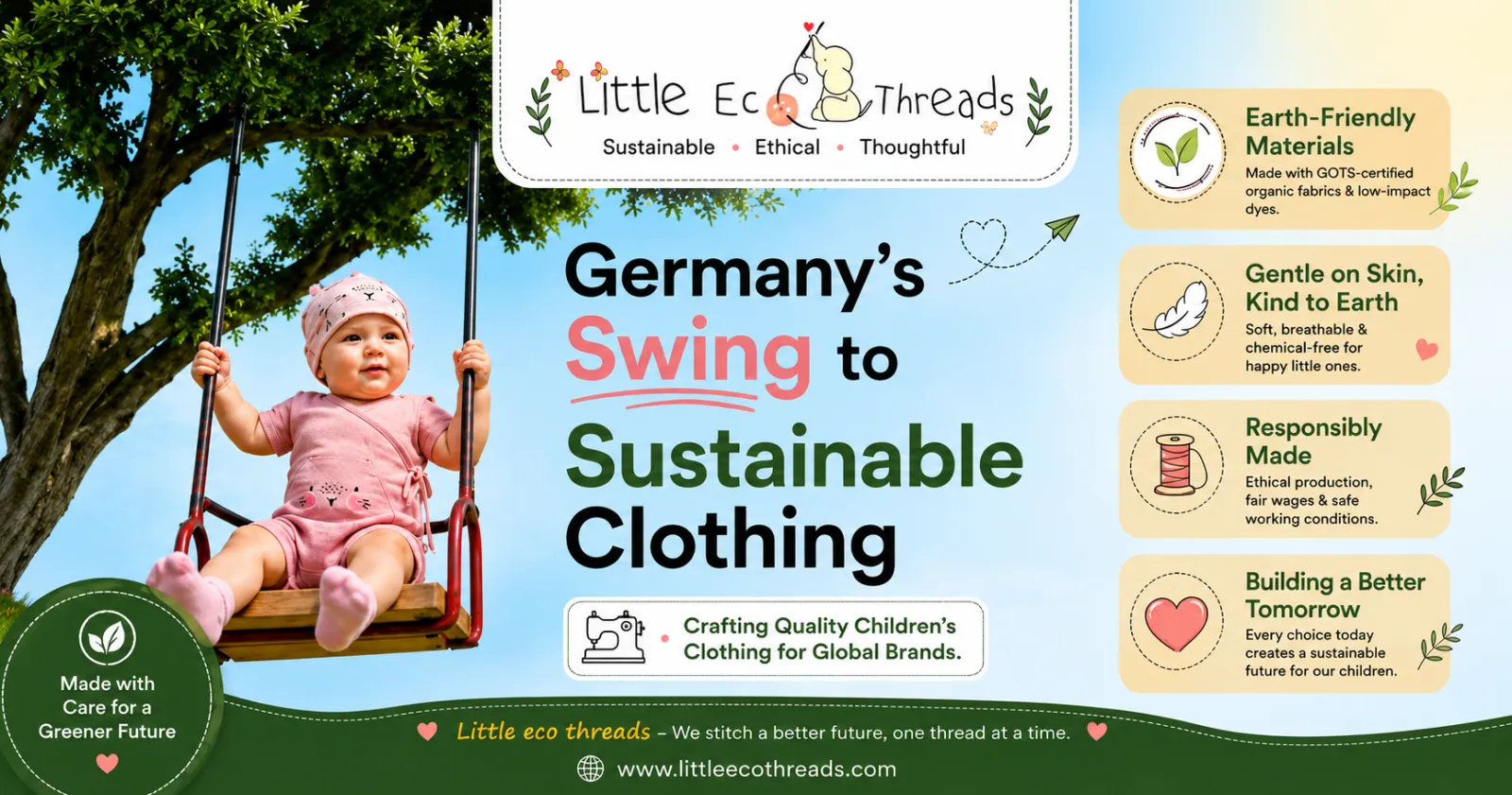
Growing preference for organic and certified textiles. Consumers increasingly prefer clothing that is safe, sustainable, and chemical free, but they are not buying it just because it carries these tags. They want proof, in the form of GOTS certified organic textiles and OEKO-TEX certified fabric testing. Brands that hold these certifications are seeing a real increase in sales. Little Eco Threads, for example, backs its kids' clothing with exactly these standards.
-
The rise of circular fashion. German consumers are embracing practices such as repairing, reselling, recycling, and reusing garments. This shift is encouraging brands to design higher quality pieces with longer lifespans and a lower environmental footprint.
-
More conscious parents. Parents are becoming more aware of both their children's health and the environment. They increasingly prefer clothing made from organic, skin friendly, and responsibly produced fabrics, creating strong growth opportunities for sustainable kidswear brands and manufacturers.
The German Children's Apparel Market
Germany has one of the largest children's clothing markets in Europe, but it is not growing very quickly. The market is expected to grow from about 3.55 billion dollars in 2025 to around 3.86 billion dollars by 2032, with an annual growth rate of about 1.2%. At first glance, this may seem like slow growth. However, these numbers do not show the full picture.
The biggest growth is happening in sustainable and organic children's clothing. While the overall market is growing slowly, demand for certified and eco friendly clothing is increasing much faster.
For example, the organic children's dress market is expected to reach a retail value of around 120 million to 155 million euros in 2026. Over the past three years, this segment has grown by about 10 to 12 percent every year, and experts expect this trend to continue until 2035. Organic children's hoodies are also becoming more popular, with organic products making up an estimated 12 to 18 percent of total sales by 2026.
In simple words, the overall children's clothing market is growing at a steady pace, but the sustainable clothing segment is growing much faster. This is an important trend for brands and manufacturers because it shows where future demand is increasing.
What's Driving the Shift
- Cultural orientation toward environmental responsibility. The German Environment Agency reports that 67% of Germans consider environmental protection a factor in daily consumption decisions.
- Health driven purchasing. More than 60% of German end users say they are willing to use sustainable textiles, with comfort and safety cited as the deciding factors specifically for children's clothing.
- Premiumization. The premium sustainable subsegment (typically €60+ retail) is growing faster than the mid market core, even as overall unit volumes stay roughly flat against a slowly declining birth rate.
These are not vague sentiment numbers. They are tied to specific, trackable behavior: certification penetration, price tier shifts, and category level CAGR that has held steady across multiple independent market reports rather than spiking on a single data point.
The Business Perspective on the Data
From a business standpoint, a slow growing overall market paired with a fast growing sustainable segment is actually the more attractive setup, not the less attractive one. A market growing at 15 to 20% a year usually means low barriers to entry and a flood of competitors chasing the same growth. Germany's pattern is the opposite: flat overall demand keeps casual entrants out, while the sustainable segment's steady 9 to 12% growth rewards brands that build the compliance and sourcing infrastructure to compete properly. It is a moat made of paperwork rather than price.
Compare this to the Netherlands, where sustainable kidswear demand is strong, so the market rewards marketing polish nearly as much as verified compliance. Germany rewards the latter almost exclusively, which raises the bar but also protects brands that clear it from being undercut by greenwashed competitors.
For a startup or an established brand, this changes how timing should be thought about. There is little upside in rushing into Germany with an unverified sustainability story; the market will simply ignore it. The better strategy is to spend the first six to twelve months building certification and supply chain documentation, then enter with a story that can survive scrutiny, rather than entering fast and retrofitting compliance later.
Why Certifications Carry More Weight in Germany Than Almost Anywhere Else
In many markets, 'organic' on a clothing label is a marketing claim with loose enforcement. In Germany, it is closer to a legal one. The term 'Bio' (organic) is legally protected for textiles sold in the country, and claims must be backed by recognized certification, most commonly the Global Organic Textile Standard (GOTS) or OEKO-TEX Standard 100.
This is not a minor technicality. German market surveillance authorities actively audit organic claims, and random inspections of imported organic children's clothing have increased an estimated 30 to 40% since 2022. Fines for false organic claims can range from €5,000 to €50,000, depending on the scale of the violation. For a brand or manufacturer, that changes the calculation: certification in Germany is not a nice to have for marketing purposes. It is closer to a license to operate credibly in the category.
The Certifications That Matter Most
- GOTS (Global Organic Textile Standard). The most widely requested certification for organic cotton children's clothing, covering both ecological and social criteria across the supply chain.
- OEKO-TEX Standard 100. Focused specifically on testing for harmful substances. An estimated 60 to 70% of children's dresses sold in Germany carry this or an equivalent credential.
Compliance also runs through several layers of product safety regulation that intersect with sustainability claims: the EU General Product Safety Directive, the German Product Safety Act (ProdSG), EN 71 (small parts and chemical migration), and EN 14878 (flammability for children's sleepwear). None of these are unique to sustainable products, but sustainable and organic claims are scrutinized within this same compliance framework, not separately from it.
What German Parents Are Actually Looking For
It would be easy to assume German parents are simply price insensitive when it comes to sustainability, but the data suggests something more specific. German households spend roughly €200 to €400 per child per year on clothing, a budget that has to stretch across a child who will likely move through two to three sizes annually. Within that budget, parents are not uniformly trading up to premium sustainable options. They are being selective about where sustainability claims actually matter to them.
Two patterns show up consistently across the market data. First, sustainability concerns concentrate most heavily in the baby and toddler segment, where skin sensitivity and chemical exposure are top of mind, and decline somewhat in the school age category, where price sensitivity reasserts itself. Second, parents increasingly favor brands that can demonstrate durability and longevity, such as 'grow with me' designs, adjustable fits, and resale value, alongside material sourcing, treating sustainability as something that includes how long a garment lasts, not only what it's made from.
This is also visible in how the market is structured by channel. E commerce and direct to consumer sales account for an estimated 30 to 35% of organic kids' apparel volume in 2026, up from just 18% in 2020, but physical retail, particularly specialist organic baby stores and natural product supermarkets like Alnatura and Denns BioMarkt, still represents 35 to 40% of sales. Sustainability minded German parents have not abandoned brick and mortar. They have simply raised what they expect to find there.
What This Means for Brands: Understanding the German Buyer
For brands trying to win over the German buyer, it helps to know exactly what they are checking for. The label alone won't satisfy them. Look for a named certification, GOTS or OEKO-TEX Standard, rather than the word "sustainable" or "eco friendly" on its own, since those terms are not legally protected the way "Bio" is. A brand confident in its claims will usually list its certification number or link to a certificate, not just show a badge image.
One thing that stands out while researching this space is how wide the gap can be between a brand's marketing copy and what is actually verifiable. Plenty of brands describe their cotton as "responsibly sourced" without any certification behind that phrase at all. It is a marketing choice, not a compliance one.
It is also worth watching the resale and secondhand market, which has grown quickly in Germany. Parents increasingly treat a garment's resale value and durability as part of what makes it sustainable, not just how it was made. A well made piece that lasts through two children and still resells well is, in a very real sense, more sustainable than a certified piece that falls apart after one season.
The Supply Side: Why Germany's Demand Outpaces Its Domestic Manufacturing
Here is the part of the story that is less visible from the shelf: Germany consumes far more sustainable children's clothing than it manufactures. Across nearly every product category in this space, hoodies, dresses, t shirts, import dependence runs from 80% to over 90% of unit volume. Domestic German production is real, but it is concentrated among small bespoke workshops and a handful of mid scale "made in Germany" producers serving an ultra premium niche, not the volume that mainstream demand requires.
That gap is filled by an international supply chain, with Turkey, India, Bangladesh, and Portugal as the dominant sourcing countries for GOTS certified and organic cotton children's garments. Turkey alone supplies an estimated 40 to 45% of organic cotton children's dresses sold in Germany. India and Bangladesh together account for another 35 to 40% of volume, with India leading in GOTS certified woven garments specifically.
This is the structural reality underneath the consumer facing sustainability story: German demand for certified, ethically produced children's clothing is real and growing, but meeting it depends almost entirely on manufacturing partners outside Germany who can deliver GOTS certification, consistent quality, and reliable lead times at scale. That is a meaningfully different problem than "finding organic cotton". It is a sourcing and verification problem, and it is where many brands, especially newer or smaller ones, run into difficulty.
The Sourcing and Manufacturing Perspective
Sourcing GOTS certified children's clothing at scale comes with a specific set of friction points. Minimum order quantities are often set for adult apparel volumes and do not flex well for a new kidswear brand testing a small collection. Lead times get squeezed further when a factory has to source certified fabric on top of production, and documentation (transaction certificates, scope certificates, chain of custody records) has to be requested, verified, and kept current, which many smaller manufacturers simply are not set up to manage.
There is a real difference between a manufacturer that happens to use organic cotton and one that can actually support a brand through the certification process itself. The former can produce a nice garment. The latter can hand a brand the paperwork trail needed to sell that garment credibly in Germany: a scope certificate, transaction certificates for each shipment, and consistent documentation across seasons, not just for the first order.
What separates long term manufacturing partners from the ones brands churn through after a season or two usually comes down to consistency: samples that match bulk production, lead times that hold even as order volumes grow, and a willingness to flag problems early rather than let a brand discover them at final inspection. These are the same signals worth probing in the questions you ask before choosing a supplier.
For Brands Building in This Space: Where Little Eco Threads Fits
Everything above describes a market with a clear, durable pattern: rising demand for genuinely certified sustainable children's clothing, a regulatory environment that punishes vague claims and rewards verifiable ones, and a domestic manufacturing base that cannot meet demand on its own. For an established label or a founder building a new children's clothing brand aimed at Germany, or any market with similar expectations such as the growing UK sustainable kidswear market, that pattern points to one practical question: who can actually produce to this standard, reliably, at the volumes a growing brand needs?
This is the problem Little Eco Threads is built to solve. It is the dedicated baby and kidswear manufacturing division of Home Fashions, a manufacturer with more than 30 years of experience producing apparel for global brands. Operating from its production facility in Noida, India, Little Eco Threads manufactures for brands across Europe, the United States, and Australia, working from GOTS, GRS, and Sedex aligned production standards, the same certification language that German retailers, marketplaces, and increasingly, consumers themselves, are asking to see.
In practice, that means a brand entering or scaling in a market like Germany is not starting from zero on the sourcing side. Little Eco Threads' catalog spans the categories that matter for this segment, specifically organic cotton knits and rompers, smocked and embroidered detailing, swaddles, sleepwear, and seasonal collections, manufactured to order with design flexibility on fabric, print, and construction, rather than from a fixed stock catalog. Production lead times run 45 to 90 days with worldwide sea and air freight, and the company's design and sampling team can turn around a sample within roughly a week of a brief, which matters for brands iterating toward a German retail or e commerce launch on a tight seasonal calendar. For brands ready to move on a German launch or expansion, the Little Eco Threads team can walk through catalog options, minimum order quantities, and timelines based on your target price point, starting with a sample brief.
The B2B Case: Manufacturing Partner vs. In-House or Agent
For most brands entering or scaling in Germany, a manufacturing partner is a faster and less risky path than building in house production or working through a trading agent. In house production means carrying the certification, compliance, and quality control burden directly, which is a heavy lift for a brand that has not yet reached volume. Trading agents solve the sourcing problem but usually add a layer between the brand and the factory, which makes it harder to resolve quality issues quickly or adjust a design mid production. A direct manufacturing partner keeps that communication close and gives a brand more control over both compliance and product decisions.
Little Eco Threads sits in a specific niche within that landscape. Being the dedicated kidswear division of a manufacturer with more than 30 years of apparel experience means the certification and compliance infrastructure, GOTS, GRS, Sedex, already exists at scale, rather than being built brand by brand. The catalog's depth in smocking, embroidery, and detail heavy kidswear construction is also less common among India based manufacturers focused mainly on basics.
In practice, working with a manufacturer like this starts with a clear brief: target price point, fabric and print direction, and expected order volumes. Brands that come prepared with those details typically see a sample back within about a week. What tends to surprise founders is less about product quality and more about pace, how much faster the process moves once certification and documentation are already in place, rather than being assembled from scratch for each new brand.
Conclusion
Germany's sustainable children's clothing market rewards patience and precision more than it rewards speed. The growth is real, consistently in the high single digits to low double digits annually across the organic and certified segments, but it is gated by genuine compliance, not by marketing language. For parents, that means the label on a garment is, more often than markets elsewhere, actually backed by something. For brands and manufacturers, it means the bar to compete is real, but so is the reward for clearing it: a market that is growing, demanding, and increasingly unwilling to settle for anything less than verified.
The brands that will do well here over the next several years are unlikely to be the ones that simply discover this trend. They are likely to be the ones that build the manufacturing, certification, and sourcing relationships needed to meet it before the market gets even more crowded with brands trying to catch up.
Key Takeaways
- Germany's sustainable children's clothing market is expected to keep growing in the coming years. As more people become aware of environmental issues and rules become stricter, brands will need to do more than simply call their products sustainable. They will need to prove it with trusted certifications and clear supply chain practices.
- For end consumers, the takeaway is simple. They are looking beyond words like "sustainable" or "eco friendly" and checking for trusted certifications like GOTS and OEKO-TEX. This is exactly why brands need to lead with proof, not just claims.
- For brands and retailers, success in the German market starts with strong planning. Working with a manufacturing partner that already follows recognised certification standards can make it much easier to meet customer expectations and build long term trust.